Source ID: 1376

Mose


Author: Howard, Amy
Primary project: 1
Collection: 195
Published: 2025-08-16
Medium: 1
Full text? 0
Online link:
Primary doc?
Published in:
Race described:
Provenance:
Provenance notes:
Filename received: Na
Filename assigned: Na

28 Timeline Entries

Add Quiz Question

Part 1: Introduce Characters' Goals

Chapter 1: African Slave to Cimarron

Want Ignacio keeps the musket ball that he dug out of his mother's clavicle. He keeps it in his pocket for the rest of his life and fingers. It like a lucky rabbit's foot to remember her.
In the field with the cows, Su watches Indians pass through. He brings the cows back to the farm. Slaves are arguing among themselves and come to him about it, but nobody understands each other because they speak different languages. Su only speaks Mandinga and English. He tries both languages to no avail. He encourages them to learn, speak English, and dress like whites so they can earn their freedom. (Later in SA, runaways report that Charleston outlawed all the things Su promoted: slaves learning, speaking English, or dressing like free people. Some slaves even got punished for it.) Then the farmer arrives and instructs him to load up whatever rice they have and take it to the market. It's not enough to make a profit, so he gives Su a note to show anyone who will hire him for the day to send the money back with him.
Screaming she was innocent. She saw Su and screamed he was the guilty one.
testing

Chapter 2: Native Yamasee to Spanish ward

When Juan is preparing his bed at night, he looks for things that smell good. In particular, he likes the fragrance of the red bay tree. He will pack his mattress with red bay cuttings. Or just maybe stuff some leaves in his pockets. If he has a hard time sleeping, he will go and find this. He sniff plants a lot and stuffs them into his clothes and bed. The novice reader will think he just likes fragrant things, perhaps to offset his B.O. As it turns out, these things are insect repellants.
Juan Ignacio is a loner. He doesn't have to be. He can join any of the tribes that he visits. He can stay in St. Augustine like a lot of the Indians did. But he likes to be alone. Why is that? I like to be alone. He's just like me. I like to be alone because I don't fit in. I don't know how to respond to big conversations. I don't know how to act positive when people are intentionally skewing information or I see them clinging to things I disagree with. Because when I try to express my viewpoint, people often get mad at me. They shun me. At the age of 56, I am finally realizing that people who don't like truth don't like me. As I stare at them trying to understand what they are saying when they are skewing truth, they think I can see inside of them. They think I can see through their facade. When in fact I am just confused trying to understand them. And as I do about it later, I come to the conclusion that they were avoiding truth and they thought I knew it. Let want Ignacio have that trait. He doesn't understand people oftentimes until way after the fact. But in the moment, they get offended by him. They get offended by his mere blanks stare. But that doesn't happen with straightforward people. It doesn't happen with simple. People. It doesn't happen with honest people. Juan Ignacio is me.

Juan Ignacio's job is to collect information. The only way to do that is from people. He was supposed to collect information about the enemy, and the best way to do that is from the enemy. He has to be a diplomat. But he can't seem clever or savvy or else people won't trust him. They need to quickly trust him. Use the alien Jules as a guide for a personality that is not congenial but totally unassuming with no agenda. Jules never even has a facial expression other than open.

Chapter 4: Worldly war captain to small-town governor

Habakkuk 2:15 ESV

[15] “Woe to him who makes his neighbors drink— you pour out your wrath and make them drunk, in order to gaze at their nakedness! 


Francesca makes Tomas invite the new governor to dinner. He is scared s******* to do that because he is a lowly cannon ear. But she insists that she is local nobility. Tomas tries to convey this to Marciano. Menendez Marquez is in the governor's office at the time. After Tomas leaves, menendez Marquez frowns upon Montana with the lower echelon. He explains Francesca's background. Marciano decides to accept the offer. He finds welcome and safety tomas's home and family. But later, he is betrayed. When Francesca again insists that Tomas go and demand a transfer from montiano. She now is quiet quitting him. He is confused. And hurt. This is why he values Captain Francisco and wantingnacio so much because they are the only people who are real to him. The only honest ones.

Part 2: Enemy In Our Midst

Chapter 5: Denied Legal Right to Freedom

The story opens with Suleiman delivering rice in Charles town with a permission slip to earn other money. He cleans the slave ship for money. Then he goes over to Father Le Jau's house. Outside of Le Jau's house, a captive slave woman is tied to a stake with a wood pile under her. She is screaming that she is innocent. When she sees Suleiman, she screams that he is the true culprit. He stands there with other slaves and residents Disturbed at the scene. She keeps screaming that she is innocent and Suleiman is the true culprit. Father Le Jau comes out of his house and tells the authorities that Suleiman is innocent and could be trusted with any white man's life. He makes Suleiman go in the house and start copying the Bible page that is open on the table. Then he comes in with him. When the woman starts screaming from the fire, he drops to his knees and orders Suleiman to do the same and they pray together. Father Le Jau cries while he prays.

The next day, Suleiman is back and the charred remains are outside Father Le Jau's house. Officials visit questioning about Suleiman. They are looking for someone trustworthy to visit the Indians at Pocataligo. They rent sulemon to take with them to mind the horses.

Suleiman is then captured by the Indians in the massacre, and eventually is adopted by Yamasees. Juan Ignacio brings him to St. Augustine..

When Suleiman is purchased in St. Augustine by the treasurer, he is given a wife who was already a slave of the treasurer. The wife looks exactly like the woman who was burned at the stake in Charleston. She speaks Spanish and has no idea what he is talking about. Suleiman is haunted by his own wife. He oscillates between feeling redeemed and accused by her. It is a twisted form of Resurrection. He wants to talk to Father Le Jau about it. He watches the Spanish priests and wonders if he can talk to one of them about it. Finally, he discovers the franciscans are much more native friendly and talks to one of them about it. He asks questions about Resurrection and redemption.

Captain Francisco is haunted by the woman's screams as she burned at the stake in Charleston, screaming at him that he's the one and she is innocent. It comes back to haunt him by way of some survivors of the stono rebellion who thank him for showing them how to organize and escape. Ironically, all of the Europeans hail Francisco as the only trustworthy one among the bunch. He capitalizes on that. At the expense of the lady who was burned at the stake for exactly that, even though she didn't do it. He has to confess this. He can't make up for it. She already suffered his punishment. It comes out in a blind rage at bloody Mose.

When he confesses to the priest, the priest aligns it with Jesus hanging on the cross to allow us to live. We can't make up for it. We just have to be thankful that we were the ones that got to live. Even though we don't deserve it.

Archeology in the mandingka region of West Africa has found remnants of the organized slave trade, artifacts include bones with cut marks on them. Metal objects also include shackles and neck restraints including shackles wrist restraints. Too small for an adult obviously meant for children. Mend was captured when he was between 5 and 7 years old. When the merchant ships come for market Day in St. Augustine, have a random pile of metal objects that shoppers can dig through at the market. Francesca Gonzalez's Young son is rummaging through it finds a child's shackle. He tries it on. His mother Francesca is disgusted by it and recommends it be melted into something else. The merchant suggests the Spaniards better beyond guard or else their kids could end up in shackles as well by the English. After that, Francesca demands Tomas request a transfer out of Florida. Mend watches this tense interaction. He has flashbacks for the first time of his childhood capture. Mend quietly purchases the shackle and keeps it as a keepsake near his bed to remind himself of where he came from.

Chapter 6: Fear of the Enemy

He hears and ospreys happy shriek. He sees the osprey land on a branch nearby. The osprey doesn't notice him. He ever so slowly reaches for his bow and arrow. He presses something soft and round. On the tip of the arrow. He aims and shoots the osprey in a way that doesn't injure it. The osprey is startled and drops the fish and flies away. Juan picks up the fish and Cooks it and eats it. The osprey stands nearby watching grumpy. Yes, they do that. I saw one standing grumpy on the sidewalk in Ponte Vedra Beach, I asked Zack about it. Zach said they'll do that when they've lost their fish. It's like they pout.

Juan Ignacio has that uncanny personality that anyone can love and trust. Everybody confides in him because they think they can trust him. In fact, they can trust him. He doesn't spill the beans. Rather, he condones everything they say so that they will speak more freely. They think he agrees with them. And eventually they start saying mortifying things that he absolutely does not agree with. He is haunted by them thinking he agrees. For example, some of the Indian tribes still believe in sacrificing children. This leaves him taking on the guilt of other people's sins.


Juan also doesn't know who he is. He did not get to live with the Yamasee. Long enough embrace their ways. When someone asks who he is or who he is affiliated with, he doesn't know the answer. So he just thinks, trying to think of how to answer the question. Someone always interjects and answers it for him. The Indians say he is one of whatever tribe they are. Or maybe they diagnose him as from a different tribe. The English say he is an English friendly. This Spaniard say he is a Spanish citizen. He finds something uncomfortable about every single option so he's never able to settle on one.

At a campsite with the English soldiers, when they ask him this question, they actually wait for an answer. At them, one of them burst out laughing and says, it's like a blank page. Exclamation and they all roar laughing. Just like Sheila did to me when we were playing Scrabble for the first time I met her.

 As he's dying, he is mulling over that he feels like he is genuinely only a child of God, not a child of any human construct. He is alone and that allows him to be one with God and to enter into God's kingdom.

In late summer. Muscadine grapes start showing up and growing. They're pretty small. But the ones that Governor Marciano has at the governor's house are pretty large because they get watered a lot more. One. Ignacio finds muscadine grapes on his travels. As he eats the grapes, he keeps the seeds in a pouch. He cleans the seeds with sand and salt water so they will dry out. By the time he gets back from his travels, he's got muscadine grapes to plant. He gives them to Governor as a gift.
That's one thing that keeps him gone for so long when the governor is worried about him. He's in Guana and he gets bit by a pygmy rattlesnake and has to get through nearly dying all by himself. Maybe some animals come to check on him, even red-faced and black-faced vultures, taking turns checking him out.

Wantingnicio goes to find his common-law wife. She is not home. He looks everywhere for her. Then he sees that she is set up an oyster roast. He goes out to the oyster reef and finds her stuck knee deep in the mud waiting for help. They don't even discuss it. He just proceeds to tell her the news that he is leaving while helping her out of the mud. It was just a common scenario for them. Not even worth discussing.

At the end of the evening when they are going to sleep in the discussion is long over, she says, who will get me out of the reef? He answers, please don't go in the reef.

 Just like when those two ladies at women of Faith told the story that they were driving down the highway in California talking and so into their conversation that they did not miss a beat in the conversation and pulled over to sit on a couch that was dumped at the side of the highway.

Later while he is gone, montiano gets stuck in the reef. He refuses help. It takes about an hour for him to wrangle himself out of it. Wanting nacio's, wife watches and learns how to do it.

Find somewhere to have an English person propound the justification of African slavery through the biblical concept of Noah's curse on his son Ham to be forever a servant to his brothers. Have the person saying so be completely convinced of it. 

This could work when Juan Ignacio is sitting around a campfire with the English troops. One of them has a Bible and reads it out to his illiterate audience. His audience gets in an uproar about how Catholics don't know anything because they don't read the Bible for themselves. They want to wait for the pope to tell him what it says. They call it Popery and compare it to sorcery. 

Maybe even Juan Ignacio has a little scroll of the ten commandments tucked in his gear somewhere. Maybe they compare it and find that the Catholic ten commandments are different than the Protestant.

The goal of the scene is to show that both sides are right and both sides are wrong. And yet both sides still refer to the the Jewish God as the ultimate authority. 

For inspiration, recall the story of the Jews in the concentration camp holding a court session and declaring God to be guilty of mass murder, then they close the case to go do their mishnas.
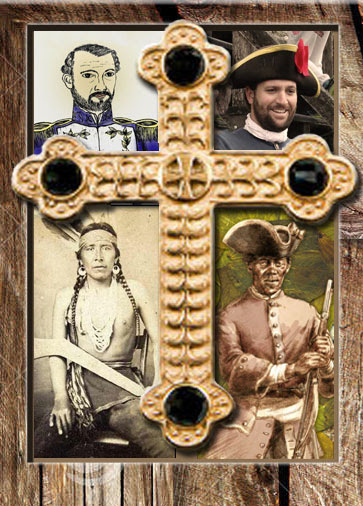

Chapter 8: Fear the Slave Raiders

Have someone say this wise thing. Maybe the Indian Chief who gets kidnapped. It's just a fact. Let it resonate loudly with the idea of Israel and Gaza. Let the obvious show up that we current Americans are living on native American land illegally. You have to accept that we don't own it, nor did they. There's no such thing. People control land. No they control access to land. But there's no way to own land. The chief who got kidnapped would be a heart-wrenching loss after he says such a profound native fact.

Part 3: No Way Out

Chapter 12: Montiano loses everyone

The town's people are crying for food. They are complaining to the governor. They say there is no food. But Indians and the Africans gobble up shellfish all day long like it's a smorgasbord. Montana. Gets frustrated with the Spaniards for not eating the shellfish. One day when someone complains to him, he storms out of his office and people follow him. He storms down to the river.

He grabs a boat and rows across to Anastasia Island to the exposed oyster reef. The people I'm sure can't see what he's doing so to us has a telescope narrating it for them.

Montiano walks out onto the oyster reef where he has seen the natives pop open and oyster and swallow it live. He does the same thing while the Spaniards look on in horror. He walks out on the reef and his boots sink to his knees in the muck. He can't get out. He sits down and pokes his butt on the shelves. He stands back up and can't get out. Everyone is staring at him in horror. And then he breaks off in oyster and cuts it open and eats it live. He waves it in the air and is hollering at the townspeople, but they can't hear him.

He has never done this. He throws up. The townspeople watch him in horror still. He gets frustrated. He can't move. People offer to help him and he shoes them away. He breaks off another oyster shucks it and eats it wet. This time it stays down. And then he does another egg and another. Finally he rides himself out of the muck with no help at all. Refusing help while everybody watches then he stomps back through town covered in muck back to his office and sits down at his desk. All covered in book. And then he writes a letter begging for food from Cuba.

Today, Josie sent me a clip of Charles Stanley talking about a Bible story where the Israelites are instructed to sing praise as they go into battle. The enemy gets all confused and ends up fighting themselves. It's in Chronicles. This is a wonderful biblical parallel to montiano telling everyone to start singing the hymn every time they hear a Canon fire. 

Have a young priest babysitting the children during the siege in a bunker. Montiano goes to visit them and check on them. The priest is reading the story from the Bible. The priest start singing with the children. Montiano goes back out where all the civilians are in the courtyard and gives the order to the guard and all personnel to sing the hymn that he loves at church

Part 5: Epilogue

Chapter 18: Juan Ignacio death by smallpox

When the weather is wet and warm and there's no breeze, the mosquitoes are horrendous. When Juan Ignacio travels through this, he covers his face. But sometimes he can't cover his face. When he's feeling well, he often inhales gnats or mosquitoes through his nose. However, when he gets sick toward the end of his life, he has allergy type symptoms. He can't breathe through his nose anymore. He breathes through his mouth and at that time is inhaling bugs into his throat.
All of the other characters moved away. The only one that is still in Florida is Juan Ignacio. His spirit is still alive because we are eternal beings. He's roams the Florida peninsula like he did in real life. He still appears to people and visits them in quiet moments like the tic tacs visit the pilots. Let him tell the story. Let the reader gradually realize that Juan Ignacio is the narrator for the other characters as well as himself. It may not add up to hear the Juan Ignacio chapters in first person and the other chapters in third person - how would Juan Ignacio know what went on when he wasn't there. But by the end of the story, we can see Juan Ignacio still alive to this day, still telling us the story, because he accepted Jesus Christ as the way to eternal life.

While Juan Ignacio is dying of yellow fever by himself out in the woods, he is getting delirious. He is visited by his childhood self. He doesn't recognize him. The child introduces himself with his Indian name, Chekilli, but Juan Ignacio doesn't remember his Indian name. He watches the child playing and Juan Ignacio knows he did exactly what the child was doing. He recognizes himself through the child's behavior. His death is a return to his innocent free youth. He is accompanied by Jesus. 

I was inspired toward this by the last episode of the crown, where Queen Elizabeth is visited by her younger self and has conversations with her younger self. I was actually crying. Also in the local musical, Ana Maggigan Gai, I was so very moved at the end of the play when she is old and goes through a doorway and her younger self is beckoning her through the doorway.

As I told Kara Sherman this morning, don't judge a religion by its hypocrites. Show the hypocrisy and naivete of all the characters and let the truth of God shine through.

In an effort to keep all four characters staying in character, get clear on each man's driving force. Imagine they all sat together in the climax to negotiate a way out of the English aggression. Imagine Putin, Zelensky, and Trump all sitting together.

Moderator: What do each of you want deep in your heart?

Montiano: Respect from men and the crown. His leadership crisis leads to God's governance.

Mend: To live free before I die. His guilt about the lady burned at the stake leads him to respect Jesus taking innocent punishment.

Tomas: My wife's respect. Masculinity crisis is rewarded by him being in the shipfight.

Juan Ignacio: Peace on earth. Identity crisis leads him to Imago Dei.

Put these desires and motivations in a conversation somewhere.

Montiano is Greg Frucci's marine fighter pilot father who finds himself in a small pond with a bigger fish (Oglethorpe) looking down at him.

Juan Ignacio is a Native American scarred from the Pocataligo Massacre. He is thrown about by self-serving European ideals, even exhibited by the Native American chiefs he is visiting. None of it promises peace. He keeps hoping to find cohesion in his own people, but he doesn't find anywhere except in nature and the bible.

Mend is a natural lord with willing followers who finds himself at the mercy of man-made lords with paid followers. (Bible: I will put children in charge of you.) He learns to 'manage up'. But he is haunted by the woman burned at the stake in Charleston for conspiracy that he in fact had been talking up.

Tomas is a prestigious cannoneer with a large family who finds himself unable to breathe at work. He is afraid to lose the respect of his family if he goes on medical discharge.

Make sure they all get their resolution through a prayer.

I'm watching the episode of the crown. It's season 6 episode 4 called the aftermath. I have sensed a growing appreciation for Prince Charles. This episode really brings it home. I was reluctant to like him in the last few episodes but couldn't help it. I was forgiving him as a new person. That is an extremely valuable experience for a reader. Give this to my readers. Every awful person in the book eventually can be redeemed. And every Saint eventually can be evil. In the end, we have to forgive each other. We are all human.

Cross References