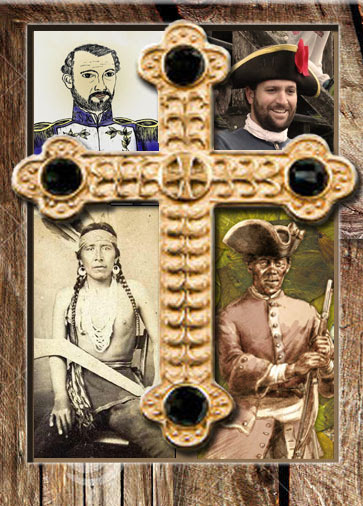








1700-4/1/37 Introduce Characters
The first chapter for each character shows their background, goal for the story, and obstacle for that goal. The chapter runs through a quick age progression from childhood to 1737. The character reveals his goal and then is slapped with an obstacle that grows throughout the novel and is finally resolved in the climax scene. The chapter ends with a segue to the next character.
In Part 1, contrasting facets of freedom are introduced through the four primary players in this novel.
*Sulayman is an African child kidnapped and sold into English slavery. He escapes to the swamps of South Carolina.
*Juan Ignacio is a Native American who compromises his freedom in exchange for protection in Florida’s Spanish mission system.
*Tomas Gonzalez is a government employee in the Florida colony who provides for his family via cooperating with the English.
*Manuel Montiano is a decorated soldier who becomes governor of that colony, with high hopes for prestige and luxury.
All of them tolerate human trafficking.
1715-1724 Native Yamasee to Spaniard
The natives in this story just want to live off the land in peace, but the growing demand for slaves forces them to seek security however they can find it.
*1715 Juan Ignacio was 15 during the Yamasee War. The Yamasee migrate to St. Augustine.
*1734 he testified to Creeks at San Marco that the Spanish were trustworthy. This may be how got to go to meets Guemes in Cuba.
*He accompanies a Yamasee scout taking a runaway slave (Sulayman) to St. Augustine.
Chapter 2 Framework
Chapter 2 shows Chekilli’s (Ignacio’s) background, goal for the story, and obstacle for that goal.
The chapter runs through a quick age progression from childhood to 1737.
Chekilli was 16 years old when (some Creek Indians) visited his Yamasee tribe to convince them to quit their alliance with the English. They pointed out (all the violations) committed to Indians by the English. Soon after, the (English officials) responsible for preventing those violations visited and promised to do a better job. The officials spent the night, and awoke the next morning to their own (slaughter) . The next three years of Chekilli’s life were a steady stream of farm attacks designed to drive the English out of Carolina. During one of those attacks, he saved an 11-year-old African boy named Sulayman and trained him how to fight with the Yamasee. After losing many lives, including his parents, Chekilli’s Yamasee tribe sought sanctuary with the Spanish in St. Augustine. Sulayman wouldn’t come.
Chekilli (Ignacio) reveals his goal
In St. Augustine, the (padre) assigned to (Chekilli’s village) baptized him and changed his name to Juan Ignacio. As an orphan, he became the padre’s favorite student. While the other tribespeople had to work in the (fields) and (construction), Juan (learned) to read and write and (deliver messages) for the officials. He loved his new country, and he wished the other Indian tribes would help protect it.
then slapped with an obstacle that grows throughout the novel and is finally resolved in the climax scene.
In 1734, Ignacio (testified) to some Creeks at San Marco that the Spaniards were trustworthy. The Creeks (dismissed) Juan’s enthusiasm and said he was offending his (heritage). Juan wanted their approval without giving up his security.
The chapter ends with a segue to Tomas Gonzalez.
Juan often joined the soldiers in the (tavern) for a smoke. Tomas Gonzalez always wanted news from Juan’s travels and messaging.
1717 Ignacio moves to Spanish mission
Chekilli was six years old when he frantically dug the musket ball out of his mother’s broken rib. His father was too busy charging the cloud of gun smoke to know it happened. The Creek medicine man was also too busy to tell Chekilli how to keep the splintered rib from tearing his mother’s lung below. He held his fist in the hole to stop the bleeding and felt her lung tissue move against his fingers every time she gasped for air. He pleaded with her to tell him what to do, but her eyes rolled around wildly. It was like she couldn’t even see him face to face with her.
Then the crowd of Creeks began running away from the cloud of smoke. Someone grabbed Chikilli’s arm and dragged him along in the stampede. Every time he tried to turn back to his mother, some Indian screamed at him and pushed him forward with the group. Finally, the crowd slowed to a walk, and eventually stopped to camp. Chikilli found a few people from his tribe and hung near them. Neither of his parents were anywhere to be found.
After several days of walking and camping in clusters of remnant tribes, the long line of Creeks filed past the coquina wall of St. Augustine, Florida. Spanish soldiers directed them to various locations south of town to set up their separate villages. A Spanish man in a long robe spoke with the remaining members of Chikilli’s tribe. The tribe circled around and tried to understand what he was saying. He appointed old Menewa to replace the chief who never came back from the battle. Then he carried a golden bottle of water around the circle and poured a little bit onto each of the Indians’ foreheads. As he did, he gave each Indian a new name.
When Chikilli’s turn came, the robed man said, “Your name is Juan Ignacio.”
By the time Chikilli was sixteen years old, his birth name and his parents had become figments of his imagination. He could no longer distinguish memories from stories. One day, Chief Menewa summoned him. He poked his head into the chief’s teepee.
“You asked to see me, sir?”
“Juan Ignacio,” nodded the bag of wrinkles under the headdress. “Sit down.” He waited while Juan lowered himself to a straw mat, then continued.
“The labor draft is one man short. Why did you not go to the Castillo?”
“I didn’t know it was my turn.”
Menewa looked into Juan’s eyes. Juan looked down, then protested.
“Why is it always my turn to go to the Castillo?”
“You prefer to sit down and wait for someone to bring food to you?”
“I help plenty in the field.”
“That’s not what Father Lopez says.”
“He only notices when I take a break. He never sees me working.”
“That is why it is always your turn for the draft.”
“But they will just make me burn lime or carry logs.”
“If you want to live in the pueblo, you will do your part.”
“Why do we have to live here? Can we go back home?”
Menewa nodded. “I hope someday we can. I hope the Yamasee will succeed in removing the English from our hunting grounds. Until then, we are only safe here.”
“Why?” Juan protested. “I am an excellent archer. All of the men are excellent archers. Our aim is true, much more than any musket.”
The chief nodded. “I know. The Spaniards know. You make the Spaniards feel more safe. And they make us feel more safe. But we are only safe together.”
“But I am a brave. Why do they make me work like a burro?”
“There is work to be done, Juan Ignacio. You must do your part if you want to stay here.”
“Yes, Sir.” Juan mounted his short, stocky horse and rode up the path toward St. Augustine. As soon as he was out of sight of his village, he veered west and disappeared into the woods.
Ignacio seeks freedom with the Yamasee
Juan rode north for three days looking for Yamasee. He had just roped a scrawny, wild, black cow when two scouts approached him. He offered the cow in exchange for a visit to the scouts’ cacique. That evening, he sat in a circle of warriors, trying to convey his desire to join them.
“I belong here,” he said. “I will help you remove the English from our hunting grounds.”
The other warriors grunted and nodded their agreement. Some were old, some were young, and some were black. The cacique waved him over. Juan knelt before the chief and kissed his hand. Juan wished he could remember his Creek name, but he had to settle for “Juan.” The chief appointed him to a warrior troop of seven Yamasee and one young black man about his same age.
The next day, Juan impressed his new scout troop with an arrow through every edible animal they came across. The next week, he disappointed his new scout troop by lowering his bow for a passing wagon train. That night at their camp, he had no excuses.
“I thought you were going to help us eliminate the English,” said the warrior called Yaholo.
“I am,” said Juan.
“How?” Yaholo grinned. “You will scare them away with an angry look on your face?” The circle of braves laughed, but then Yaholo spoke seriously.
“We are preparing for war. In a war, you will be a burden more than a help. We don’t need you here.”
Juan’s eyes burned. He looked around the fire at all the eyes fixed on him. The most intense stare came from the black face of the warrior called Sulayman.
The next day, the troop fanned out. Juan rode alone, looking for game to redeem his worth among the warriors. Then he heard a shout and some crashing in the trees. Then silence. He dropped from his mount and ran silently toward the noise. Soon, he found two Indians with striped faces wrestling the black warrior, Sulayman, into ropes. Another warrior from the troop already stood gagged and bound to a horse.
Juan drew his bow and sent an arrow through the chest of one of the stripped Indians. The other attacker jumped for a musket just as Juan loaded another arrow. They both shot at the same time. The arrow hit home. The musket ball hit a tree. The noise of the gun drew the remaining Yamasee to the scene.
“Man-eaters,” explained the Yamasee. “If they can’t sell you, they eat you.”
The troop brought the heads of the striped Indians back to the Yamasee chief. That night, the camp praised Juan and rewarded him with the finest cuts of meat.
After that, Juan could not sleep. Every shout or rustle in the trees was a potential man-eater. He paced several times each night, often finding Sulayman doing the same thing.
Sulayman was half a head taller than Juan. His muscles looked like the smooth rocks in the nearby river. His eyes seemed to pierce into everything, and they never closed. Juan began to gravitate toward Sulayman during scouting and hunting.
“You should not ride with me,” Sulayman told Juan.
“Why?”
“I am a target for the man-eaters.”
“So am I.”
“I am more,” said Sulayman.
“Why?”
“I am worth more money.”
Juan laughed. “I am the best archer in the land. How can you be worth more?”
“I am strong.”
“So am I.”
“I don’t get sick.”
“Neither do I.”
“I don’t faint in the field.”
“Neither do I.”
“Do you work in the field?” asked Sulayman.
Juan hesitated. “Sometimes.”
They rode in silence for a bit. Then Sulayman spoke.
“You should not ride with me.”
Ignacio and Sulayman join Spaniards
Sulayman was ___ when he arrived in St. Augustine with nine other runaways and a Yamassee scout. Spanish soldiers escorted them to Government House and had them sit on the floor against the wall opposite Governor Moral’s desk. The Yamassee scout translated.
“They come for your offer of freedom and protection,” he said to the Governor.
Governor Moral sent his uniformed, African messenger boy running out of the office, then studied the group from across the room. The Yamassee scout waited. The soldiers waited. The slaves waited. The boy returned with a scribe and a priest. The runaways stared at Father Buenaventura’s black dress with gold ropes. The messenger left again as the priest addressed the group.
“If you want to stay here you must be baptized in the One True Faith. You must pledge your faith in the Holy Catholic Church.” The Yamassee scout translated as best he could, but he could not figure out how to say ‘baptize.’ Father Buenaventura produced a vase of water, and the Yamassee told the runaways, “you must have this water on your head.” The scribe propped a lock box on his lap and began scribbling words on a paper.
Meanwhile, the messenger returned with the town treasurer, Don Francisco Menendez Marquez. Marquez looked them over, then patted Sulayman on the arm.
“Stand up,” said the priest, and the Yamassee translated. The six slaves stood up against the wall. “Repeat after me.” The Yamassee translated, and the slaves nodded. “Say I pledge my faith to the Holy Catholic Church.”
The Yamassee translated, and in a hodgepodge of African and Yamassee noises, the slaves said, “I give faith in the One True Faith.” The Yamassee turned to the priest and nodded.
“One at a time,” said Father Buenaventura. The Yamassee repeated the phrase to Sulayman, and Sulayman repeated it in Yamassee. Then the priest proceeded to trickle water on Sulayman’s forehead. “I baptize you in the name of the Father, the Son, and the Holy Ghost.” The trickle tickled Sulayman’s nose, and he snorted and wiped it with his hand. The priest frowned at him, but continued on.
“From now on your Christian name is Francisco Menendez,” said the priest. “Now say I pledge to shed my last drop of blood….” The Yamassee stared at the priest for a moment.
“Tell them to say it,” said Buenaventura. The Yamassee translated, and the slaves stared at him, then at the priest, then at each other.
The Governor addressed the slaves for the first time.
“Say it,” he said.
The Yamassee translated again. In perfect Yamassee, Sulayman said, “I promise to shed my last drop of blood…”
Father Buenaventura looked directly into Sulayman’s eyes and nodded. Then he went down the line and continued the process with each slave. When the baptisms were finished, Marquez sent the Yamassee scout away with four pieces of silver. A guard was assigned to each slave and they were escorted to separate homes.
Sulayman was ___ years old when he became Francisco Menendez and was re-enslaved as the Spanish treasurer’s personal assistant.
More Events
1724-1734 African Runaway in St. Augustine
Sulayman is a boy in Africa. His father always warns him to stay away from the dirty, homeless bushmen, who steal and sell children. [Amy: use this as a way to express my disgust at people who don't value education] They sometimes come around begging for food, and Sulayman's father refuses them, saying they will not work and they will not get an education. "Uneducated people cannot be trusted," he snaps. "They are always desperate and they know nothing of Allah's ways."
Sulayman's father forced him to go to school. He begged not to. "I hate it. It makes me fall alseep and the teacher hits me with a stick."
On his way to school, where he learns Arabic in order to read the Quran, Sulayman dilly dallies and is caught by a bushman and sold into slavery. He falls asleep in the baracoon trying to hear anyone speaking his own language.
Sulayman wakes up with tears on his face. He is now a teenager in Carolina. He wishes in pain that he had listened to his father. He wishes he could go back in time, and back to Africa.
He spends the entire story trying to engineer his way back to Africa, but along the way, he is changed. He becomes a Christian, and he becomes a believer in supporting the faith through the Spanish system. Before the climax, he has the option of sailing back to Africa. He decides to stay and fight for his new country.
Chapter 1 Framework
Chapter 1 shows Francisco Menendez’s background, goal for the story, and obstacle for that goal.
The chapter runs through a quick age progression from childhood to 1737.
Sulayman (Menendez) was born free in Mandinka, Africa. He was captured with his parents by (who) while (doing what) . He was chained to the inside of a ship for (#) days and nights, where he saw the (horrors of the Middle Passage) . He and his family were forced to do hard labor under such (miserable conditions) that he would rather die than live that way.
Sulayman reveals his goal.
Sulayman wanted to go home. He studied his options. He saw plenty of (ways to escape) .
Sulayman realizes his obstacle.
Sulayman’s family saw (other slaves escape) , then get returned by Indian and white slave catchers. They were (tortured) as an example of what happens when you try to escape. Sulayman’s father asked him not to make him watch his son get tortured.
Segue to the next character.
When Sulayman was eleven years old, his parents were (gone where) . He decided to risk death and torture. He escaped into the swamp and endured (the worst dangers of swamp) and (slave catchers) . He finally gave up from weakness and starvation and laid down to die, dreaming of his childhood in Africa. An Indian entered his dream, woke him up, and nursed him back to health in the Yamasee tribe. They trained him to fight, and he helped them in their war against the Carolina settlers.
Sulayman and sister kidnapped and sold into slavery
Sulayman had three mothers and eight siblings. Three of the boys attended school in the next village twice a week. One day their fahter gathered them and wanred them that men from some hostile tribe had been seen lurking around, and they couldn't be trusted. Sulayman had seen them and they seemed harmless. He thought his father was paranoid. He also thought he didn't need school anymore. He had learned quickly and could write sentences and read the Quran. He had learned enough, and school was a waste of money. He asked if he could quit school and join the men who guarded the cattle. His father said, "When a king will read a letter from you, you have learned enough.
The next day the boys walked out of the village to school, each with their tuition shells clacking in a sack on their belt. Sulayman saw the cattle pouring out of the krawl. Halfway to school he stopped.
"I'm going with the herd," he said to his brothers. "Don't tell father."
"Sulayman, father will whip you for an hour. If we lie for you, he'll whip us two hours."
Sulayman held out his sack of shells. "Here. You spend this in town if you don't tell."
The older brother waved him away. "Money for whippings. Father will find out. Come on, Junior." The two boys continued on to school and Sulayman darted into the bush toward the grazing fields. Once he reached the herd, he saw the cattle drivers with their firearms starpped across their backs. He realized they would tell his father. He decided to be a cattle driver in secret. Without them seeing him, he guided cows that tried to wander into the woods. He even climbed on the head of one of them and got a little ride before being bucked off.
Then he went to the creek and got a drink of water. As he stood back up, a hostile tribesman stood facing him from the trees. Sulayman turned and ran towad the herd. The man chansed him. Sulayman untied his money sack and threw it at the man. The man kept coming. Just as Sulayman ran out onto the field he tried to scream for help, but the man caught him and covered his mouth. Sulayman kicked his legs and swung his arms and tried to gasp air but the the hand cover the lower half of his face. Tears and muffled screams dispappeared into the hand. He couldn't breathe.
Sulayman woke up gasping for air. The cabin was dark and silent. His face was wet. His heart was pounding. He looked toward the window and saw Boatswain's sillhouette beneath it. Sulayman gathered his blanket and slid in next to Boatswain, trying not to wake him. He lay very still, trying to calm his breathing. Boatswain's eyes remined closed, but his hand patted Sulayman's.
The next morning, Boatswain handed Sulayman some oatmeal.
"I see you got captured again."
Sulayman shook his head in shame. "It was my fault. I shoudl have obeyed my father."
Boatswain nodded. "That is true."
"I will always obey you, Boatswain."
Boatswain laughed. "That won't do you any good. You obey Master Canty, and everything will be alright."
As usual, Master Canty assigned Sulayman to be the cow boy. Sulayman no longer liked the job. It gave him flashbacks.
Boatswain reassured him. "You obey Master Canty and he'll protect you."
The job was better here because he got a horse to ride. He led the small herd out of the krawl and out to the pasture land. While he was out there, he noticed he was one cow short. He herded the rest into a nearby cow pen, then rode around looking for the lost one. He finally found it munching in a small corn garden. An Indian appeared, also on horseback, and came screaming at Sulayman and the cow. The Indian speared the cow, and amid the terrible wails of the animal, Sulayman raced back to the cow pen. The Indian did not follow. Sulayman brought the herd back to the krawl and confessed what happened to Master Canty. He usually had to fight not to stare at the man's red hair but this time he watched fearfully for the anger and punishment sure to come.
Master Canty's jaw was set and his eyes pierced Sulayman's. "You said you knew how keep cattle."
Sulayman looked down.
"Now them Indians gonna harrass my farm."
Sulayman kept lookng down to show respect.
"Look at me when I'm talking to you."
Sulayman looked up, but it felt painfully disrespectful.
"That cow is worth ___ pounds and could have fed this whole farm."
Sulayman continued looking at the man.
"You gonna go without meat till you pay it back. You don't get meat till Christmas."
Sulayman contined looking at the man.
"Now it's time to say Yes Sir."
"Yes Sir."
After that, Sulayman was assigned to notching pine trees. He worked alongside an Irish servant.
One day, Master Canty sent Boatswain and Sulayman to town to exhange ___ for ___. On the way, they ran across the missing boy and slave stuck in the mud. They reported it to the constable in Charlestown. While there, Sulayman saw Indians collecting rewards for runaway slaves and slave heads, fisherman, deal Africans floating in the harbor, slave punishments, the market.
That fall, Master Canty's family was hit with the fevers and ague. They moved into town. An overseer was put in charge, just as the experimental rice crop was coming in. The rice was lost in an accident, and Master Canty sold the farm and slaves. Sulayman ended up at Goose Creek Planation.
Then Father Le Jau came to Goose Creek. The other slaves were not interested in going to Father Le Jau's lessons because they had to grow and hunt their own food and make their own clothes and furniture. Sulayman wanted to go because he knew his father would want him to. He was able to feed himself with his musket, even if it was just a squirrel for dinner.
Father Le Jau gave him a pen and paper, and began to demonstrate writing.
"I already know how to write," Sulayman said.
"You do?"
"Yes," said Sulayman.
"Can you write your name?"
Sulayman wrote his name. Father Le Jau studied the paper.
"Is this Arabi?"
"It's writing," said Sulayman.
"Can you write anything else?"
Sulayman wrote a paragraph. Again, Father Le Jau studied the paper.
"What does it say?"
Sulayman picked up the paper and read. "ajkjadjajda;j" (speaking in Arabic)
Father Le Jau studied Sulayman a moment. "What does it say in English?"
Sulayman looked at the paper. He struggled to convey the words. Finally, he got the first verse out. "(popular verse from the Quran)"
"You are Muslim?"
"I am Mandingo."
"Can you read this?" Le Jau opened the Bible to Sulayman.
Sulayman stared at the page, then slowly shook his head.
"Well then, let's get started."
While being tutored by Le Jau, Sulayman was exposed to Jesus versus Mohammed, the woman being burned alive, Le Jau critizing the planters, and whites coming to visit, including the lady who asked if she will see her slaves in heaven, then committed suicide, and Thomas Nairne. Nairne took a liking to Sulayman and rented him to help with the envoy to the Yamasee.
Sulayman experienced the Pocotaligo Massacre and was recruited by the Yamassee. His new father figure became Chief Jospogue, and his new friend was Juan Ignacio. He fought bravely with the braves for three years, then the Yamasee went to St. Augustine. Sulayman didn't want to go to St. Augustine. He didn't trust any white people. He snuck in and out of plantations and Charlestown to get food and encourage others to join him. Then someone got punished for harboring him. He returned to the wilderness.
In Juan Ignacio's chapter, Juan is visiting the Yamacraws and finds Sulayman's group half starved trying to make it on his own. He convinces them to come to St. Augustine.
Sulayman was eight years old when his Mandinka father bought a little girl from a passing (slave-holding) tribe (from the Congo?) . Their fellow Mandinkas scowled at the support of slave traders. Sulayman’s father said she was better off with their family than someone else buying her. She did not know her name or age, so Sulayman’s mother named her Makuto, and she became Sulayman’s little sister.
Sulayman was nine years old when his father insisted he teach Makuto how to catch fish in a creek off the Gambia river. While the children were alone fishing, two men of the same passing tribe appeared at the river bank with friendly smiles. Sulayman thought they were going to show the children how to fish. They didn’t. They covered the children’s mouths with their hands. Soon, Sulayman and Makuto were tied together with a group of other people. Not long after that, both their parents joined the rope parade. They were marched three days to a slave ship at Sierra Leone.
It was only a two-day walk, but the group had to sit and wait a day while Sulayman’s mother went through a miscarriage with her seven-month pregnancy. The raiders were kind enough to give her an overnight rest before tying her back up for the march. Young Sulayman could not understand his father trying to convince the raiders to leave her behind. As a boy, he was filled with relief that his family was staying together in this terrifying experience.
His relief became laden with guilt when he saw his mother choking on her own vomit in the hull of the slave ship. His father was able to stretch his chains far enough to reach her head and turn it sideways. Sulayman had never seen his father cry before that moment. The more horrible it got, the more relieved he was to be with his parents, and the more guilty he felt for wanting his mother to be with him in the misery. He was sure Makuto was the cause of this tragedy.
Things were physically better once they got off the boat, but even more scary for Sulayman. People stood chained in long rows on the dock. He could not count them all. He and Makuto trembled as other parents were pulled away from children screaming and wailing. His parents could barely speak. Even though they gripped his hands to the point of pain, he was horrified to see them struggle to get the chains off. The chains were the only thing that gave him reliefthey kept him attached to the one thing he needed in this journey through hell.
Amazingly, Sulayman’s family was kept together. A white man tied them to a wagon pulled by a donkey. Moments later, two other African men were tied to it also. The white man climbed onto the wagon and drove it away from the dock of chained Africans. He pulled Sulayman, his parents, and the other two African men along behind.
The six Africans followed the wagon through a crowd of chaos. African parents and children screamed. Twice, Sulayman saw angry African men try to fight their way free; both were beaten unconscious by multiple white men. All of Sulayman’s group remained silent in the madness. They passed many wagons and many chained Africans. Some sat in wagons pulled by horses. Others walked behind wagons like Sulayman’s group. A chain of brown people with long black hair waited sullenly while two brown men with bald heads and striped faces traded money for them.
Just beyond the crowd, the six Africans stopped at a lean-to made of cow hide stretched over cane poles. Under it were two tablesone piled with deerskin shoes, the other with woven blankets. An old brown woman with long black hair and a deerskin dress looked at the bare feet of each of the six Africans. She dug through the pile on the table and handed the white man several pairs of shoes. He distributed a pair to each African and pointed at their feet. The Africans held the shoes until the white man barked something at them and pointed at their feet. Sulayman’s mother began to put hers on, and the men all followed her lead. While they figured out how tie them, the white man picked out five blankets, then gave the brown woman some silver coins. Then they walked out of the town and into the woods.
They were dragged for another day of walking. They walked through dry woods and wet muck, and a few dry clearings. Bugs swarmed in the air and clung to their skin and bit welts all over their bare bodies. They all squirmed to swat at them with chained hands. The white man used his hat to swat at bugs that tried to get through his shirt. Makuto hardly got any bites because she didn’t sweat. When Sulayman’s mother fell, the white man unlocked the rings around her wrists, pushed her onto the back of the cart, and re-locked her wrists to the cart. The donkey struggled with the added weight.
One of the other African men leaned toward the one in front of him and whispered. The one in front nodded. Then the rear man leaned toward Sulayman’s father. He spoke a different language, but Sulayman recognized one of the words.
“…free…” the African whispered.
Sulayman’s father nodded, just as the white man heard the voice and turned around. He pulled the donkey’s reins, got down off the bench, and carried his donkey-whip to the back of the wagon. Standing about four feet away, the white man lashed his whip across the face of the African who had talked.
Then he turned Sulayman’s father and did the same thing. Sulayman’s father saw it coming and ducked. But the white man kicked him to the ground and lashed the whip several times across Sulayman’s father’s head till he made some marks on the face. Then the white man yelled at all the Africans, putting his screaming face up close to each African’s face. Makuto stood stone-faced. Sulayman could not understand a word the man said. He trembled with tears coming to his eyes.
“Sulayman!” cried his mother. The white man pivoted toward the wagon and raised the whip at Sulayman’s mother. Sulayman and his father screamed at the same time. She scooted back in fear, and the man jerked the whip at her, but not all the way. His message was clear. Then the man pulled Sulayman’s father to his feet, climbed back on the wagon, and whipped the donkey into movement. Sulayman’s father threw angry glances at the African who had talked, but the other man would not look at the rest of them anymore.
Finally, the march ended at a clearing that held a wooden shack with a dirt floor. The white man tied the donkey to a tree. A white woman and boy about Sulayman’s age appeared in the doorway to the shack. The boy stared at Sulayman. The woman stared at Sulayman’s mother and Makuto.
The white man said something harshly to the woman, and she went inside the building and came back out with a steaming pot of food. The white man reached into a bag in the wagon and retrieved five metal dishes. The woman poured the food into the dishes, and the man gave a dish to each African except Makuto. He gestured for Sulayman to share with her. It was rice with some kind of meat in it. It was too hot, but they all gobbled it up, gasping over their scalded mouths and throats. They hadn’t eaten for two days.
Soon, two horses trotted out of the woods toward them. They were ridden by another white man, and by an African man in white-men’s clothes. The two white men talked to each other. Again, Sulayman could not understand their language. Then the African in white-men’s clothes spoke to the group of Africans in chains. Again, Sulayman recognized a few of the words.
“I speak … white man…” said the African from his horse. “…home… master… die.”
The white men conversed some more, and the African spoke again from his horse to the Africans in chains.
“… chains… fire… death.”
The white men spoke again, and the African spoke again from the horse.
“…forest… monsters… capture…”
More talking, then another message.
“…rest… house… rice...”
Then the white man on the ground handed the white man on the horse two silver coins, and the two horses turned and disappeared into the woods they had come from.
Life with the farmer
After the first meal, the farmer only gave them rice to eat. Even though there were cows wandering around freely, the farmer would not let anyone kill them. Sulayman’s parents concluded cows were sacred in this land. Instead, the farmer and his boy hunted and sometimes came back with a bird or squirrel for his family to eat. When the Africans were finished working, they scavenged their own game within eyesight of the farm. They managed to round up fish, frogs, squirrels, and marsh hens. When the white man saw the food they had, he took it from them instead of doing his own hunting. So the Africans learned to catch enough for the white family in addition to their own food. Occasionally, they rejoiced when someone killed a deer. When their shoes wore through, they made some more with the skins from their dinner food.
Sulayman, his father, and the other two Africans worked side by side with the white man and boy. They cut down trees and built a cabin for the slaves. They carved grooves into standing trees and caught the sap that ran out into drain pans. They hoed rows in the ground for rice seeds and dug ditches for irrigation.
The white woman, Sulayman’s mother, and Makuto made food for the rest, and washed clothes, and chopped and hauled wood for the cooking fire. They tended another fire to cook the tree sap into tar, which they ladled into barrels. The white woman fainted once from the heat, and Sulayman’s mother caught her and dragged her under a tree. After that, the white woman stayed away from the fires in the heat of the day. Eventually, she kept Makuto in the house with her day and night.
The boy taught Sulayman words, like dirt, horse, tree. The boy laughed every time Sulayman tried to say “skeeter” for the stringy little bugs that covered them all with large, itching welts. Sulayman learned the boy’s name was Samuel Robinson, his father was Massa Robinson, and his mother was Missa Robinson. Brown people were “Injuns,” and they lived hidden in the trees. Africans were “slaves,” captured workers who could never leave, could never go home. The cows were not butchered because the farmer planned to sell them to buy more slaves. Sulayman taught the other Africans everything Samuel taught him.
Apparently, Samuel was also teaching his own father some things, because Massa Robinson began to call Sulayman and his mother by their namesSulayman and Zahda. Massa never could pronounce the three African men’s names, so he called them something that sounded like their namesSulayman’s father became “Ben,” and the other two Africans were “Jon” and “Tooley.”
The Africans learned to communicate with each other rather quickly, since they had a lot of words in common. Tooley was the trouble-maker. He had been separated from his wife at the ship, and he was determined to get back to her. He figured they would have been kept together like Sulayman’s family if they had a child.
“I think she was pregnant,” he said several times.
Indian slaves
Slowly each day, the trees fell and rice plants grew and more slaves arrived. As they did, more cabins were built. Each cabin became a clique of its ownlittle makeshift tribes. In the spring, a trio of Injuns were brought in chains by more Injuns with striped faces. Massa Robinson traded money for the captives and put them to work in the fields. But by August all three of them were covered in red bumps and could not work. They died within a week of each other.
A white servant arrived and was given one of the existing slave cabins all to himself. The slaves who lived in it had to squeeze in with another cabin until one was built for the new white man, far away from the rest. The white servant became a second “Massa” of the slavesMassa Roland. His job was to make sure the slaves did their jobs. At first, he tried to work with them. He fainted, and two slaves carried him to his cabin, where he shook with fever and chills for three days.
“He’s white,” explained Samuel. “The sun is meaner to us white people than slaves.”
Runaway lashed
One day Tooley was sure he heard a female voice in the woods at the edge of the rice field. He stood straight up and looked over there.
“Did you hear that?” has asked. The slaves around him glanced at the woods, then continued working. Tooley stepped through several rows of trenches and listened again.
“That was my wife,” he said, turning around to his fellow workers.
“His wife is a marsh hen,” laughed Jon.
Ben said, “If we finish this field before sundown you can go look.”
“She’ll be gone,” said Tooley. “Somebody make a diversion. I’m going over there.”
“Tooley,” said Ben, “you need to learn not to drag other people into your troubles.”
“Listen to you!” barked Tooley. “You have your family. You have no idea how I feel.”
Ben looked down at his hoeing and said nothing. He glanced over at Sulayman, who had stopped working and was watching Tooley.
“Sulayman, get to work,” said Ben.
Sulayman returned to his work. He wanted Tooley to try to escape. He wanted anybody to try to escape. He couldn’t believe his people were so passive to not fight back. He didn’t want his parents to risk their lives. He just wished somebody would.
And Tooley did. He waited till Massa Roland was at the off the field getting a drink from the well. Then he sprinted across the field. His coworkers forgot to cooperate. They all stopped and stared at the one soul who dared to do what no one else could get the courage to do.
Massa Roland never saw a thing. When he returned to the field, the twenty working slaves looked just like the twenty-one working slaves he had left. That night, the cabins buzzed with excitement at the one who got away. Others began devising plans to escape, too. Sulayman’s parents didn’t want to participate, so Jon joined another cabin’s conversation. Sulayman wanted to go with him, but his parents forbade him. He listened to the voices outside the open doorway, while his parents whispered together at their bed.
“We should have gone with him,” he murmured. Then he wished had hadn’t said it. It betrayed his fear that his father was a coward. In a flash his father was at his side, grabbing his arm. Ben jerked Sulayman away from the door and slammed it shut. He shoved Sulayman onto the bed, and then stomped back and forth, fuming. Zahda rushed to Sulayman’s side and held his hand. Finally, Ben calmed down and spoke in Sulayman’s face.
“Sulayman, why did Tooley risk his life?”
“To find his wife,” Sulayman answered in a weak voice.
“Right,” said his father. “I have my wife. And we have you. And you have us. Do you think we should risk losing each other?”
Sulayman looked at his father’s feet. “No,” he said. Then he piped up again. “But we could go home. We could find all those other slaves and fight and get free. Remember how many got off the ship?”
“Do you mean dead or alive?” asked his father. Sulayman looked in his eyes and didn’t answer. Ben continued. “Do you know what we do with animals, Sulayman.”
Sulayman snorted. “Eat them?”
“What else?” asked Ben.
“Sacrifice them?”
“And?”
“Make them carry us and pull things for us,” answered Sulayman.
“And?”
“Use their skins.”
“And?”
Sulayman was out of answers. Ben looked at Sulayman with sad eyes.
“You must understand one thing here, Sulayman. These white people think we are animals.”
Sulayman’s throat went dry and he swallowed to wet it. His mind raced. He didn’t want to believe his father, but it made perfect sense. It explained why the white people didn’t negotiate anything with the slaves.
Ben pushed their beds together and the family slept against each other. Sulayman hardly slept a wink that night, always making sure some part of him was touching one of his parents.
Before dawn the next morning, Massa Roland walked through the cabins banging a metal pan with a metal ladle. He called them to the well. The pale morning light revealed Tooley tied to a nearby tree, with his face against the tree and his arms wrapped around it. Massa Robinson and Samuel stood nearby. They all watched in horror as Massa Roland lashed Tooley’s back into dripping red lines. When they tried to look away, Massa Roland stomped over and yelled at them to keep their eyes on the screaming Tooley.
Tooley was locked in the barn for two days, and the rest of the slaves worked in silence. After Tooley recovered, he told the other slaves about his escape.
“When you get past the creek, some of the trees become brown people,” he said.
“Injuns,” said Sulayman.
Tooley nodded. “Injuns,” he agreed.
“Two of them caught me and tied me to a horse, and brought me to three farms in the middle of the night. Then when we got to this one, Massa Robinson said ‘yes,’ and gave them each a coin. Then they went and turned back into trees again. I think that’s what made the sound of a woman, to lure someone out there.”
Sulayman’s urge to escape subsided after that. Certainly, he wanted to be back in Africa, catching fish in the river. But there seemed to be no way to get away from the farm. Every time he tried to think of one, he pictured himself, or his father, or even his mother getting lashed on the tree.
Father Le Jau
One day a white man dressed in black clothes came to the farm. He talked to Massa Robinson, then sat on the ground outside Sulayman’s cabin for the rest of the day. When Sulayman and his father finished their work, they went into the cabin for their hunting tools, trying not to stare at the man. When he appeared in the doorway, they stared at him.
“You speak English?” the man asked Ben. Ben looked at Sulayman to see what the man said.
“No,” Sulayman answered for his father.
“You speak English?” The man smiled at Sulayman.
“No,” said Sulayman. Then he told his father what the man was asking. They both stood with their tools, looking at the man.
“You want to learn English?” asked the man, looking from father to son. He carried a square box. He held it up toward them. “Words,” he said. “You learn words?” The man opened the lid of the box. Sulayman and Ben saw that it was not a whole box, but many white sheets held between a box bottom and top.
“Words,” said the man, pointing at one of the sheets.
Ben spoke to Sulayman in African. “What is ‘words’?” he asked his son.
Sulayman answered in African. “It means ‘speak,’” he said.
“The box speaks?” asked Ben.
“I don’t know,” said Sulayman.
“Ask him,” said Ben.
Sulayman pointed at the box of sheets. “It speaks?” he asked in English.
The man grinned from ear to ear. “Yes,” he said. Then he looked at one of the sheets and spoke. “It says, ‘For God so loved the world that he gave his only begotten son.’”
Sulayman didn’t understand any of what the man said except the last word.
“What did he say?” asked Ben.
“He said the box talks about someone’s son.”
“I didn’t hear it talk,” said Ben.
Sulayman shook his head. “Me either,” he answered in African.
The man closed the lid of the box and pointed at it. “Book,” he said. Ben and Sulayman just stared at him. He put his hand on his chest. “Father,” he said. “Father Le Jau.” He held the box out to Ben and bowed a little to show it was a gift. Ben took the box obediently. He held it away from himself, as if the man wanted it back. But the man backed out the doorway.
“Tomorrow,” he waved, then walked toward Massa Robinson’s house.
Ben stood holding the book for a while, still thinking the man would come back for it.
“We better get dinner before it’s dark,” said Sulayman. Ben furrowed his eyebrows and nodded thoughtfully.
“I think he told us to do something. I don’t want to get in trouble.”
“He said ‘tomorrow,’” said Sulayman.
“He did?”
“Yes. Whatever it is, it’s tomorrow.”
“Are you sure?” asked Ben.
“Yes. Tomorrow means the day after today.”
Ben slowly put the box on a shelf. Then they went and caught three squirrels for dinner. It was someone else’s job to get food for the Massa’s this week.
Father Le Jau arranged with Massa Robinson to teach the slaves on every seventh day. Except that was the only day the slaves were free to farm their own vegetables and make their own clothes. If they didn’t do that themselves, they went cold and hungry. They received an allotment of dried rice from each crop, but nothing else.
Slave breeder
One day Massa Robinson called Ben to the side of the field. They talked and gestured for a few minutes, then Ben returned to the field.
“What did he say?” asked Jon.
“He asked why Zahda’s not pregnant yet.”
“What for?” snorted Tooley. “Who would want to bring a child into this hell pit?”
Ben shook his head as he focused on his hoe. “It’s how they get more slaves for free,” he said. “He said women must have one child a year.” Ben kept working while Sulayman, Jon, and Tooley all stopped and stared at him. He kept working when he said, “He said if I can’t get her pregnant by harvest, he’ll lay her with men until she gets pregnant.” Then he sobbed and collapsed into the dirt.
Tears poured down Sulayman’s face.
Tooley said very slowly, “Ben, I’ll kill any man that goes near your wife.”
Jon said, “We’ll all sleep outside.”
Then Massa Roland hollered at them, and they quickly got back to work.
Ben and Zahda had the cabin to themselves until Zahda vomited three mornings in a row.
When the baby came, Missa Robinson helped deliver it, then Massa Robinson took it into the big house. He called for Zahda several times a day to feed the baby, then sent her out of the house as soon as she was finished. On the sixth day, Zahda stayed in the house all day. She finally came back to the cabin just as Ben and Jon returned from fishing. She had no expression on her face at all, and she did not look at anyone else’s face.
“It’s dead,” she said to no one. Then she did not talk anymore. There was no funeral, and no mention of the baby after that.
Massas son dies
In August, Samuel got the fevers again. In the middle of the night, Massa Robinson threw open Sulayman’s cabin door. All five people sat up in their beds, looking at his silhouette in the moonlight.
“Tooley!” Massa Robinson called into the dark cabin. “Tooley!”
“Suh,” Tooley answered. He stood up beside his bed.
“Go get the doctor from town,” barked Massa Robinson. “Take the horse. Hurry!”
Tooley pulled on his pants and shoes as fast as he could. As he hurried out the door, Massa Robinson grabbed both Tooley’s shoulders and pushed him against the doorway.
“If you run away,” he growled, “I will burn you alive.”
Tooley stood and stared at Massa Robinson. Sulayman wondered if Tooley understood. He heard Tooley’s breath through his open mouth.
“GO!” shouted Massa Robinson.
Sulayman kneeled on his bed and watched out the window as Tooley ran to the barn. Massa Robinson knocked on Father Le Jau’s cabin. The door opened for a moment, then closed, then Father Le Jau came out, pulling his robe over his head. Massa Robinson walked briskly back up the hill toward his house, followed by the priest. Just then, the saddled horse bolted out of the barn with Tooley bouncing on top. The two men jumped out of the way as the horse swerved around them. Then the men disappeared into the big house and Tooley disappeared into the woods. Sulayman watched the silent clearing while the scene replayed in his mind for a long time.
“The boy caught it all of a sudden this time,” Zahda’s voice came from the dark corner.
“He isn’t much more than a girl,” said Ben.
Sulayman watched the moonlit yard till he was sure nothing else was happening. Then he laid back in his bed. An hour later, galloping hooves and rattling wheels woke him again and he popped back up to the window. The doctor’s carriage jiggled up the hill and stopped at the big house. A shadow jumped out and disappeared inside. Sulayman scanned the black edge of the woods for a long time. Tooley was nowhere. After a while, Ben spoke.
“He’s gone, Sulayman,” Ben said softly. “Go to sleep.”
The doctor’s carriage was still at the big house in the morning. Father Le Jau came to Sulayman in the field.
“Help your father dig a hole,” he said. “Under the pecan tree in the meadow.”
Sulayman told Ben, and they exchanged their hoes for shovels.
“How come the white people get sick, and we don’t?” he asked his father as they scooped leaves and dirt into a neat pile. Ben shook his head.
“I imagine it’s that thin skin,” he said. “The sun goes right through ittakes the breath right out of them. Bugs go right through it. Spirits go in and out whenever they want to. I saw the boy two days ago. His eyes were yellow.”
They shoveled in silence. Then Ben spoke some more.
“I used to feel bad for white men when they came through the village. They were so small, and usually exhausted or sick or starving. I could see why they had to cover up with so many clothes. And why they left their women home. It’s like their god decided not to give them enough protection. Back then, I thought it made sense that they had weapons more powerful than themselves.” He snorted. “Now look at us. We’re captives of people who can’t even catch their own food.”
Sulayman shook his head as he shoveled. “Makes no sense,” he agreed. Then, still shoveling, he added, “Tooley’s not.”
Ben stopped shoveling and stood up straight. He stared at Sulayman till Sulayman slowly stopped shoveling and looked back at him. Ben looked into Sulayman’s eyes, then shook his head and looked away, then back at Sulayman.
“Remember this, Sulayman,” he said. “No amount of freedom is worth watching your mother, your father, your wife, or your child be tortured.” Sulayman looked down, and Ben reached out and lifted the boy’s chin back up to face him. “I will never do that to you. Please don’t do it to me.”
Sulayman looked at his father with his chin in the man’s hand for a long moment.
“Yes, father,” he said.
Father Le Jau fashioned a cross out of pecan limbs. In the afternoon, Massa Robinson told the slaves to take the day off and attend the funeral. They all gathered around the grave. Massa Robinson held Missa Robinson as she cried and coughed and collapsed several times. When it was over, Massa Robinson struggled to lift her into the doctor’s carriage, then into the big house.
“She’s got the fevers, too,” said Zahda.
“Yes she does,” said Jon.
The next morning, Massa Roland instructed Ben and Jon to load trunks up on the wagon. Jon cut four green saplings and bent them into tall humps which he tied to the sides of the wagon. Then he draped an old boat sail over top of them and tied it down, too. Zahda laid blankets on the floor of the wagon. Jon held the flap of sail aside while Massa Robinson and Massa Roland helped Missa Robinson climb up and lie down it. Makuto was left on the ground with the Africans.
Sulayman, his parents, Makuto, Jon, and Massa Roland watched as the wagon rolled away, followed by the doctor’s carriage. When they were out of sight, the slaves looked at Massa Roland. He pointed at the field.
“You all better get going if you expect to have time to hunt before dark,” he said. Then he turned and went into the big house, closing the door behind him.
Overseer takes over
Father abused
Massa Roland moved into the big house and tried to keep the farm going until Massa Robinson came back. He rented out the slaves from the other cabins, but kept Sulayman’s group because they had learned the most English. Makuto moved into the family cabin and Sulayman had to share his bed with her. Father Le Jau traveled from farm to farm to continue his lessons with the other slaves. Massa Roland went to town several times a week to drum up business for rice and tar and slave rental. Occasionally, a rented slave went missing, and Massa Roland posted reward for them. Soon, Injuns arrived to exchange runaways for money. Sulayman and his family cringed through the lashings and hangings they were forced to watch.
Still, Sulayman secretly planned ways to escape. It was obvious the forest was full of slave catchers, and to travel on the open road or creek would be downright foolish. But he still held out hope for escaping through the swampuntil the day the striped Injuns arrived with an African slumped over the rump of one of the horses.
Massa Roland inspected the limp body and leaned it against a tree. He handed the Injuns a coin and they rode away. When their work was finished, the Africans crept up and inspected the putrid carcass against the tree. After much debate, they concluded the body was Tooley, waterlogged, covered in leaches, and missing one arm. The body was left there for a week before Massa Roland allowed them to bury it. It remained in Sulayman’s mind forever.
One day, Massa Roland rode the horse full speed up the road from town.
“They’s some Spanerds looking for rice!” he called to the slaves. “They got gold to pay fer it. Load up what we got on the barge. And hurry, ‘fore someone else beat us to the sale.”
Ben and Jon rolled four full barrels across a plank and into the barge’s hull while Sulayman held the boat steady. Massa Roland was hammering a lid on the half-empty farm supply.
“Take this one, too,” he said. Ben and Jon looked at the loaded boat, then at each other, then at Massa Roland. Massa Roland looked at the boat and saw there was no more floor space for another barrel.
“Put it on the seat,” he ordered. “Ben, you can sit on top of it to paddle.” Ben, Jon, and Sulayman all looked at each other with wide eyes.
Sulayman could just see a chuckle in his father’s sparkly eyes. Zahda was pregnant again, and Ben seemed to find everything amusing. So they rolled the half-empty barrel up the plank and into the boat. The rice shifting inside the barrel sounded like rain. Ben joked in African.
“Do you think they will pay more for a rain maker?”
“Come on, Ben. Hurry up, now,” urged Massa Roland from atop the horse. “Get going. I’ll meet you there. I’ma go back and close the deal.”
Sulayman and Jon held the boat while Ben climbed on top of the barrel, which was on top of the seat. When he leaned to one side to get his leg over it, the boat tried to capsize despite the others holding it. Massa Roland already had his horse facing toward town, while he was twisted around to see Ben off.
“Sit on it like a horse,” said Massa Roland. The barrels lay crosswise with the boat, and Ben tried to find gaps where he could stretch his legs all the way across. Massa Roland could not wait any longer.
“I don’t care how you do it,” he grumbled. “Just get there within the hour.” Then he galloped down the road.
After trying all sorts of positions, Ben finally shook his head.
“That partial one has to come off,” he said.
Jon and Sulayman both nodded. They used a pole to pry the last barrel back out of the boat. Soon, Ben was on his way. Sulayman heard his voice singing through the trees as he drifted through the swamp.
Half an hour later, he came splashing back on foot in a panic.
“Sulayman!” he called. “Jon! Come help me.” Zahda came running around the cabins when she heard her husband yelling. Sulayman and Jon ran to meet Ben at the edge of the swamp. “It tipped over!” he said breathlessly. “The rice is in the creek. And the boat!”
Zahda’s hands flew to her mouth. “It’s ruined?” she gasped.
“Maybe we can save some,” said Ben. “The barrels were floating when I left. But there was no hard ground to stand on. Come on! Zahda, stay here and tell Massa Roland where we are.”
Zahda just stood with her hands covering her mouth, while the three men splashed away through the swamp.
At dusk, the three weary salvagers trudged back through the swamp. Zahda watched from the cabin. Massa Roland watched from the clearing. They had no boat. They had no rice. They hung their heads in front of Massa Roland.
“Ben, come to the barn,” said Massa Roland. He waved the others to their cabins.
In the cabin, Zahda and Makuto pulled leaches off Sulayman and Jon. None of them spoke a word, for they were straining to hear from the barn. They heard nothing. Jon went to his cabin. After several hours of dead silence, Zahda could take no more.
“Stay here,” she whispered. The children watched from the window as Zhada’s silhouette floated slowly across the yard. Moments later, it came pattering back. She collapsed just inside the cabin door and let out a sob. She reached for Sulayman as he ran past her, but then let her hand fall to the floor.
As Sulayman slipped into the barn, he heard raspy breathing from the back stall. He crept back there. It was bolted with an iron lock over the latch. He stood up to see over the stall door. He heard his father’s breath, but could not make out a man’s shape. Slowly, his eyes adjusted to the dark, and he could make out the shiny rings of a chain. All over what should be his father. Forgetting all caution, Sulayman immediately clambered over the stall door. He felt all over his father. Felt the chain binding his hands and feet together behind his back. Felt it stretched across his father’s open mouth. Every time Ben tried to swallow, he made a gagging sound. Tears poured from Sulayman’s eyes as he tried to carefully loosen the chain on any part of his father. The chain was held tight with an iron padlock just like on the stall door.
“Unh,” grunted Ben.
“I don’t care,” Sulayman whispered hoarsely. “He can tie me up with you.” Sulayman groped everywhere in the barn for a key, even though he knew Massa Roland had it with him. Finally, he gave up and laid down beside his father.
Soon, Zahda returned. She, too, lie down beside Ben. Sulayman knew she was trying to stifle her crying, because she kept sniffing, then went for long periods without breathing, then gasped for a breath. Makuto arrived a while later. All night long they stroked Ben’s skin where the chain pinched it, trying to make it looser.
In the morning Massa Roland and Father Le Jau looked down at them.
“This is very wrong,” said Father Le Jau. “Please let him loose.”
“Loose,” snorted Massa Roland. “That’s how we lost all the rice. He let it loose. I saw him joking before he left. He needs to learn what it means to hold something tight.” He unlocked the stall and entered. He kicked Sulayman, Makuto, and Zahda till they left the stall. They looked back and saw Ben’s mouth was bleeding from the chain. Massa Roland glanced at them.
“If you’ll get to work I’ll loose him some,” he said. They slowly backed out of the barn. Then stood just outside the door.
“Work!” Massa Roland yelled at them. They walked to the field and worked side by side while they watched the barn door. After a while, Massa Roland emerged from the barn, half dragging Ben, whose feet were still bound. His hands were now bound at his chest. His mouth was free. Massa Roland propped the sagging statue against the corral fence.
Sulayman and Zahda pretended to work while they watched. Massa Roland wrapped the chain around the fence cross-tie and around Ben’s chest three times and locked it. Then he freed his hands and feet. He draped the chains loosely around Ben’s neck like a scarf. Ben did not pull them off, even though his hands were free. He hung his hands over the fence board. If he sagged, the chain constricted his chest and he couldn’t breathe.
Massa Roland put the key in his pocket and walked into the house. Father Le Jau was standing in the barn doorway. He walked over to Ben and took the chains off of his neck. He stood looking at Ben a long while. Then he approached the three slaves.
“I have to go to town to get my rations,” he said. “Roland is fit to be tied. Please don’t provoke him.”
Sulayman nodded, but the other two just looked at the priest. He sadly turned away and began walking down the road.
Massa Roland did not come out of the house all morning. Sulayman, Zahda, and Jon took turns checking on Ben. They removed the leaches still on from the swamp. They brought him water. Once the water rinsed his mouth, they saw his front teeth were broken. His tongue was swollen so much it seemed to fill his mouth. He didn’t even try to talk.
When lunch time came, Zahda brought some bread from the cabin for Ben. She milked a cow into a small cup. Massa Roland intercepted her, stumbling drunk.
“He gets no food,” he said, snatching the bread. Then he took the cup from her hand. We’ll all starve this winter with no rice and no money. He’ll be the first to go.” Then he wavered his way back to the big house. When he got there, he sat on Missa Robinson’s rocking chair on the porch and ate the food. He did not leave the chair. Sulayman, Jon, and Zahda skipped lunch and continued working.
When the sun glowed gold in the late afternoon, a carriage rattled into the clearing. It was the doctor and Father Le Jau. The two men spoke with Massa Roland for a long time on the porch.
The slaves finished their work. Jon left to hunt dinner, while Zahda and Sulayman stood by Ben. They propped their shoulders under each of his arms to help hold him up.
“Don’t worry, Papa,” he said. “Father Le Jau is fixing this, I know.”
Sure enough, the three men came down from the porch and approached the family connected by Ben’s armpits. Massa Roland pulled Zahda out of the huddle. Sulayman turned to take the full burden of his father’s weight. Ben’s legs could no longer hold him. Massa Roland pushed Zahda toward the cabin.
“Go get your things,” he said. “You belong to the doctor now.”
Zahda, Sulayman, and Ben all looked at Massa Roland.
“No!” Ben moaned in a whoosh of breath. It was the first word he’d said all day.
Massa Roland threw his head back in exasperation. “You varmints have no respect.” He lunged at Zahda, and she sprang back.
“GET ON, I said!” he growled. “There ain’t no food for y’here nohow.”
Sulayman Escapes /Yamasee War
[Amy: Maybe Sulayman escapes twice before the Yamassee War. The first time, he is caught and returned by a Yamassee for a reward. The second time, he is caught by a Georgia freeholder and used as a slave, until the freeholder gets caught and fined, in which case, the freeholder returns Sulayman to South Carolina for the reward to repay his fine. Then the Yamassee War starts, and he is allowed to stay with the Yamassee this time.]
Sulayman was eleven years old when Massa Roland fell to the ground with a Yamasee arrow in his throat. Sulayman ran for the woods. Three new slaves followed, screaming at Sulayman in a language he could not understand. But he understood their actions and tried to keep up. When Injuns appeared on horseback and tackled the older runaways ahead of him, Sulayman slipped into the marsh and closed his eyes to the sounds of ambush.
He froze like a crocodile just below the water, only his eyes and nose above the surface, hidden in weeds. He remembered the haunting image of his fathersunken eyes and toothless, gaping mouth that hadn’t smiled since the day of the rice. He tried to remember what his mother looked like, but he hadn’t see her since she got sold. Massa Robinson was angry that she had lost another child.
Makuto could not run. Since the first time she showed evidence of being a woman, Massa Roland had sent her to lie with any male who seemed like he would be careful with her. Now she was nursing a child and pregnant with another.
The hours faded into silence and the skeeters covered Sulayman’s face in stinging welts. Swimming bugs probed at his ears and lips, and crawled up his face and head. But still he barely breathed. He knew the forest was made up of Injuns who returned runaway slaves for money, and silence was their camouflage.
Night came and the marsh loons coo’d. He dozed until water went up his nose and woke him into immediate panic. His heart pounded him into decision. Sulayman slowly rose from water, every inch of his skin an aching bubble. His work shoes snorted wet and loud, so he stepped on the heels and pulled one off then the other. It seemed his soggy skin would come right off with the shoes. He tiptoed through the trees, hoping not to wake the ones which morph into Injuns. He pulled off leaches as he noticed them.
After a couple hours of creeping through the dark, the ground rose and dried, and Sulayman’s skin along with it. Now it cracked and bled. He walked faster. Then he ran. He ran until he collapsed and passed out. When he came to, he ran some more, then walked.
As dawn broke, he saw a road and veered away from it. The sun cut thin beams through the forest trees. Swamp surrounded him on all sides. He climbed over stumps and swam when it was deep enough. He spotted a log moving toward him. Another log slowly wagged back and forth behind it. Sulayman recognized the creature and saw it was longer than himself. He climbed a tree and waited a full day for the alligator to go away.
More Events
1708 Blacks outnumber whites in Carolina (Source lost)
1711 Slave revolt in Carolina (Same source)
1714 Slave revolt in Carolina (Same source)
1734 - 3/11/1737 Spaniard/Gonzalez/Fish lazy welfare recipients
The Spanish element of St. Augustine is represented by Tomas Gonzalez, a transplant from the Canary Islands.
*He is a canoneer at the Castillo, with asthma and broken equipment. It is announced that the paychecks have been delayed again.
*His wife calls him home and he sees Governor Moral get arrested.
*When he’s not manning canons at the Castillo, Tomas spends much of his time at the tavern, where the men banter about current events, and Tomas’s father-in-law regales them with tales of St. Augustine’s history. Their mentality is revealed as pacify the English rather than fight.
Chapter 3 Framework
Chapter 3 shows Tomas Gonzalez’s background, goal for the story, and obstacle for that goal.
The chapter runs through a quick age progression from childhood to 1737.
Tomas Gonzalez was (#) years old when he left the Canary Islands to work off his father’s debt. He was (#) years old when he first met Francisca at the presidio in St. Augustine, and (#) when he (signed up) to work there. When he (married) her, she was only (#), but she always seemed to understand things better than he did. Moreover, her father “Poppy” became Tomas’s surrogate father and best friend. Even though his job as a (cannoneer) triggered his asthma and the presidio was perpetually on rations, Tomas and Francisca happily raised seven children in their two-room house.
Tomas reveals his goal…
Unfortunately, Tomas was never really sure how Francisca felt about him. She was always busy and didn’t seem to need him for anything. Even their strong coquina house was funded mostly by her (parents), who lived in the house with them. Nevertheless, he found pride that she depended on him for his paycheck and protection.
…then is slapped with an obstacle that grows throughout the novel and is finally resolved in the climax scene.
One day, the treasurer (announced) that the presidio’s payroll had been lost at sea in a (storm) . While lamenting at the tavern, Tomas was summoned home by Francisca fearing an enemy invasion. His asthma delayed him so much that by the time he got there, she no longer needed him.
The chapter ends with a segue to Montiano. The crisis was not an enemy invasion, but rather the town officials chasing Governor del Moral who was evading his own (arrest).
Castillo-Drills, paychecks delayed
Tomas comes to San Agustin
Tomas Gonzalez was ___ years old when he kissed his parents goodbye and sailed away from the Canary Islands. It was the dream of gold and silver that had drawn him to the open sea. But instead of carrying gold and silver, he carried gunpowder, cannonballs, and cleaning rags. He worked his way up to assistant to the gunmen on transport ships. Every once in a while, the gunners actually had to fire those cannonballs at enemy ships who tried to capture them and their cargo. Those fearful moments made all the prep work seem critical and worthwhile. The treasure island ports also raised his heart rate, with their colorful crowds and caravans of precious metals and merchandise.
Far from the hustle and bustle, one quiet little port tugged at his heart even more even more than the adventure of New Spain. It was Spain’s tiny outpost at the northern frontier of the empire. Every time the ship docked in that remote port called San Agustin, Tomas looked for Captain Hernandez. Hernandez treated Tomas like a son and hero, and he always had simple words of wisdom to impart over a pint of weak rum. It was a feeling Tomas began to miss while at sea or other ports.
Often, Hernandez’s young daughter, Francisca, was following her father around. At twelve years old, she gazed at Tomas with piercing, curious eyes. He got in the habit of bringing her little trinkets from the other ports. At one such visit, he brought her a live baby fig tree from Havana. She took the burlap bag in her arms like a human baby. On the day his ship sailed, Tomas was taken aback to see those curious eyes had become knowing eyes. They looked like she knew things he didn’t know. They were still gazing at him until he rounded the bend of the inlet. No glitzy sights in the other ports could shake that image from his mind.
Tomas was twenty-three years old when he signed up for the position of artilleryman at the Castillo de San Marcos. As he walked out of the employment office, Senor Hernandez hugged him joyfully and took him to the tavern to celebrate.
Drills and Duties
As artilleryman, Tomas preferred to work at the Castillo, where the guns were mounted like on the ships. The Castillo was always a safe haven for the men. In fact, when the Carolinians came to attack in March of 1728, Tomas and his co-workers sadly but safely watched from the Castillo’s gun deck while the intruders burned down the Indian huts at Nombre de Dios, just north of town. There were far more English than Spanish soldiers, and Governor Benavides wouldn’t allow anyone to go fight with those odds. Tomas was hoping to get a shot at any Englishman or their Indians allies from the gun deck, but none of them ventured any closer than Nombre de Dios.
Unfortunately, Tomas was not always stationed at the Castillo. He had to do an occasional tour of duty at one of the nearby outposts. That happened more often lately, because after Governor Benavides left, the next Governor, Moral Sanchez, decided to build two more forts out on the St. Johns RiverFort Pupo and Fort Picolata. Tomas dreaded getting duty out there. Not only did the canons have to be hauled and set up, but it was nerve-wracking to be out in the woods where you couldn’t tell the good Indians from the bad ones. To top it off, the dusty woods and physical exertion triggered his asthma, which made him look like a weakling.
Other than that scary visit from the Carolinians, Tomas’s shifts at the Castillo were long and quiet. He had nothing to shoot cannonballs at. He wasn’t even supposed to shoot the cannons during drills because it was a waste of precious iron. Instead, he pretended to shoot cannonballs at the dolphins in Matanzas Bay. They were especially active in the spring. The dolphins who swam in pairs made him long for his new wife, whom he would not see until his 24-hour shift was over.
Paychecks Delayed
After work one day, Tomas had one stop to make before he could go home to his bride. He joined the pack of blue wool uniforms hurrying down Treasury Street to collect their monthly payroll. Then he joined them all at the tavern to sort out how to survive when the town’s entire year of payroll is at the bottom of the Atlantic Ocean. The transport had gone down in that hurricane last week. The shipwrecked crew joined them at the tavern to complain about their near-death experience and their long trek up the coast to San Agustin.
Tavern-History, young minister wannabe
At the tavern, the invalidos complained just as loudly as the activos.
“Our pension payments are also at the bottom of the ocean,” said Captain Hernandez. “So is this month’s shipment of food and supplies. This is not the first time the payroll was lost, and it has little chance of getting replaced.”
“Remember that time Drake raided the treasury?” asked the musician.
“Remember? That was two hundred years ago!” scoffed Captain Hernandez.
“[Musician] was probably here. Look how old he is.”
“How old are you?”
“I don’t remember.”
“But you remember a pirate raid two hundred years ago?”
Hernandez continued. “I’m talking about in our time. The payroll got lost to pirates out at sea four times while I was active. Never once did it get replaced.”
“The English take our money by stealing, and we still give what’s leftover to them every time one of them comes to town with something to sell.”
“Thank God the Governor doesn’t hold us to the law on that.”
“He knows we’d be starved if we had to wait for the Spanish wheat to get here, then throw half of it out from worms.”
“Who can afford it anyway? The Spanish supply is nearly twice as expensive as the English. And the English will take oranges in trade. Try that in a Spanish colony.”
“I miss Governor Benavides. The English have been building houses closer and closer since he left in 1733.”
“Remember that peddler with the piece of paper from the king of England?”
“Si, Si. He said the king had actually granted that land to the settlers.”
“Like it was his to grant.”
“It might as well be. We can’t do anything about it.”
“I don’t see why not. I heard how Spain walloped to Moors to get Oran back.”
“It was high time. Seven hundred years is way too long to be controlled by another country.”
“Maybe we’ll have to be controlled by the English that long before the king will do anything about it.”
“That’s sure what it feels like. If we don’t do what they say, they’ll come down here and wipe us out.”
Juan Ignacio said, “It was Tomochichi that gave the English permission to build on the Savannah River.”
“The Creek cacique?”
“Si. He sailed to London to make peace over it. Even spoke to the king and queen.”
“Where did you hear that?”
“Tomochichi. He told me.”
“Yeah, right. Juan, I swear you dream dreams and then think it really happened.”
Don Espinosa said, “I have the magazine that tells about it.”
“What magazine?” asked a shipman.
“The Gentleman’s Magazine.”
“What’s the name of it?”
“That’s the name. The Gentleman’s Magazine.”
“I’ve never heard of it.”
“Can you read?”
“No.”
“Then why would you know about magazines?”
“My friend has a newsstand in Havana. I help him with his inventory. He’s got [Spanish magazines]. I’ve never heard of The Gentleman’s Magazine.”
“It’s an English magazine.”
“Can you read English?”
“No.”
“Then why do you have an English magazine?”
“Don [English guy that toured Fort Diego] gave it to me.”
“For trade?”
“For showing him my fort.”
“Why would he want to see that pile of sticks?”
“He’s an engineer. He said it was well-built.”
“To hold in the wild turkeys?”
“To keep out hostile Indians. Who knows who the Creeks will side with on any given day. [Engineer] said we’re better off accepting them as neighbors, since Tomochichi gave them permission.”
“Well, even if he did, it doesn’t mean anything. How many Creeks are with Tomochichi? Most of them follow Yahoulachee and attack the English. And how many are here with us?”
“He’s even at war with most of the English Creeks.”
“It’s those damn runaway slaves that makes the English mad,” said one man. “I could make up my whole sunken paycheck taking some of those slaves back to Carolina. I can either sell them or get a reward for them. Heck, I wouldn’t even have to go all the way there. There’s plenty of their Indians who’ll ride ahead and make the deal for me, for a cut of the payoff.”
The bishop’s manservant spoke. “Anyone who would take a slave back to an abusive master is a slave to the devil himself.”
“That’s easy for you to say. You’re a Franciscan. You don’t own anything. You don’t need any money.”
“I am not a Franciscan, but I hope to be. And I never will own anything, especially a person.”
“Unless you go into the secular priesthood. Then you’ll get rich and live in luxury and have slaves doing all your work.”
“That will never happen.”
“It’s a good thing you don’t cost much, because I’d complain about the waste of money on useless clergy.”
“If it weren’t for us, who would keep Hell from taking over the earth?”
“Son, Hell is already taking over the earth. It’s called England. And I guarantee you it will be soldiers that stop it, not friars.”
“Soldiers are the ones dishing out the evil on the natives. That’s how come so many of them have turned on us.”
“Oh, to be young and naïve again. Meanwhile, the rest of us have bills to pay and mouths to feed. I know of three runaways I can sell back right now.”
“I’ll the first one to stand in the way.”
“Well, you’ll have to stand in the way of Governor Moral,” said another. “He likes to sell them back himself and keep the money.”
“He uses the money for the town,” said another.
“Like what?”
“Like to build the Picolata and Pupo forts.”
“No he didn’t. He used the money that was sent to fix the Castillo.”
“No he didn’t. He used the money that was sent to fix the convent.”
“No he didn’t. How do you think they’re getting all that coquina block right now?”
“I’m telling you, he keeps the slave money for himself. I’m going write El Rey about it.”
“You try to tell the king on Governor Moral and he will have you in jail in no time.”
“How can he put me in jail for writing the truth? El Rey will have his head. Should be anyone can sell slaves back to earn a living, especially when we don’t even get our paychecks. Anybody here can write?”
“I can,” a peddler raised a piece of blank paper. “How much you got?”
“You know none of us have money.”
“How about you put my rum and rice on your tab?”
“Deal.”
The men went to a corner and dictated a letter. Afterward, the writer left and the author took the letter to the scribe to be mailed. In less than an hour, Governor Moral himself approached the author of the letter.
“Senor, did you write this letter?”
The man trembled. “I don’t think so.”
“The scribe said you brought this to him today.”
“Oh, maybe I did. But I didn’t write it. I can’t write. I just delivered it for a peddler.”
“Well, you might need to give it back to him. It doesn’t make any sense.”
“No?”
The governor looked at the paper and shook his head. “It’s just a bunch of words that don’t make sense. Some of it looks like English.”
“Oh, well, I’ll give it back to the man who wrote it, my Lord.”
Just then, a boy ran into the tavern.
“Papa! Poppy!” he yelled, then bent over panting.
Tomas and Captain Hernandez stood up. “What?”
“Mama said come home. We need you.”
Oldest House-Moral’s Arrest
Francisca and her daughter discuss love/class
Francisca Hernandez was twelve years old when the new shipman Tomas Gonzalez began bringing her treasures from other sea ports. In two years’ time, she was rich with strange shells, carved wood, coconuts, and painted beads. The gifts stopped when he took the job as artillery man at the Castillo de San Marcos.
Francisca was fourteen when her father gave her in marriage to Tomas, who was then twenty-three. Tomas built them a square shelter with boards and a dirt floor, then worked with her father to obtain coquina blocks from the island. She was fifteen when her first child was born, and sixteen when her second child died. At the age of eighteen, Francisca Gonzalez y Hernandez moved her husband and ___ children into their new home on St. Francis street, across from the monastery. That same year, her ___ child died.
Francisca’s first child was Gladys. When Gladys was ___ years old, she realized she needed a pretty dress.
“Momma,” she whined as she followed her mother out of the house. Both were barefoot, and both carried an armload of bed mats. “How will I ever find a husband if I’m not pretty?”
“Ha!” cried Francisca, hanging her bed mat over a limb of the fig tree. “You are already too pretty. I’m thinking of limiting your food so you’ll stay skinny.” She picked up the stick leaning against the tree and whacked the mat. A cloud of dust floated out of it, and she stepped upwind from it.
“You wouldn’t!” gasped Gladys, dropping her mats on the ground. Her mother glanced at her sideways while she whacked.
“First time I see one of those drunk soldiers eyeing you.”
“You’ll starve me?”
“No, I guess I can’t do that. But it’s either that or keep you in ugly clothes.”
“But why? Do you want me to babysit the kids forever? You’ll never stop having them.”
“You’re still one of them, as long as I can help it.” Whack. “Plus, the friars across the street don’t need some young temptress strutting under their noses. Not to mention the Indians coming in and out of there.”
“Momma, you make no sense. I’m telling Papa.”
Francisca shot Gladys a sly grin. Gladys stomped her foot.
“You two can’t keep me here forever,” she said.
“Oh, we won’t,” said Francisca. “As soon as a worthy man shows up in this God-forsaken place, I’ll make you the prettiest dress in town.”
“Out of three thousand people, there’s not a single worthy man?” asked Gladys.
“Not a one,” said her mother. “Except Father Buenaventura. Too bad the Lord laid claim to him.”
“What about ___?”
“He’s doing time here. Him and those three he runs with. It’s here or Morro prison.”
Gladys’ eyes grew wide. “Morro? Why?”
Francisca shrugged. “Who knows? Probably stealing. I hear Havana is a nonstop parade of treasure ships.”
“But they wouldn’t send men to protect the same thing they stole from. Would they?”
Francisca shrugged. “How else are they going to fill this garrison?”
Gladys was stumped. “All four of them?” Her mother nodded grimly as she rolled the mat and laid it on her daughter’s outstretched arms. Gladys carried the mat into the house and returned. Francisca draped another mat over the fig limb and began whacking.
“What about ____?” asked Gladys.
“Debtor.” Francisca shook her head. “I heard he’ll be working it off till he’s fifty-two.”
“So? Isn’t that how Papa got here? You married him.”
Francisca popped her hands on her hips. “Your Papa was different. It was his father’s debt he worked off.”
“How do you know it’s not __’s father’s debt he’s working off? He seems too young to have a lifetime of debt already.”
“It doesn’t matter. These boys are all hoodlums. They don’t want to work. They spend their paychecks on drink then go begging for dinner. They won’t even take a hoe to the ground.”
“Papa doesn’t garden.”
“That’s because he’s got us to look after, and we can tend the crops. I don’t know what’s wrong with this generation, but they have no excuse. They are a different breed from your father.”
They both grew quiet. Francisca pulled down the mat, rolled it up, and carried it into the house. Gladys hung the next one and started whacking it. When her mother returned, she asked,
“Momma, will you brush my hair tonight?”
“Papa will be home tonight. Remind me tomorrow night.”
“Okay.”
“Now, do you want to weed the crops or babysit?”
“I’ll weed,” answered Gladys. She sat on the stool beside the house and pulled on her socks and boots.
1737-2 Guemes Orders Moral’s Recall
Francisca Gonzalez was 28 years old. She folded a straw-stuffed mat in half and carried it out in to the courtyard, where she laid it across a low branch on the orange tree. Using the stick leaning against the tree, she whacked the mat until it quit shedding clouds of dust. Then she pulled it off the branch and carried it back into the house. She rolled it up and laid it on the stack against the wall. One more to go. But the last mat was occupied. Seven-month-old Margarita had fallen asleep on it. Francisca smiled at the baby. The girl was on her cheek and knees, with her bottom pushed up in the air.
Suddenly Francisca heard men shouting in the street. Her heart jumped. The English, maybe? No, the voices were Spanish. Then she heard heavy boots running. And another shout, like an argument. The baby jumped from the shouts, but kept sleeping.
Francisca leaned out the front window of the house, pressing her head into the slats of the wooden rejas. Another shout bounced down the sandy lane. Francisca could not see anything. It sounded like an argument. Then heavy boots running. She got worried and ran out back to the courtyard. Her oldest daughter, Maria, was in the yard while grinding corn with her younger sisters.
“Maria!” she hissed, running to grab Catarina’s hand. “Girls, get in the house.”
1737-3-11 Governor moral arrested
Francisca was ___ when her son Hypolito finished building the rickety ladder he had worked on for a week. He wanted to show his father, but Tomas was on a twenty-four-hour shift at the Castillo. Too excited to wait till the next day, Hypolito invited the rest of his family to climb the ladder and enjoy a king’s view from the roof of their one-story coquina house.
“No thank-you, Hypolito.” Francisca shook her head. “You will have us all on the ground with broken necks.”
Just then shouts down the sandy lane brought her scurrying to the gate in the courtyard wall. Three soldiers galumphed in and out of sight between houses, and the town scribe shuffled and panted to catch up with them, carrying his writing box. Francisca had heard her entire life that English evildoers were sneaking around looking for the opportunity to pounce on unsuspecting Spaniards. She panicked at what she could not see.
“Hypolito!” she hissed. “Gladys, get the baby!” She grabbed a hand from each of the remaining toddlers and ran to Hypolito’s makeshift ladder. She pushed one toddler up the ladder and dropped him carefully over the three-foot parapet. She did the same with the other, then rushed back down to gather baby ____ out of Gladys’s arms and carried the baby to the roof. When they were all safely above the house, Francisca flung the ladder as far away as she could into the yard, thinking the English invaders could not get to them if the ladder was no longer propped against the wall.
When she turned around, the children were gathered at the southeast corner of the roof, peeking over the half-wall parapet. She joined them.
3/12/1737 - 1/1/1738 Soldier/Mont Empire to Small Town
*Montiano is a dedicated soldier for Spain, dismayed to learn he is being retired from the field.
*In Havana, he is offered the position of governor for La Florida, which could use his brand of loyalty.
*He is looking forward to the prestige of being governor, but there is no fanfare when he reaches the sleepy little town.
Chapter 4 Framework
Chapter 4 shows Montiano’s background, goal for the story, and obstacle for that goal.
The chapter runs through a quick age progression from childhood to 1737.
Manuel de Montiano was born in (year) to an affluent family in Bilbao, Spain. He went to university in (city) . When he was (#) years old, he (joined) the (military) and began his climb to glory. He proved his valor (on the battlefield) and rose to captain of the grenadiers. When he was (#) years old, he was asked to leave the battlefield due to his aging faculties.
Montiano reveals his goal…
Montiano tried to refuse to leave the battlefield. He knew no purpose in life other than to serve God and his country. His superior, Guemes, Viceroy of New Spain, commended Montiano’s devotion and (offered) him an alternative position as governor of the presidio of St. Augustine, in La Florida. Guemes said all of Spain depended on that presidio to protect the (treasure fleets) on their way out of the Caribbean. Montiano saw this as a chance to be the commander of the most important soldiers in the empire. He (sailed) to St. Augustine expecting the (fanfare) of Havana.
…then is slapped with an obstacle that grows throughout the novel and is finally resolved in the climax scene.
Rather than a fanfare welcome, Montiano arrived to a (sleepy town with an empty pier and empty streets).
The chapter ends with a segue to Tomas Gonzalez.
His first introduction to the town was the sickly artillery man who (rowed him from the ship to shore), Tomas Gonzalez.
Montiano forced freedom (retirement)
It took Captain Manuel de Montiano fifty-five minutes to limp the four blocks from the hospital to Government House in La Habana, Cuba. But the January air in the colonial city was bright and crisp. And despite the pain shooting up his leg, Montiano’s uniform restored comfort and pride which the infirmary threatened to steal from him. Especially after six weeks in hospital pajamas.
He passed a kaleidoscope of people in the Plaza. Blue and red soldier uniforms walked by on Spanish men, African men, Native American, and mulatto. Women flowed by in long dresses, aprons, bonnets and overcoats. Some natives wore colorfully decorated tunics. Settlers in farm boots. Merchants in buckle shoes. Priests in robes.
Among them all, Montiano knew he stood out. Limp and all, he did his best to maintain posture at his full, impressive height. His telltale fur hat told everyone he passed that he was a grenadier. The elite. The most heroic of soldiers. Nothing the hospital offered could nurture him like a public appearance in his uniform.
Not that he could complain too much about his luxurious hospital stay. This city was the heartbeat of Spain’s treasure empire. Compared to his field time in Africa and Central America, La Habana reminded him of festival days his hometown of Bilbao, Spain. He pondered why his first-ever summons to Government House happened to fall on this particular dayhis fifty-third birthday.
As Montiano approached it, the governor’s mansion radiated Spain’s strength and beauty into the bustling city. Up those sparkling stone steps, Montiano carried the honor of his career in the heavy, broken foot that could no longer carry him. Past the pristine guards, he carried the honor of his country in the faded, carefully-mended uniform. He hoped that on this anniversary of his birth, he would finally receive the praise and blessing he’d spent his life earninga letter of commendation from His Majesty himself.
A guard summoned the secretary, who escorted Montiano into the governor’s office.
“You must be Captain Manuel de Montiano!” the round governor exclaimed, glancing down at Montiano’s splinted foot. “I am Juan Francisco de Guemes y Horcasitas.” He shook Montiano’s hand heartily.
“Si, Senor Don Guemes,” Montiano replied, squeezing Gueme’s meaty hand as tight as his weakened arm could manage. “We served together in ’32, at the conquest of Oran.”
“We did?” Guemes tried to remember.
Montiano’s height tended to give him immediate notice of people’s heads. The governor’s white powdered wig was framed by the carved mahogany doorway of the interior office.
“It’s been five years,” Montiano offered. “And now you are a busy governor.”
“Si, well, Oran was a beautiful victory for us, wasn’t it?”
“Most certainly.” Montiano straightened his posture proudly.
“Please sit, Captain.” Guemes pulled an armchair closer to Montiano, then walked around to his seat behind the desk. “Your poor leg must be miserable from the walk from the hospital.”
“Si, Senor Don,” Montiano replied, easing into the chair. “Gracias.” He balanced his cane against the chair’s arm. “I came as fast“ The cane slid toward the floor. He caught it, and balanced it again. “as fast as my legs would“ It slid again. Grunting, he leaned down and laid it on the floor. Don Guemes watched him. Montiano looked back up at the highest official he had ever spoken to. “I came as fast as my legs would carry me.”
“No need to hurry, Captain,” said Guemes. “I’m sure you know why I summoned you.”
“Si, Senor Don,” Montiano smiled. “I am honored by this… honor.”
Guemes looked sideways at Montiano, puzzled. “Si…” he began, then paused. “Captain, you are aware your Lieutenant Valdes has petitioned me several times to intervene in the dispute between the two of you.”
Montiano frowned. “Dispute? We have no dispute.”
“According to the Lieutenant, he has been asking you to sell him your position for ten months now.”
“Si. And I refuse. And our work continues. There is no dispute in that.”
“While you’ve been in recovery, the Lieutenant has led the company. During this time, he has submitted another petition. It includes testimony from various men in the company, plus your colonel.”
Montiano raised an eyebrow at the governor. Guemes continued.
“It seems to be a general consensus among your men that it’s time for you to retire.”
Montiano’s face darkened to a scowl. “Your Excellency, I must beg your pardon. I am a grenadier. I will die a grenadier.”
The governor gazed at the lanky old soldier in front of him. “I assure you, Captain, every loyal Spanish subject appreciates you for that. Myself included. However, being a grenadier is not the same as leading a company of them. How old are you?”
Montiano sat up straighter. “I am fifty-three years old today.”
Guemes’ eyes widened. “My congratulations, sir.” He thought a moment. “Born in 1685.”
“Si,” Montiano nodded. “In Bilbao.”
Guemes grinned. “Pure Iberian. No better people on Earth. I am only four years older than you. But I can say my effectiveness on the battlefield diminished a decade ago.”
“In all due respect, sir, I repeat: I am a grenadier.”
Guemes’ face went blank, and he fell silent. Finally, he spoke slowly.
“Captain, aging beyond our younger capacities is part of life. Your men have become increasingly uncomfortable with your leadership on the field. They have decided to follow the Lieutenant from now on. I am here to officiate that.
Montiano’s heart seemed to fall down with the cane. He sat silent. Guemes continued.
“Now that our technologies have improved, the price for the grenadier Captain position is not what it used to be. But due to your obvious loyalty, I will see to it that the Lieutenant pays what you paid, plus ten percent. That and your pension should give you a very comfortable retirement.”
“You’re forcing me to retire?” Montiano asked incredulously.
“I see it as an honorable discharge. So should you.”
Montiano snorted. Guemes’ eyes narrowed.
“In fact…” He stopped to retrieve something from a cabinet behind him. “You have earned the [Purple Heart medal?] for your long, valiant service.” He held a bronze carved pin out to Montiano.
Montiano checked his disrespectful spirit and accepted the pin. “Thank you, Your Excellency,” he said. He looked at his cane a moment, scowling, unwilling to move. Then he looked back up at Guemes. “But I can still serve grenadier guard duty.”
“Oh no,” Guemes laughed. When he saw Montiano’s stare, he added, “They’re not just there for looks, you know. The officials actually need protection. Captain, you should be celebrating. You are a free man as of today.”
Montiano felt sweat on the back of his neck. “Senor, I am a fourth generation hidalgo. I intend to serve my Lord and country till the day I die. Pain or no pain.”
Guemes looked at Montiano’s foot. “How can you protect someone you can’t even keep up with?” he asked. Montiano was stunned, and barely noticed the secretary’s voice behind him.
“Father Buenaventura is here, sir,” said the secretary. Guemes waved, then turned his attention back to Montiano.
“I understand you are from Bilbao. A convoy sails for Cadiz on Friday. If you would like to return home, I can arrange a coastal transport from there for you.”
Montiano shook his head slowly. “Gracias, Senor, but I left Bilbao when I was fourteen to serve my country. I cannot retire with so much life left in me to do that.” Then he added, “and I have no desire to.”
“Doesn’t a woman await your return there?”
Now Montiano’s neck prickled. Had someone reported his interlude with a mistress? “Pity the woman who does,” he stammered.
“Surely you’re eager to start a family.”
“This heart is dedicated to Mother Mary and the soldiers who carry her name to the lost.”
Guemes looked sad. “I’m sorry, Captain. We have no position for you now.”
Montiano stared into the Governor’s eyes, then down at his cane.
“Tell you what,” Guemes forced a cheerful voice. “Some delegates are coming here for dinner tonight. It would be a great honor if you would join us. We can raise a glass to a job well done by one of Spain’s finest.”
Guemes held the door as Montiano limped solemnly out of the office.
“Meanwhile,” said Guemes, “give some thought to where you’d like to settle. The ships out of La Habana go everywhere in the Empire. And your voyage is paid by the Crown.”
Montiano nodded without looking up from his cane.
“And Captain?” Guemes added. Montiano looked up. “The hospital needs your bed by next week.”
Montiano’s aching foot barely made it back to the hospital. When he finally arrived, he drew the curtain around his bed and sat on the straw-stuffed mattress. It sagged under him because the ropes hadn’t been tightened since he got there six weeks ago. He sat in his uniform, with his hat on and the medal in his hand.
He didn’t move for hours. His mind drifted in and out of the present. For a while, he listened to patients whimper and nurses murmur. It sounded like the night animals in the deserts of Africa. He remembered Africa’s mind-boggling blend of immense freedom and deadly threat of vicious Moors who seemed to mock human life.
A shout outside the hospital window brought him back to La Habana. Then he drifted again, remembering the shout of a Mayan Indian in Central America. The Indian had run into the mission village Montiano’s company was visiting. The native’s exclamations warned the priests that an enemy tribe was preparing to burn the mission. Montiano’s company remained camped at the village until the attackers changed their mind and went away.
A snore choked Montiano awake. He opened his eyes and found himself slumped over on the hospital bed. A nurse peeked into his curtain, then moved on. The white plaster walls had yellowed with the sun setting over the city. The January air had chilled the giant room.
Remembering his pending discharge made him close his eyes again. He wondered if declining a dinner invitation from the governor would constitute disobedience. He wondered if it mattered, at the time of discharge.
The nurse pulled aside his curtain with a cart of dinner trays. She set one on a flatter section of the mattress. Beans and rice again. He imagined the governor’s table, set with silver and Italian majolica. It would be filled with crazy things he saw in the market, the exotic foods passing through La Habana from the far corners of the empire. He found his fur hat on the floor, donned it, and set out with his cane again.
1737-3-29 Montiano offered job in St. Augustine
“Captain Montiano!” A priest greeted him in the foyer of the mansion, smiling broadly and clasping Montiano’s hand with both of his own. “I am Bishop Buenaventura. It is an honor to meet you.”
“Thank you, Father. Likewise.” Montiano smiled weakly as the priest ushered him to the mansion’s dining room. Several hanging oil lamps bounced light off the warbled glass windows, accentuating everything in the room with shine, shadow and glow. Mahogany trim along the ceilings complemented the long rosewood table and tall chairs. Standing beside the table was white-wigged Guemes and a shorter, trim-cut man with shirt ruffles and shiny shoe buckles.
“Good evening, Captain,” said Guemes. “This is Don Antonio de Arredondo, my favorite engineer. Don Arredondo, meet one of Spain’s finest soldiers.” Arredondo and Montiano shook hands with a polite nod to each other.
The four men sat at the place settings that awaited them around the long table. Three African women in maid uniforms carried trays of food around for each man to select from. As the other three tried to outsmart each other by identifying the exotic foods, Montiano piled his plate, realizing the best birthday dinner he had ever had was happening on the worst day of his life. A maid offered him a spare plate, and soon he possessed a variety of steaming roasted meats, as well as fruits and vegetables he had never seen before. He was most fascinated by the spikey balls that looked like bright pink porcupines, of which he took three. He didn’t even bother with the rice.
Father Buenaventura blessed the food and Montiano stuffed a whole slice of salty roast pig into his mouth. Its rich flavor burst through his palate. He thought he detected curry. He stuffed a piece of mango in with it. While Buenaventura worked at cutting a leg of lamb into several bite-sized pieces, he spoke to Montiano.
“Don Montiano,” said the priest, “Senor Guemes tells me you’re wrapping up an honorable military career.” Montiano nodded once, not even trying to smile through the mouthful of meat. Buenaventura continued. “Where will you have the pleasure of calling home, now?”
Guemes looked up from his wine goblet. Arredondo lifted his eyes from a forkful of cabbage. Montiano swallowed hard, then answered over the lump in his chest.
“My home is wherever the Crown needs me, Father.”
“You are from Bilbao, no?” Buenaventura asked, putting a small bite of meat into his mouth.
“Yes, Father.”
“Many a great hidalgo from Bilbao,” smiled Buenaventura. “Certainly your family will be anxious to hear about your adventures with the Grenadiers.”
“I wouldn’t know, sir,” said Montiano. “I was a child when I left. My parents are long dead. And my brother and sisters stopped writing years ago.”
Guemes looked across the long table at Buenaventura. He said, “Captain Montiano is not enthused about retiring.”
“I’m getting that impression,” said Buenaventura.
“Captain,” said Guemes. “I showed your file to Father Buenaventura and Senor Arredondo after you left today.”
Montiano wished they would stop talking to him. He was having difficulty being polite when his world was coming to an end. Dinner was for eating, he thought. He rolled a spikey ball with his fork. It’s bright pink innocence lured him. He chose a slice of chili-garnished avocado instead.
“You have served well,” said Buenaventura. “If only Spain had more soldiers like you. Our missions would be more successful.”
The compliment bothered Montiano more than the attention. The officials seemed to be patronizing him. He decided to confine his tongue to standard, polite acknowledgements.
Arredondo chuckled. “Our missions? You speak as if you’ve ever served in one.”
Buenaventura smiled. “Of course we secular priests leave the missions to the friars. Bravo to those who court the natives through poverty.”
“And who manage to maintain their reverence within bare wood walls and dirt floors,” said Guemes.
“We all have our calling,” said Buenaventura. He extended a fork and knife out to embrace the group through midair. “My priority is the fine Spaniards of the world.” Then he tilted his head toward Montiano. “Especially those risk their lives to protect the rest of us.”
Montiano felt the priest looking for a response. More patronizing. He stifled his emotion. “Yes, Father,” he said. “You help protect us from ourselves.”
Buenaventura beamed. “Governor, I like this man. We could use him in La Florida.”
Montiano’s eyes flicked at the priest, then settled on him. He stopped chewing and looked at the other men. Guemes swallowed, took a drink, and sat back in his chair. Arredondo, too, sat back in his chair to finish a mouthful. Montiano found all three studying him.
“Captain,” said Guemes, “I may have an alternative to your retirement.”
Montiano’s eyes settled back on the governor. He put his fork down and sat up straight in his chair. “Yes, your excellency?” he asked. “You need a grenadier in La Florida?”
“Actually…” Guemes began, then exchanged glances with Arredondo and Buenaventura. “…we need a governor in La Florida.”
Montiano did not comprehend. He looked around for further explanation. They all seemed to be waiting for a response, so he broke the silence.
“But what might you need from me?” he asked.
Guemes answered. “We studied your records today. You completed university. You served 36 years with negligible leave time. You rose steadily in rank. You have sixteen commendations from seven different officials. Even the petitions for your retirement are complimentary. And you have your own financial security.”
“And you’re loyal,” Buenaventura added, drawing Montiano’s gaze to the priest. Guemes called it back again.
“La Florida has been a thorn in my side since I took office here,” he said. “Perhaps a man as dedicated as you can do something about that.”
“Since you’re not thrilled about Bilbao, how does San Augustin sound?” asked Buenaventura.
“San Augustin?” Montiano thought out loud. “Isn’t that the camp for convicts and debtors?”
“There are other people there, too,” said Buenaventura.
“Do they even have a governor?” he asked.
“Of course. Ever since 1565,” said Guemes.
“Who has been the governor till now?” asked Montiano.
“Don Francisco del Moral,” said Guemes.
“Unrighteous man,” grumbled Buenaventura.
“Where is he?”
“He’s in jail.”
“Jail? With the other convicts there?”
“No, the other convicts are out working.”
“On what?”
“Defenses.”
“What does La Florida produce?”
“Nothing.”
“Then what are they defending?”
“La Florida.”
Montiano was lost. He pinched his eyebrow and tried again. “Who arrested Moral?”
“I sent Senor Josef de Justis,” said Guemes.
“So who governs now?”
“Justis.”
“Why doesn’t he remain governor?”
“He doesn’t want to,” said Guemes.
Buenaventura chuckled. “It doesn’t work so well to have a governor who doesn’t want to be there.”
The more questions Montiano asked, the more he got confused. He grew quiet, caressing the carved leaves on the edge of the table. He had almost forgotten Arredondo was there, till the quiet man clarified.
“La Florida needs to be defended,” said Arredondo. “Moral was practically handing it over to the English.” Montiano furrowed his brow to help put the pieces together in his head.
“No backbone,” said Buenaventura. “He had the friars and the priests almost at war with each other. But I think I got that cleared up.”
Guemes said, “Since it’s a military post, and you’re an experienced military Captain…”
“And available right now…”
Montiano’s thoughts drowned out their words. When his head finally stopped spinning, his choice was simple. He could hobble home a disabled veteran. Or he could embark on another adventure. Trading in his beloved title of Grenadier for the ritzy one of Governor. Trading the furry grenadier hat for a powdery noble wig. Trading the field tent for a governor’s mansion. He thought, the Lord blesses those who build His kingdom.
Still, Montiano felt overwhelmed and unnerved. The opportunity felt too good to be true, yet too bad to be good.
Buenaventura coaxed. “They call it the Noble and Loyal City.”
“They do?” asked Montiano.
Buenaventura nodded. “And you are a noble and loyal man.”
Guemes finished it. “So what do you say… Governor?”
With that, the bad vibes fizzled out like the fuse on an empty grenade. Montiano stood and hobbled down to Guemes’ chair. With a little painful maneuvering, he knelt beside Cuba’s governor.
“My lord.” He kissed the governor’s hand. “Please accept my assurances of faithful and affectionate obedience. I pray our Lord may keep your Excellency many years.”
“Wonderful,” said Guemes. He patted Montiano’s head and gestured him back to his place at the table. Buenaventura smiled and raised his glass. Arredondo resumed his dinner.
“Tomorrow,” said Guemes, “Don Arredondo can debrief you on the situation in La Florida. He just returned from an investigation there. Then we’ll arrange your voyage.”
Grinning from ear to ear, Montiano stabbed a pink spikey ball and popped it in his mouth. It was horrible.
“The fruit is on the inside,” laughed Buenaventura, as Montiano dropped the mangled ball back onto his plate.
Montiano hobbled up the gangplank to the deck of the three-masted ship (name). He wore the new tailored uniform and white wig befitting a governor of His Catholic Majesty. He kept a sharp eye on the deck hands as they carried his two trunks to the executive stateroom. Once they left, he opened the trunks and checked that everything was still there.
The larger trunk held all of his new purchases to suit his new status: the trunk itself was hand-carved mahogany, from the Havana market. He unlocked its smooth iron latch and confirmed it still held [fancy new governor things that are rendered useless in SA]… the satchel of reports Guemes had given him to get up to speed. Satisfied that all was well in his trunk, he re-locked it and poked his head out of his cabin door. A crewman passed by carrying a crate of oranges along the deck.
“Por favor, how long before we sail?” Montiano asked.
The porter glanced at the mountain of cargo waiting on the dock.
“I’d say about four hours,” he said, hunching his shoulder to wipe his dripping brow.
“Four hours?” gawked Montiano. But very quickly, he knew what to do with those four hours.
Governor Moral in prison
Amy: Check out Gov. Moral’s signature. Maybe Mont can mock it or admire it on his way into the prison. At least on Moral’s letter of 3-14-38, he continues the last Z in his name into what looks like a tornado shaped like a martini glass holding a dollop with a dot.
Ex-governor Moral had arrived at Havana’s Morro prison the same day Montiano was to board the ship for St. Augustine. Still baffled by Moral’s arrest, Montiano went to visit him at Morro. As he walked over to the prison, he stifled his limp; most of it was gone anyway because he had healed well. He had gone from royal officer to royal official, and he wanted to look the part.
Moral was imprisoned with petty criminals. The conditions in the cell were deplorable. He had not shaved, and his fingernails were dirty. Montiano introduced himself as the new governor of La Florida.
Moral smirked. “Ahh. I see they found a new pawn.”
“Pawn?” asked Montiano.
“Pawn,” said Moral. “The crown will make you accountable for everything they cannot properly manage.”
“Like what?”
Moral shrugged. “Everything. You’ll probably end up here with me within a couple of years. Hopefully I will get out by then.”
“Sir!” Montiano was shocked. “I am a faithful Catholic and a loyal Spaniard. I will never end up here.”
Moral raised his eyebrows. “I lost my freedom because I tried to protect myself. You will do the same.”
Montiano shook his head. “You lost your freedom because you put yourself before your country. I will not do the same.”
Moral grinned. “Enjoy your new position, Senor Montiano.”
Montiano’s Voyage
Welcome to St. Augustine
When the schooner arrived at St. Augustine, a sparkling white beach glowed at Montiano. On the dunes, yellow flowers danced among sea oats. Sea gulls fought over something in the sand, while pelicans sailed six feet above the water and then dove with a splash to come out with a fish flopping half-in, half-out of their saggy mouth sack. Two Indians stood with a Negro Spanish soldier at the edge of the forest watching the incoming schooner. Other than those three, there was no sign of a town.
Montiano was now the highest official in St. Augustine. In all of La Florida, for that matter. Mainland Spain and all the higher officials were far away. Most of the residents here had never even seen an official higher than governor. He was like a king to them.
He looked forward to stepping onto a pier lined with cheering people and musicians. The crowd would parade him through town on something besides his own feet. Something with bells and tassels. They would eventually arrive at the governor’s mansion, where festivities would carry on till the wee hours of the morning. Then some sweet, doting, personal servant would show him to his room, remove his boots, and promise him a wonderful new life. He couldn’t wait to find out the name of his personal servant; the name that would forever more tend to his simple needs and soothe his worries.
“Plug up!” called the first mate. Montiano turned just in time to see the crew man step away from a cannon and plug his ears.
BOOM! The blast shook Montiano’s ribcage. The crew man reloaded the cannon and another mate loaded the next one down the deck. Another boom echoed back from the distance. The first mate hollered something again, lit the fuse, then stepped back and plugged his ears. As Montiano plugged his ears, he saw the other mate light the other fuse and step away.
BOOM! BOOM!
Then the crew men put away their tools and began dragging crates and barrels to the landing gate. The three men still stood on the shore.
Half an hour later, a skiff appeared from around the bend of the beach. Two men rowed it up to the ship.
“Here is your new governor,” called the captain. “No more vacation for you all.” He chuckled, then ordered his crew to let Montiano take the first trip ashore. The oarsmen tossed two ropes up to the deck, where a deck hand caught them and looped them around a hook. The crew lowered Montiano’s trunk into the skiff, then held the rope ladder steady as Montiano climbed down. One of the oarsmen stood at attention until they were face to face.
“Buenos Dias, Your Excellency.” He said, extending his hand. Montiano wondered if he was supposed to shake hands with commoners. He did it anyway.
“Heads up!” called a deckmate above. They looked up to see both ropes sailing down at them. Each of the oarsmen caught a rope and swirled it into a pile beside him, making the boat rock. Montiano lost his balance and sat down hard on the bow bench. The handshake man smiled and sat down at his oars.
“Welcome to St. Augustine. I am Tomas Gonzalez, and this is Pancho.”
Pancho tilted his head shyly. “Buenos Dias, Your Excellency,” he said, his oars poised over the water.
“Buenos Dias and Gracias,” Montiano gave the most noble-looking head bow he could manage. Then he kept his eyes away from them to establish respect. The oarsmen began their slow, synchronized strokes.
“The captain makes us sound lazy,” said Tomas. “Vacation is over! He is the one on vacation. I’ve sailed with him. He spends his days sitting in his office… drinking rum… and strolling the deck… and looking at the sky… and sometimes he bellows an order just so he can pretend the crew needs him.”
“They need him to get paid,” said Pancho.
“Ha!” laughed Tomas. “You are right. He is an important man.” They rowed quietly for a moment, then Tomas continued.
“He is just jealous of our freedom here.”
Montiano’s eyes darted to Tomas’s face. Freedom was an alarming word to a faithful Spaniard and Catholic. Tomas saw the look.
“I am here for freedom,” he explained. “Most of us are.” Pancho grunted a nod.
“Freedom from what?” asked Montiano.
“I was in debt. My father’s debt, actually. The Council said I could wipe it clean by serving here for four years.”
“How much longer do you have?” asked Montiano. Pancho spit out a laugh. Tomas chuckled, too.
“That was…” he thought. “Let’s see… 1723. More than four years ago.”
“It’s 1737,” said Montiano. He was accustomed to doing brainwork for commoners. “You’ve been serving your debt for fourteen years?”
Pancho chuckled again. “Now he serves a lifetime of debt to his wife.”
Tomas smiled. “It’s true.” He thought into the bright sky. “Right when my time was up and I was ready to head back home to the Canaries. That’s when she finally said yes.”
Pancho said, “That’s when her father said yes.”
Tomas smiled. “It’s true.” He quieted down for almost two whole minutes. Montiano found himself imagining Tomas’s life with a woman to come home to. Then he remembered Leila, and his thoughts grew sad.
“Where do you come from?” asked Tomas. Montiano didn’t understand why this harbor crew was so casual with a governor. He decided he’d just be social until he figured out how to distinguish himself respectably.
“I come from Aragon,” he said. Tomas’ eyes grew and glistened with intrigue.
“Aragon?” he asked in a breathy voice. “From the castle?”
Tomas clearly thought this was an esteemed position. Montiano saw it as an opportunity to illustrate the chasm between their social classes, so Tomas would see how inappropriate this personal conversation was. Pancho seemed to have a better grasp of it.
“Yes. I worked at the court,” he said. He knew it sounded like royalty. Royal guard duty, is what it was. An impressive looking door man.
“They have governors at the royal courts?” asked Tomas.
“No,” said Montiano. “Just at the colonies. I was a grenadier.”
Now Tomas really gaped. His eyes bulged out of his head, and he quit rowing. Pancho continued without him.
“A grenadier?” Tomas looked as if he might finally give the worshippy bow Montiano had been waiting for.
“Captain of them,” said Montiano. Governor or not, he missed his grenadier position terribly. It was the ultimate status of manhood, in personal experience as well as in the public eye. The elite of all loyal soldiers. Tomas’s stare had begun to droop into confusion.
“But you’re…” He didn’t finish. He cleared his throat and returned to his oars.
“Yes,” said Montiano. “I am fifty-two years old. It was time to slow down.”
Once Tomas registered the past tense of Montiano’s military life, he wanted to hear all about it.
“Did you ever see someone blow up? Did a grenade ever get thrown back at you? Where did you fight? Are there battles in Aragon? Can you make a grenade? Can you show me how?”
Tomas overwhelmed Montiano’s thoughts. Montiano responded with a polite smile, then looked off along the coast with his memories. Tomas apparently took the hint.
The skiff bobbed north toward the bend of the beach which disappeared to the east. The three men reappeared on that side of the barrier island. Tomas dropped one oar to wave at them, then grabbed it again.
“Anastasia,” he said, jerking his head at the island. “It’s a good lookout point.”
As the skiff slowly rounded the tip of Anastasia Island, Montiano got his first look at his new domain. On his right, north of the town, sprawled the white and red Castillo de San Marcos. It looked a bit like the Castillo del Morro in Havanaminus the tower. The Castillo’s white plaster and red trim declared Spain’s dominance. The white flag waved at him from above the Castillo, it’s jagged red X warning intruders, Don’t mess with us. Montiano’s heart swelled with pride. He almost wished he wore his grenadier hat instead of the governor hat.
The oarsmen rowed up to a dock at the Castillo. A soldier was walking toward them from the guard shack. It seemed as if both the man’s feet pointed sideways from his body.
“Pedro!” Tomas called out to the soldier. “Go get General Powell. Tell him the new governor is here!” Pedro brought both sideways feet to a stop. He leaned forward on his perpendicular stance and stared at Montiano.
Tomas lifted one end of Montiano’s trunk. Montiano climbed out of the boat and looked around for the parade, or at least some kind of official. Tomas grunted. Montiano turned, and saw Pancho still sitting at his oars.
“My back, Your Excellency,” shrugged Pancho. So Montiano climbed back down into the boat, lifted the other side of his trunk and together he and Tomas hoisted it onto the dock. Out of the corner of his eye, he saw Pedro waddle closer, still leaning for a better look. When Montiano turned to look at the curious example of a soldier, Pedro straightened up and scooted back the way he came.
“Where is everyone?” asked Montiano.
“Who?” asked Tomas.
Montiano didn’t know who. The crowd. The court. Whatever this province had.
“Where are the officials?” Montiano asked. “Where are my assistants?”
“You mean like… the scribe? The treasurer?” Tomas stood with his hands on his waist and wiped his sweaty face on his shoulder. He turned toward the town, as if one of the two he mentioned might be visible from there.
Montiano looked, too. It was hard to make out. A whole farm field stretched between the Castillo and the town. He could make out two Negroes hoeing trenches in the field. A handful of people moved about town, but they were too far away to determine if they were officials or commoners. He thought he could make out three row of houses stretching away from them. And the streets did not exactly follow straight lines like they were supposed to. A broad strip of sand and gravel lay between the bay and the first row of houses.
Just then Pedro reappeared. He called out from the midpoint between them.
“General Powell is in La Necessaria.”
Tomas looked at Montiano with wide eyes, then shrugged apologetically.
“That is where he usually is,” he said.
Montiano frowned in disapproval, and Tomas hurried to correct him.
“Not like that. It’s…” He rubbed his belly and shook his head, then glanced at Pancho. Pancho nodded solemnly at Montiano.
“He is sick?” asked Montiano.
“No.” Tomas shook his head. “He just has to go a lot.”
“Uh oh,” said Pancho. Montiano and Tomas followed Pancho’s eyes to the street leading into the town. Several people were coming toward them. A few pulled carts. Two pulled donkeys pulling carts.
“We have to hurry,” Tomas said. He hopped down into the boat. “Senor Justis will discover you are here soon. He will know what to do. Or Father Buenaventura.”
Montiano watched the two boatsmen row off toward the inlet, their boat bobbing on the choppy water. The people came up behind him on the dock.
“Tomas!” shouted a man. Tomas either didn’t hear him, or pretended not to hear him.
“He heard me,” grumbled the man. Then he noticed Montiano looking at him.
“Ola, Senor,” he bowed his head to Montiano.
More Events
Montiano Meets Menendez
Montiano gets sick
Montiano’s maid is a gorgeous mulatto
Montiano Meets Catalina
4/2/37-3/15/38 A Year of Disappointment
In Part 2, each of the four primary players is hit with a crushing blow to their hopes.
*Tomas sees Montiano crack down on the town’s illegal cooperating with the English.
*Montiano sees James Oglethorpe preparing to take over Florida, and the Spaniards sitting back letting it happen.
*Juan Ignacio sees Spanish protection fail when one of the “protected” Indian tribes is kidnapped for slavery and their chief murdered.
*Sulayman gives up his escapee freedom to redeem an old Spanish decree of protected freedom. However, the previous governor re-enslaves him under the name Menendez and he remains subject to being returned to the English.
*Montiano throws the book at the region’s fake diplomacy games by finally declaring long-denied freedom to the runaway English slaves.
Part 2 Chapter Frameworks
The second chapter for each character shows their mode of overcoming their obstacle in pursuit of their goal. Each character’s pursuits are frustrated by a more powerful example of their obstacle, which is finally resolved in the climax scene. The chapter ends with a segue to the next character.
Ch.5 African/Mend Denied Legal Right to Freedom
Sulayman was adopted into the Yamasee tribe, but it was not secure enough for him.
*He seeks Spain’s offer of sanctuary, but is re-enslaved under the name Menendez.
*As a Spanish slave, he learns about Spain’s laws and religion, and relays it to other slaves while they farm together after work.
*He appeals for his freedom to the new governor; Montiano responds by officially granting the runaways their freedom.
Chapter 5 Framework
The second chapter for Sulayman (Menendez) shows his mode of overcoming his obstacle in pursuit of his goal.
Sulayman fought for three years with the Yamasee tribe. However, when they went to La Florida, he would not go. He spent the next seven years with other tribes, where Ignacio occasionally showed up. When he was 20, Ignacio finally convinced him to come to St. Augustine. Nine other Africans followed him. Ignacio interpreted for Sulayman as the Spanish padre baptized (lookup) him and changed his name to Francisco Menendez. Ignacio also interpreted while Governor Benavides made Sulayman swear (lookup) to shed his last drop of blood for the King of Spain and the One True Faith. When he was 22, the governor appointed him to command the black militia. When he was 24, his militia helped fight off an English attack by Colonel Palmer.
Menendez’s pursuits are frustrated by a more powerful example of his obstacle, which is finally resolved in the climax scene.
When Menendez was 25, Governor Benavides got scared. The English were demanding compensation for the slaves St. Augustine had “stolen.” Benavides was afraid of a larger attack than the one they just withstood. He held a public auction and sold Menendez and his nine comrades to pay off the English. Once again, Sulayman stood for bidding. Some of them were taken to Cuba. Sulayman-Menendez was purchased by (lookup). The conditions of Menendez’s new slavery were much better than with the English. He farmed and hauled (lookup) for his master’s household and continued to train (lookup) with the militia. He appealed (lookup) to Governor Benevides, and the next Governor del Moral, for the freedom he was promised, but they did not want to upset the English by following through on the freedom part.
The chapter ends with a segue to Montiano.
When Menendez was 33 years old, he and his militia stood next to Tomas’s artillery company while another new governor, Montiano, was sworn in.
More Events
When Montiano laments to Menendez about the townspeople allowing English encroachment, Menendez tells the origin of the name of the African kingdom of Dahomey. One chief asks another chief for some of his land, and the second chief replies sarcastically, “Should I open up my belly and build you a house in it?” The second chief kills him and builds a castle on that spot. Maybe Menendez tells this story at the tavern, instead. Maybe the quote is repeated when Oglethorpe requests a parley during the siege.
“Frank Tannenbaum’s important book, Slave and Citizen: The Negro in the Americas, initiated a long historiographic debate about the relative severity of slave systems and the transition from slavery to freedom in the Americas” (17)[i]
“…flaws in Tannenbaum’s analysis” (17)30
“…the institutions that he claimed made Spanish slavery less severethe church and the lawwere not commonly accessible to field hands in remote agricultural settlements… [but St. Augustine’s closer provinces were better about it] as they were more closely connected to economy and institutions. (17)30
“Michael Mullins’ study of British Caribbean slavery pointed out the impact that proximity to authorities had on slave systems in general. In Spanish Florida, slavery was “generally organized by the task system, and slave had free time to engage in their own social and economic activities… the trade in slaves was never massive; the paternal model of plantation management prevailed… [European contentions] gave slaves additional leverage and made the Spanish more dependent on free people of color.” (18)30
“As Tannenbaum documented, Spanish law and custom granted the enslaved a moral and juridical personality, as well as certain rights and protections not found in other slave systems… right to personal security, legal mechanisms by which to escape a cruel master. A slave could legally own and transfer property and initiate lawsuitsa significant provision that in the Caribben evolved into the right of self-purchase. Social and religious values in Spanish society promoted honor, charity, and paternalism toward “miserable classes,” a category that included the enslaved. Although legal and social ideals did not always obtain, slaves in Spanish Florida made good on the institutional promises of freedom through creative and persistent individual efforts, aided by community support… This is not to suggest that Spain and its colonies were free of racial prejudice; however, acknowlegement of a slave’s humanity and rights and a liberal manumission policy made it possible for a significant free black class to exist through the Spanish world.” (18)30
“Several free Africans, including Juan Garrido, accompanied Juan Ponce de Leon when he “discovered” Florida, and by then they were already veterans of the conquest of Hispaniola, Puerto Rico, and Cuba. Other Africans, free and slave, took part in the expeditions of Lucas Vasquez de Allyon, Panfilo de Darvaez, and Hernando de Soto, and slaves helped Pedro Menendez de Aviles establish St. Augustine.” (18-19)30
“Like other areas in the Spanish Caribbean, Florida suffered from early and dramatic Indian depopulation and a shortage of European manpower, and this demographic imperative created a demand for black labor, artisan, and military skills. Florida’s first slaves came from Spain, but thereafter, royal officials and private owners imported slaves from nearby regions of the Caribbean, primarily Cuba. The Crown considered slave labor indispensable in Florida, noting that the work of cutting and sawing wood for fortifications and ships was unceasing, and the entire government subsidy would not have been sufficient had wages to be paid.” (19) The government found many other uses for its royal slaves, such as quarrying coquina from Anastasia Island, making lime, loading and unloading government ships, and rowing government galleys. Private owners of slaves employed them in domestic occupations, as cattlemen and overseers on Florida’s vast cattle ranches, and in a myriad of plantation jobs. In times of crisis, slaves were also incorporated into militia units and expected to help defend the colony. The hard and dangerous work demanded of them, and various “pests and contagions,” kept the slave and free black populations of Florida low through the 16th and 17th centuries. Population figures are scarce through the early years, but a census of 1600 counted only 27 royal slaves in a non-Indian population of 491 people (SD 231 AGI). By the end of the 17th century, however, numbers were upaugmented by imports from Cuba [Amy: maybe Catalina’s new boyfriend is a transplant or son of] and incoming runaways from Carolina. By 1683, the free black militia boasted a complement of 48 men, and numbers of both fee and enslaved blacks rose slowly through the 18th century.” (20) For a comprehensive look at the demographics of the triracial South, see Wood’s..[i]
“In most cases, several generations of slave families lived and worked together, and the paternal model of slave management was reinforced by religion, law, and social norms. Slave masters were often linked to their slaves as godparents, further underscoring paternal obligatoins. Urban slaves could also benefit from the strength of “personalism” and popular understandings of justice and honor in the Spanish community. Slaves used these intangible, but very real, assets to improve their conditions, petitioning the courts when they were ill-treated, not materially provided for as required, or when they wanted to change owners. They also employed these assets to achieve freedom.” (21)30
“Slaves of Spanish masters in Florida became free through a variety of mechanism, including manumission by their owners, coartacion, or gradual self-purchase, and judicial process.[i] Other enslaved people adeptly exploite Anglo-Spanish rivalry in the Southeast to achieve freedom. In 1670, English planters challenged Spanish territorial claims to the entire Atlantic seaboard and established a settlement at Charles Town. Shortly thereafter, their slaves began escaping to St. Augustine, claiming they desired baptism in the “True Faith.” Rather than return the runaways as English owners demanded, the Spaniards offered them religious sanctuary. A royal decree of 1693 granted “liberty to all… the men as well as the women… so that by their example and my liberality… others will do the same.”[ii] (22).
“During the next decades, more fugitives from Carolina straggled into St. Augustine, and in 1738, the Spanish governor established the runaways in the free black settlement of Gracia Real de Santa Teresa de Mose, about two miles north of St. Augustine. While conditions were harsh on this frontier, the black homesteaders were at least free to farm their own land, build their own homes and live in them with their familiesin short, free to begin the process of community formation. Spaniards commonly administered subject populations through indigenous leaders, as they did at Mose. Florida’s governor recognized the group’s spokesman and the captain of their militia, Francicso Menendez, as “chief” of Mose, and referred to the others living at the village as his “subjects.” (The establishment of Fort Mose and the various petitions of the Carolina fugitives gathered for review by Governor Montiano are described in[i]). “This degree of autonomy and Mose’s distance from the Spanish city also served to develop black community identity. The residents of Mose established complex family and fictive kin networks over several generations, and successfully incorporated into the founding group incoming fugitives, Indians from nearby villages, and slaves from St. Augustine. Community and familial ties were further reinforced by a tradition of militia service at Mose.” (23)30
“The freedmen and freedwomen in Spanish Florida represented many different cultures and experiences, but over time they formed a fairly cohesive community. This process was assisted by a variety of mechanisms. Some ex-slaves shared previous work experiences and geographic origins. Others were related by blood or had formed affinal bonds prior to entering Florida. In St. Augustine, these bonds were consecrated in the church, and families were also joined in a ritual kinship through compradrago, or godparentage networks. Such networkds not only linked families horizontally, but in many cases compradrazgo also functioned to link clients vertically to important patrons in the Spanish community. In both cases, the fictive kin were linked by mutual obligations, and they shared a pool of resources and talents greater than that enjoyed by individuals in the community.” (23)[i] [ii] [iii]
Read up on Antonio Proctor as character study for Mend. They both knew English, Spanish, and Indian.
Show contrast with slavery in other European colonies (including Spanish), then the quiet life in St. Augustine.
Sulayman re-enslaved as Menendez
Sanctuary (Bushnell 35)
Learns about Spain’s laws and wants to support the government.
1725 Spanish and English agree on slave return
English claim Spanish agreed to a two-way return of any slaves that should for the future desert either Government.
Here’s that part of the whole account written by English officials in 1741:
The Evil encreasing, altho' Col. Barnwell, who was sent from hence to St. Augustine, immediately after the Conclusion of Queen Anne's Peace, had in Behalf of this Government then entered into a stipulation with that, mutually to return any Slaves that should for the future desert either Government; Col. Hall was sent to St. Augustine in 1725, with whom that Government confirmed the said Stipulation. Notwithstanding which, the very year following: (Source lost)
1726 Benevides appoints Mend. to command slave militia (Source lost)
1728 Mend’s militia helps defend S.A. against English Palmer attack, remain enslaved (Source lost)
1729 Benavides sells the 10 at public auction… (Source lost)
…to reimburse their English owners, for fear of an attack
Slave community in the fields
Slaves would farm, something that Spanish soldiers and merchants weren’t comfortable with.
1939-3-9 English envoy requests return of runaways
Runaway Slaves In Danger of Return and Hanging
Mend asks priest to read to him about black Saint Augustine and Saint Maurice
1738-3-15 Montiano grants militia slaves freedom
Montiano grants slaves in the militia their freedom and names as their captain an escaped slave named Francisco Menendez. (Source lost)
As the battle plan came to life in Montiano’s head, so did an age-old sore on St. Augustine’s bottom. A black man requested a meeting with the governor. The man spoke broken Spanish with an accent that sounded both English and African. He told Montiano that he was captured in Africa as a boy and sold as a slave to an English plantation. After a few years, he had escaped the plantation and came to St. Augustine to accept an offer of freedom he had heard about. Several others had done the same thing. There was a royal decree somewhere, from the previous century, that said any slave could obtain freedom in a Spanish colony if they serve in the military and swear to shed their last drop of blood to protect the Spanish crown and the One True (Catholic) Faith. Montiano was beginning to understand why the English liked to harass Floridians.
The man reporting this had received a Spanish name from the local man who took him in as a servant, Don Francisco Menendez Marquez, who had since died. This man’s Spanish name was Francisco Menendez. All of the runaway slaves had given the pledge, and none of the previous governors had followed through on the freedom part. The ex-slaves were all up for grabs to anyone who wanted to sell them back to the English, and some of them did suffer that fate. It wouldn’t happen if they could carry an official document declaring their personal freedom.
Montiano looked into the matter. His secretary went through the files and produced an old copy of the royal decree. It was exactly like the man had said. And it was exactly what Montiano needed. On March 15, 1738, Montiano signed the documents granting all the slaves serving in the military their freedom. He allocated land for them to re-build an abandoned Indian village, one mile north of the Castillo de San Marcos. He appointed the men as militia soldiers, and appointed Francisco Menendez as their captain. The engineer Arredondo gave them instructions to build up a scarp to protect their village in the event of attack. Montiano gave them uniforms and guns, training in warfare and Catholicism, and freedom to farm the land in and around the fort. St. Augustine now had another military outpost to head off aggressors from the north.
The English complained about Montiano enticing runaway slaves in a 1741 complaint:
Ch.6 Spaniard/Gonz/Fish fear/obey another country
Spaniards start this section to show the mental weakness of the town Montiano and Menendez have become a part of.
*Tomas tags along on Montiano’s tour of the dilapidated Castillo.
*He escorts his wife to the market, and witnesses Montiano’s crack-down on illegal English trading.
*One of the banned English peddlers banters with the tavern group; the locals feel Spaniards should return runaway slaves to keep relations peaceful, and get goods from the English because the Spanish supply is so bad.
Chapter 6 Framework
The second chapter for Gonzalez shows his mode of overcoming his obstacle in pursuit of his goal.
Tomas was a bit intimidated standing next to the African militia. In the Palmer attack, they fought like demons. It both reassured and unnerved Tomas. This was (second?) inauguration Tomas was to attend. Montiano had already given him a vibe of honor and nobility. Tomas donned the pieces of his uniform that had been cast aside long ago. His superior (lookup) included him on a tour of the Castillo with the governor because Tomas had to explain why half the artillery was out of commission. He stayed on the tour to defend the Castillo while Montiano pointed out one shortcoming after another of St. Augustine’s defenses.
Gonzalez’s pursuits are frustrated by a more powerful example of his obstacle, which is finally resolved in the climax scene.
When Montiano demanded to see each canon fire, Tomas broke into wheezing and coughing with each blast, till he had to get someone else to do it for him. That night at dinner, he told his family a much more flattering version of the tour.
A few weeks later, he helped Francisca carry her goods to trade at the market for Indian corn and English rice. Because they hadn’t been paid, she brought some herbs and personal items to trade. Tomas felt useless again that Francisca was providing the means to feed the family.
The chapter ends with a segue to Montiano.
Governor Montiano was strolling through the plaza appalled that the Spaniards were blatantly violating the trade embargo with England. He spoke to a guard, and soon soldiers were forcing English traders to their boats. Francisca was negotiating with one of them and followed him to his boat. The soldier threatened to arrest her, and she looked to Tomas for help. Tomas was helpless. Francisca went home empty handed, and Tomas went to the tavern to sort it out with Poppy and the retirees.
The Gonzalez family has lived in St. Augustine long enough to see their own government forsake them. They have developed a false sense of security in cooperating with their English encroachers. They would rather have the freedom to move and do business with their “enemy” neighbors. Tomas largely learned this from Governor Moral, because Tomas follows a leader without thinking for himself.
JFK: “Ask not what your country can do for you, but what you can do for your country.” As if freedom isn’t enough!
Castillo-Governor Montiano inaugurated, tours Castillo
1737-4-29 Manuel named Governor
A month later, St. Augustine received its new Governor. This one was not the slippery negotiator that Moral was. This one was ready to fight for his country. Don Manuel de Montiano was born in 1685 to a distinguished family in Bilbao, Spain. He joined the army and rose to Captain of the grenadiers at the age of 34. He served in Spain’s kingdom of Aragon and also in Panama and Oran, Africa. Cuba’s captain-general Guemes also fought the Moors in Oran; did they know each other there? Montiano was now 52 years old, but still had no wife or children. His first few months in
Mont tours the Castillo
Design/Designer. The layout that Spanish engineer Ignacio Daza created for the Castillo de San Marcos is simple and straightforward. This fortress is a hollow square with diamond-shaped bastions at each corner, with only one way in or out.Error! Bookmark not defined.
Powder Magazine, 1675-87. This was the only vaulted chamber completed when the Castillo was build (th rest were added during “modernization”). Its thick coquina walls were buried in the earth fill of San Carlos Bastion to protect the fort’s gunpowder from fire or enemy shot. Lack of ventilation, however, created such a high level of dampness inside th esmall room that it proved unsuitable for storing the powder. When larger, better vaults were built, the powder was moved and this room was used for other things.
Chapel. Religion was an important part of daily Spanish life and this chapel alloweda priest a place to conduct mass for the soldiers. With the introduction fo Christianity to th eIndians in this area, various missions were established north and west of St. Augustine. The mission system of Florida was established by the Spanih more than 100 years before they introduced it into our western states.Error! Bookmark not defined.
Storage Rooms. Despite their prison-like appearance, the rooms around the Plaza de armas, or central courtyard, were actually storage areas. During Spanish times, most of the rooms would have been stockpiled with gunpowder, ammunition, weapons, lumber, tools, and food such as dried beans, rice, flour, and corn. Since St. Augustine was not self-sufficient, such stockpiles of food and ammunition were an important part of the town’s defense during a seige.Error! Bookmark not defined.
Guard Rooms. St. Augustine was a garrison town or presidio and no one lived inside the Castillo. The soldiers lived in town with their families and came to the fort to stand a rotating guard duty (usually 24 hours). At such times, they slept and prepared their meals in these rooms. The large fireplaces offered warmth on chilly days and provided an area for cooking. The platforms attached to the walls served as beds for the soldiers.Error! Bookmark not defined.
Ravelin. This triangular outer work shielded th effort’s only entrance from enemy fire. It was never finished as planned. If completed, the outer wall would have been five feet higher, with embrasures for cannon and a powder magazine. The drawbridge here and the main drawbridge are both working reconstructions. The ravelin bridge would have been secured each night at sunset; the main bridge was secured only when the fort was under attack.Error! Bookmark not defined.
Moat/Glacis/Covered Way. The Spanish kept the moat dry and, during sieges, used it as a pen for domestic animals. Whenever th e fort was under land attack, the moat could be fillled with sea water by opening flood gates on the seawall. Around the outside of th effort is a man-made slope called a glacis. This embankment shielded and protected the lower fort walls from enemy cannon fire. The The area betweenthe glacis and th emoat is called th covered (covert) way. The allowed soldiers to leave the fort and still be covered or protected by this wall.Error! Bookmark not defined.
Bastions. Each of th efour corners of th effort is protected by a diamond-shaped bastion. Cannons in one bastion were positioned so as to create a deadly crossfire with those in two other bastions. The bastions’ thick stone walls were packed solid with rubble and sand to support the immense weight of th ecannon.Error! Bookmark not defined.
Cubo and Rosario Lines. After the British burned St. Augustine during the siege of 1702, the Spanish constructed a wall fo earth and palm logs with awide shallow moat around th etown. The only entance was fromt eh north through City Gate. A portion of this wall, the Cubo Line, has been recovered on the park grounds.Error! Bookmark not defined.
Well. Three shallow wells in the Plaza de armas provided water for the garrison. One of the wells still exists. Fresh water lies six to eight feet below the surface.Error! Bookmark not defined.
Outpost of Empire. Castillo de San Marcos was for many years the northernmost outpost of Spanis’ vast New World empire. It is
This aggressiveness from the English struck fear in the hearts of the Spanish Floridians. They scrambled to use what little resources they had to protect themselves. By this time, they had already lost nine wooden forts to pirates, fire, and weather; they had nowhere safe to go in the event of attack. The viceroy in Havana sent what help he could, including an engineer to design as safe a fort as possible. The King sent some African slaves to help.
When the officials in Spain asked why the Floridians continued to build fortresses with wood, one officer wrote back: “There are no rocks in Florida.” In desperation, the Spaniards experimented with something that looked a bit like a rock. It was a section of the earth on Anastasia island that was not dirt. It was a compressed mass of the tiny clam shells they called “coquina.” Coquina clams were a popular base for the Spaniards to make broth with. Millions of them packed together would now act as a building material.
It was desperate measures, for sure. The coquina mass in the ground was soft enough to carve with a saw. In fact, it was soft enough for the Spaniards’ boots to sink into. But the men noticed that the clam compact dried on their boots, and was nearly impossible to chisel off the next day. For the next twenty-three years, Florida’s soldiers, Indians, and slaves cut blocks of coquina from the ground, dried them in the sun, ferried them across the river, and hoisted them into walls.
This was the largest labor project that took place in Florida during the First Spanish Period. It was plagued with problems, including deaths. But the threats were mounting from the nearby English, and the promised fort was the only sign of safety. They put the final touches of white lime paint and red trim on in 1695, and christened their new protector the Castle of St. Mark, or Castillo de San Marcos.
Oldest House-English trading banned at the market
Montiano has peddler arrested, and threatens to arrest any Spaniards caught trading with English.
Tavern talk current events
Spaniards trade illegally with Georgian peddler, who explains Georgia’s prohibition on slavery. The tavern debates the issue and its effect on SA’s safety.
Spaniards Want to Return Runaway Slaves to Placate English
They doubt Montiano and wish Moral was still around.
1706 Spaniards try to attack Charlestown
Here’s that part of the larger account written in 1741 by Charleston officials…
In 1706, the Spaniards at St. Augustine joined the French from Martinico, in making up a Fleet of Ten Sail, with Eight Hundred Men, Whites, Mustees and Negroes, and Two Hundred Indians, to invade this Province. The Ship on Board which the Chief Commander was, being separated from the Fleet, fell into Sewee Bay, not knowing the Place. The rest coming over Charles-Town Bar, anchored just within on a Sunday, where they remained, sending Parties ashore on James Island and Wando-Neck, plundering and burning Houses, &c. 'till Friday following Capt. Fenwicke going from Charles-Town, with One Hundred Men, landed at Hobkaw in Sight of Town, upon a Party of One Hundred and Thirty Men, who had got thither and set a Ship on Fire. He attacked them, killed and wounded about Thirty, and took Seventy Prisoners. The next Day the Ship which had lost Company, still not appearing, the whole Fleet set Sail again. (Source lost)
1702 New Georgia attacks
“Tensions between Carolina and Florida mounted. In 1702, the English were finally angry enough to attack, and Governor James Moore brought an army south. St. Augustine residents, knowing they could not stop the English, fled into the Castillo de San Marcos. The English arrived and took over the town, but could find no way to capture the Castillo. After six weeks, they gave up, burned down St. Augustine, and left. The people of St. Augustine were safebut their town was in ashes and the job of rebuilding it took years.” (Source lost)
“The English launched more attacks against Florida between 1703 and 1706. This time they sent raiding parties recruited from Indian allies. Raiders ignored St. Augustine and destroyed the mission towns. They captured or killed most of the people living at the missions. A few escaped to St. Augustine and some of the Apalachee at San Luis managed to escape west and settled in Mobile.” (Same source)
“Destruction of the missions was a severe blow to Spanish rule in Florida. The only settlements left in the colony were Pensacola and St. Augustine. But new people were coming into Floridamore runaway slaves.” (Same source)
St. Augustine suffered the consequences of war throughout the next century. [Amy, like the whipping boy, the outpost gets the punishment for homeland fights.] In this perilous period, the city was twice besieged and burned to the ground. British attacks on St. Augustine began in 1702 and in only a few years, the economic, military and missionary development of the previous decades ended, never to resume again in Spanish Florida. From 1702 to 1704, Governor James Moore of British Carolina launched two onslaughts on the colony. St. Augustine, with its recently constructed stone fortress, resisted the first attack but the residential areas of the town were destroyed by both British and Spanish gunshot. Unable to breach the defenses of the Castillo de San Marcos, the Carolina governor abandoned his siege when four Spanish warships arrived to support the city’s garrison. Governor Moore burned his own fleet of eight smaller ships and fled overland to Charles Town. He then returned to Spanish Florida and irreparably destroyed the Franciscan mission system, burning tentative villages and dispersing the Christianized people throughout the peninsula.
More Events
Montiano and SA Lose Faith in Each Other
(2) Montiano Spies an Extramarital Affair
The record of an affair at the Pena house gives opportunity for Montiano to show his piousness. Since he is the only one who saw evidence of an affair, the townspeople begin to see him as pious and paranoid. Montiano begins to see the town as lax and careless.
Senor Pena was out for a few days visiting Apalachee, leaving his wife home alone. Montiano was watching the plaza just after dark from the shadows of his loggia, waiting for the town scribe to join him for his nightly rounds. From that view, he saw a shadow of a man move through the darkened doorway of Don Pena’s house. Manuel bounded down the steps of the mansion and grabbed the officer stationed at the entrance. As they rushed toward the Pena house, they passed the town scribe.
“Come with me as a witness,” Manuel ordered the scribe. Confused, the man hurried to keep up with the other two.
When they got to Pena’s house, Governor Montiano pounded on the closed door. The house was completely dark, in contrast to the flickering lights from the other homes.
“Senora Pena!” called Manuel. He heard no answer, and pounded some more. “Go around back,” he ordered the officer. While the officer swung the gate open wide and stormed through it, Manuel pounded on the door some more.
“Senora Pena!” he called. “I saw a man come in here.” Then he heard her voice through the thick oak slabs of the door.
“I am alone here, Governor,” she called. “My husband has traveled to Apalachee.”
Manuel looked at the officer, and at the scribe returning through the gate, shaking his head. Manuel shook his own head.
“Let us in, Senora,” he demanded. “I know I saw a man come through this door.”
“Please, my lord,” Senora Pena pleaded. “There is no one here but me. And it is not proper for me to have you and your men in after I’ve gone to bed.” Her voice sounded so sincere that the officer and the scribe looked at their Governor in doubt. Even Manuel began to doubt what he saw. He ground his teeth together for a moment, caught between concern for her safety and distrust of her claim. The two officials watched him in silence. Their attention to him rather than the intruder indicated they thought he had overreacted. Finally, he let it go.
“As you wish, Senora,” he called. “But for your safety, I am leaving this officer to guard your door for the night.”
“Yes, governor,” she replied. Then all fell silent again. Manuel looked the officer in the eyes and pointed at the wall beside the door. The man nodded and took the position. Then Manuel walked slowly down the sandy lane, the scribe by his side. After a few minutes of tense silence, he spoke to the scribe.
“I know I saw a man enter that house,” said Manuel.
“Yes, governor,” the scribe answered politely.
Manuel had invited the scribe to walk with him on his nightly rounds that night to get some background information on the town. But now he didn’t feel comfortable talking to the scribe, who seemed to not take him seriously now. They made the rounds in silence, then said goodnight.
The scribe went home and documented the incident.
Manuel’s relationship with the town wasn’t improving. It seemed most of the citizens there had a lackadaisical attitude. He felt his efforts to clean up the town were mostly met with a mild irritation on the part of the residents. He could not tell if the alienation was because of his adherence to the law, or because of the discontent brewing over the runaway slaves.
Montiano sets about cleaning up the corruption of the town.
He tries to catch Pena’s wife in adultery, but cannot bring himself to enter her house to prove it. The charge is left unproven, to correspond to the letter with is unfinished to this day.
He orders a full funeral ceremony for an indian girl so her tribe will recognize the value of Catholic sacraments.
He visits the provinces and receives messengers from them with updates.
He watches the process of coquina quarrying, sorely disappointed in how unstable it looks as a mushy clay, then a porous stone. He doubts its ability to withstand the impressive cannons the English are gearing up with.
He visits the militias and garrisons, taking inventory of the town’s equipment and manpower.
He directs projects to strengthen the fort.
He tries to correct Consuela.
He directs and funds restoration of the cathedral.
He writes letters and letters.
Montiano bashes privateers and black-market
Later, he ends up resorting to those very things he said he’d never do.
Montiano Is Alienated From His Townspeople
· We still have class-conscious people. Professors want to be called “Doctor” (i.e. Dr. Horner: “you just demoted me” when someone called him Mr. Horner), and those who want to be treated as superior (i.e. Dr. Parker).
1740 Cattle Background & Move
It was not until the administration of Governor Diego de Rebolledo in the middle of the17th century that documentary evidence can be found proving that there were cattle ranches in Florida. He reported that an Indian revolt had flared in Timucua, resulting in the slaughter of the Spaniards herding cattle there.
Between 1680 and 1702 there was a real cattle boom, which had its foundation in the changing character of life in St. Augustine. Up until then most military men assigned to St. Augustine were very unhappy about it and pulled every strong they could to attain a new post in one of the bigger capitals of Spanish America.
But things changed. Both officers and men began to remain here as private citizens and soon there was a solid nucleus of local families, whose sons sought a way to gain wealth and security. Two governors, Luis Horruytiner and Pablo de Hita y Salazar, chose to stay on when their terms were up. In 1685 we find that Lorenze Horruytiner, who was also an officer of the garrison, was demanding more land for his cattle. The family already operated an extensive ranch along the St. Johns. It is believed that Salazar had relatives in St. Augustine. At any rate during his term of office (1675-1680) he was very liberal in allotting tracts of grazing land to local ranchers. For this he was reprimanded by the Crown, but there is no record any of this land ever went back to the royal patrimony or to the Indian chiefs who presumably had a claim to it.
Succeeding governors looked sourly upon the burgeoning power of the local families, but since there was nothing they could do to break up the power of the cattle barons, they decided to make the best of things. After all, their soldiers could eat the beef.
It was ordered that all cattle be brought to the slaughterhouse which was established in St. Augustine and a tax of one head in every ten was imposed. This did not make some ranchers happy, so those farther west and out of the governor’s closer scrutiny bootlegged their beef down the Suwannee River and sold it at higher prices elsewhere around the Caribbean.
Records for 1698 and 1699 show that there were 25 ranches in the province and tax of 223 head of cattle, but it is thought that far more than 2,230 [Amy: is this a typo? 233/2230] head actually grazed in Florida, since many were never reported to the tax gatherers.
In 1702 when the English invaded Florida and besieged the fort, cattle were driven into the moat and helped the garrison to weather the long attack. In the next five years rustlers from over the Georgia border and marauding Indians destroyed nearly all of the herds. However, in 1740 when Oglethorpe descended on the city there was still a big ranch to the north of town on the ”Plains of Diego” (now Palm Valley).
As the Englishmen drew near, 93 head were driven south and ferried to Anastasia for safekeeping. The Spaniards did not know, alas, that the British fleet would soon appear and use Anastasia Island as a site for the battery which would lob shells into town, so it is presumed that most of those 93 beeves were eaten by the sailors.
Ch.7 Soldier/Mont Town Unprepared to Fight
Manuel finds the St. Augustine residents naive and apathetic about the looming danger.
*He tours the town and finds the church squeezed into the hospital, and the secular priests at war with the friars.
*He visits Fort Diego and learns about the local cattle industry as well as English spying.
*He takes a boat ride out to see the treasure fleet go by, which shows him what he is there to protect.
*He gets increasing word that English are settling on Spanish land, and hints that Oglethorpe is planning to attack St. Augustine.
Chapter 7 Framework
The second chapter for Montiano shows his mode of overcoming his obstacle in pursuit of his goal.
Montiano tried to lead by example and show the town what honor and valor look like. He dressed in full (uniform) and carried himself with all formality. He avoided the tavern and avoided conversing with lower ranks and lower classes of people. He expected them to take their positions as seriously as he took his.
Montiano’s pursuits are frustrated by a more powerful example of his obstacle, which is finally resolved in the climax scene.
Montiano was baffled and disgusted that his new team did not take their positions seriously. He found the (Castillo) and (weapons) falling apart and the soldiers dodging their more uncomfortable tasks. He found the city’s (church) squeezed into the (hospital) and the (clergy) consumed in their own (rivalries). He found the (pillars) of the community evading (taxes) and (trading) illegally with the enemy. He saw the enemy English building (settlements) on Spanish property, and nobody in town worried about it. He sent (scouts) to get more information on the English intentions, but they always came back with (excuses) and no news.
The chapter ends with a segue to Juan Ignacio.
Montiano felt like his was losing his mind because he was the only person concerned about English intentions. Just as he thought he might overly suspicious, he was visited by an Indian cacique. Juan Ignacio translated as Cacique Sacafaca (described) for Montiano a recent Indian convention called by the English, where commander James Oglethorpe offered (gifts) to any Indians who would harass the Spaniards into leaving Florida.
The previous chapter showed the mental weakness of the town. This chapter shows its military weakness. Montiano has never feared losing his freedom or security. He was born and raised with it. Once he sees that St. Augustine lacks everything, he develops a fear that he will lose not only the region he was assigned to protect, but also Spain’s treasure route and all of its Caribbean possessions. The African runaways are the only people with a fighting spirit he can relate to.
“In Latin America the colonial past is not a nostalgic memory but a harsh reality. It signifies economic backwardness; political arbitrariness; corruption and nepotism; a hierarchical social order and attitudes of condescension and contempt on the part of elites toward the masses (2)”14
Tour the town
1702 Church moved to hospital chapel till 1763
After the 1702 fire, “the chapel at the hospital, Nuestra Senora de la Soledad, was taken over by the priests for daily and Sunday mass, and served as a parish church until the Spanish turned Florida over to the English in 1763” (32) (the hospital was not burned in 1702).
Secular priests at war with the friars (Bushnell 32).
1706-1713 Government House rebuilt
First picture of Government House is a watercolor 1762. It was rebuilt in 1706-13. In 1713, the Governor’s wife held a party. The next renovation was 1763. (Source lost)
5/15/37 Arredondo duplicates his map of Gualquini in Havana
Maybe Mont meets Arredondo in Havana before he leaves for SA.
Montiano Visits Fort Diego
1737-4/5 Espinosa inform Montiano of possible spying from English
“Hello, Governor. I brought this for you.” The man held out a cow tail with the cut end wrapped in leather. Montiano eyed the tail in disgust.
“No gracias.”
“I’m sorry, Senor. I must insist you leave now.” Montiano shut the door on the man’s next comment and returned to his chair across the desk from Justis. “These people,” he grumbled. “Are there any respectable people here at all?”
“That was Diego de Espinosa,” said Justis.
Montiano scowled. “He is a clown. Why did you let him waste our time? It’s almost time for you to leave.”
“Espinosa is one of the most respectable citizens of this Post,” said Justis.
“Then we are in trouble.”
“You might want to listen to him.”
“informed me that last year Mr. Charles Dempsis, an Englishman, the second in command over the inhabitants of New Georgia, came here, and desiring to return to them, Don Francisco del Moral permitted him to pass overland, and to facilitate his movements gave him in charge of the Adjutant Don Manuel de Arze, now in this city who permitted him to see a fort which the said Espinosa built at his cost with five falconets in pasturing district including six leagues of this settlement, and allowed him to sleep one night in it; the said Charles Dempsis being an engineer and the first Englishman who visited that fort, the only defense we have in these parts; and that since then he has granted the same privilege to two other Englishmen, which whatever it may import, it is my duty not to conceal from your superior penetration.
Don Manuel Joseph de Justis To Senor Don Juan Francisco de Guemes y Horcasitas
After hearing that Espinosa had a whole fort as well as taxable cattle, Montiano decided to ride out and visit him.
Espinosa makes beef to welcome Mont
1600s Cattle industry grows in Alachua prairie
Espinosa can bring Mont up to speed on this.
“In the Alachua prairie, near present-day Gainesville, a thriving cattle industry developed in the 17th century… In the first half of the 18th century the cattle ranches in Alachua collapsed under pressures from English and Indian rustlers… By 1763 the interior ranch lands were untended domains of buffalo, deer, wild black cattle, and ungoverned human runawaysnatives, blacks, Englishmen and others (9).”
1700 Alachua’s thriving cattle industry begins to collapse
“In the Alachua prairie, near present-day Gainesville, a thriving cattle industry developed in the 17th century… In the first half of the 18th century the cattle ranches in Alachua collapsed under pressures from English and Indian rustlers… By 1763 the interior ranch lands were untended domains of buffalo, deer, wild black cattle, and ungoverned human runawaysnatives, blacks, Englishmen and others (9).” [Amy: make Menendez (or someone) be one of these people, whose descendents would be here today]
Mont Views Treasure Fleet
· Have Manuel take a boat ride out to the Gulfstream to watch the annual parade of the Treasure Convoy each year. Maybe he can holler fruitlessly at them that without St. Augustine, they’d be gator bait.
Suspects Oglethorpe planning attack
1737-11-11 Mont writes first long letter to Guemes
Paper trail (Bushnell 35)
After six months of trying to make do with St. Augustine’s resources, Montiano sat down and wrote a long letter to his boss in Havana, the captain general and Governor of Cuba. Montiano told Governor Guemes all about Oglethorpe’s agreement with Parliament, the Indian Sacafaca’s warning, and the condition of the Castillo. Throughout the letter, he seemed particularly fascinated by Oglethorpe’s independence.
Montiano used several sheets of paper to describe the state of St. Augustine’s defenses. Then he wrapped up his long update with a long plea for help standing up to Oglethorpe.
1737-11-11 Two spies took the letter to Havana aboard Pedro de Alcantara’s schooner.*
Montiano received Guemes’s response later that month.* In it, Guemes said Montiano was way off about James Oglethorpe.* Guemes had immediately doubted Montiano’s claims, and sought explanations from English people he knew.* His English sources assured him that their king did not give Oglethorpe command of their American colonies.* In fact, there were only a few members of Parliament who even supported Oglethorpe.* Moreover, Guemes did not believe that King George had authorized settlement of “New Georgia,” as that would be a blatant violation of the standing peace treaty of 1670.* To add insult to injury, Guemes treated the rest of Montiano’s letter as if it was all conjecture.*
Montiano was floored. Guemes acted like Montiano was dreaming. But the fact remained. English were building homes, plantations, and forts on Spanish land.* And they kept getting closer.* And they apparently didn’t care about their king’s authority.* And their king apparently didn’t care about his subjects violating an international treaty.* These people were exhibiting a kind of lawless that had already included violence in the 1702 attack on St. Augustine, and in the violence among Indians they were promoting.
The fact also remained that Montiano’s job was to protect La Florida, mainly by advising Guemes on what was needed to protect it.* All Montiano could do was make sure he told Guemes everything, then let Guemes take the blame for not heeding obvious warnings.*
Nevertheless, Guemes apparently took a little action in response to Montiano’s fears. He suggested transferring the company of grenadiers somewhere.* Perhaps to Apalache? Guemes also sent a note about news he had received from a harbor pilot, and suggested Montiano use that note as a pretext to send a “messenger” to spy on the Georgians.*
1738-2-10 Mont receives news of British queen’s death
A week later, a small vessel brought big news to St. Augustine.* An explorer in the little boat had sailed from Port Royal, South Carolina, where a big ship from London had delivered big news.* He said the Queen of Great Britain had died three months earlier on November 20th.*
Upon the queen’s death, Spain’s ambassador, the Count of Montijo, had spoken to the court of Britain.* The count explained Spain’s right to the land in America south of 33½ degrees latitudethe land England was actively settling in Georgia.* He relayed his king’s request that the English give up that land without a fight, and that sending troops there would be regarded as an act of war.*
The count’s message was not well-received. England’s response was to issue a very large order.* Sixty ships were to sail to Cadiz and sit ready to attack.* Eight hundred soldiers were to report to James Oglethorpe500 from England and 300 from the garrison of Gibraltar.* The best engineer in the kingdom was to command those soldiers.* Oglethorpe was to command both Carolinas, and look for two frigates, one with 40 cannons.* He was also to stock up provisions in Georgia to support all these people at any cost.* The count did not feel welcome at the British court anymore.* He returned to Madrid, where everyone had no doubt the English would follow through on this action.*
The explorer in the little vessel said the Carolina settlers were also on edge.* One of their frigates out at sea was approached by an English one that had just left Havana, with news that Havana planned to attack Carolina in March.* The Carolinians were fortified, and they ordered 6,000 of their Chalaque Indian allies to go to Georgia.* According to the explorer, the inhabitants of Old Carolina didn’t care for Oglethorpe.* They thought he was overly bold and prideful, and that he was disrupting their commerce.*
The explorer also delivered an array of world news. He’d heard that,
4,000 men would come from Spain, as well as some vessels of war which had joined the Windward Armada.*
The English ask of the Spaniards the prizes made in America.*
Spaniards in Europe had captured an English merchant ship, killed all its crew, and carried it to Alicante.*
Hollanders had captured a Spanish vessel on the coast of America with some persons of note and held them as hostages until they returned the prizes which they had made.*
The Germans & French maintained a strict peace.*
The Germans and the Muscovites had captured many places & provinces from the Turks, killing a great number of them with little loss on their side.*
Montiano didn’t know what to make of this explorer’s freedom of speech.* Or did he pay him? He refers to this man as a spy.* It was far more information than his adjutant Rodriguez had been able to collect. He wondered if perhaps the man was trying to discourage St. Augustine’s battle preparations.* With those numbers of troops, Indians, and arms, St. Augustine didn’t stand a chance.
Montiano had already heard some of these details from Guemes’s letters.* However, the part about the ambassador abandoning his position at the British court was new news, and it didn’t feel good to have to hear it from an outsider.* Now, the squatting English settlements began to feel more like army camps preparing to attack. A few days later, Don Juan de Ojeda prepared his bilander for a trip to Havana. Montiano wrote his update to send to Guemes.*
1738-2-15 Mont to Guemes re: English Preparing for War*
Sir:
The departure of Matheo Rodriguez's schooner from this point was followed on the 10th inst., by the arrival of a small boat from Puerto Real. An explorer who came in her reports that a ship from London to the Port of Carolina* brings the news of the death of the Queen of Great Britain on November 20 of last year. Further, that the Count de Montijo, our Ambassador to that (the English) court having set forth the indubitable right of the Spanish crown to all the colonies south of latitude 33 degrees 30 minutes, our own Sovereign asked that they be released without resistance, the despatch of troops to hold them constituting an act of hostility. The answer to this was an order to prepare 60 ships of the line to take station off Cadiz, and at the same time to send Don Diego Ogletor with 800 regulars, 500 from England, and 300 from the Gibraltar garrison under the orders of a colonel, the best Engineer of the kingdom, Oglethorpe to have the supreme command of both Carolinas, and to receive all necessary assistance. He was expected this month with two frigates, one of 40 guns, and already in anticipation ordered the purchase of great supplies, now being stored in Georgia at all hazards. The Count de Montijo accordingly withdrew to Madrid, and the resolution of the English to send troops made war certain. Further, both Carolinas are acquainted with the designs of Habana against those Colonies for the month of March, having obtained the news from an English frigate that left the said port in August and transmitted the news at sea to another frigate encountered on its way to Carolina. Here, he continues, fortifications are under construction, and six thousand Chalaque Indians have been ordered to assemble to go to Georgia: the citizens of Old Carolina do not relish the command of Ogletor on account of his boldness and arrogance, and because they fear an interruption of their business. He reports that 4,000 men are said to be coming from Spain and a few warships to be joined by the Windward fleet; further that the English are asking the Spaniards to return the prizes taken in America, and that in Europe an English ship was captured by the Spaniards, all its crew put to death, and the ship taken to Alicante ; that the Dutch have captured a ship of ours in American waters, with a few persons of distinction who were being held as hostages until the return of the captures made ; that the Germans and French were bound by the closest ties of friendship, and that the former and the Russians had taken from the Turks many places and provinces, killing many people with but little loss on the part of the allies.
This is all that is reported by the spy, and it agrees with what Your Excellency has written to me. It is possible however that a visit to this place with this information is a ruse to cause us to suspend operations, if it is certain that he has, as he says, got hold of a plan without their knowledge, and I wonder that such piece of information as the withdrawal of our Ambassador should not have been communicated to these parts, upon which subject Your Excellency will know exactly what to say.
Having no further news, and begging, etc.Florida, February 15, 1738.
Montiano had just sealed the letter to Guemes when a cavalry soldier knocked on his office door.* The soldier had a letter for Montiano that had just arrived in an English piragua (canoe).* It was from the commanders of New Georgia.* The soldier relayed a bit of chit-chat he had with the sailors who had brought the letter.* They said Oglethorpe had arrived in Gualquini.* Considering the rumors of Oglethorpe’s preparations for war, they asked if St. Augustine’s sailors had seen any Spanish or English warships off the Florida coast.* They left after hearing there were no warships.*
Montiano opened the letter from Georgia. Surely this was the official confirmation of English battle intentions.
Just the opposite. The commanders claimed to be overwhelmed with grief about the death of Indian king Pujoy.* They promised to search for the murderers and punish them, and restore the prisoners if they find them.* They said they wanted to maintain the good relations and treaty that Oglethorpe made with ex-governor Moral.* What treaty had Moral made with them? Did he give them permission to settle there? They may not have known that Moral was now in prison for disregards for Spanish authority.
The commanders also responded to Guemes’s note about the harbor pilot.* They said that only William Horten saw the pilot, and since Horten lives in Gualquini, they knew nothing of his answer.* They had neither seen nor heard from this pilot, and denied giving him permission to correspond with Guemes.*
Montiano contemplated this strange mis-match in sentiments. Why would the commanders be asking for peace while their general was preparing for battle? Were they just trying to trick Montiano? The next day, he wrote this latest update to Guemes.
1738-2-16 Mont to Guemes re: English Apologetic for King Pujoy’s Death*
Sir:
Just as I was closing my despatches to send them in Ojeda's sloop, I received the answers of the commanding officers in New Georgia. They may be summed up as expressions of regret for the murder of King Pujoy and promises to capture and punish the aggressors, and to restore the prisoners if they can be found. They further express the desire to maintain good relations, as well as the treaties made by their General Oglethorpe with Don Francisco de Moral.
In respect of Your Excellency's letter treating of the Pilot, which no one saw except Don Guillermo Horton, living at Gualquini, there is not a hint in his answer. The others say that as they have not seen it, they do not understand the matter; I am persuaded they have not failed to interchange sentiments on the subject. The trooper that brought the letters says that the crew of the English canoe report Oglethorpe as arrived, and as being in Gualquini ; that they asked if there were any Spanish or English ship on the coast, and on hearing there were none, returned without going any further. I have no more to report to Your Excellency, etc.
Florida, February 16, 1738.
1738-2-22 Guemes to Mont
Montiano’s letters must have finally gotten Guemes’s attention. During February and March, he received several letters from Guemes with promises of troops, arms, and supplies. There was a large expedition on the way under the able command of Colonel Don Juan Baptista de Echeverria, whom Montiano knew and admired.* If Montiano was confused about the intentions of his English neighbors, he was relieved to hear Guemes wasn’t willing to take chances. Guemes sent instructions to implement a grand plan to remove the English settlers from Florida with a shock-and-awe strategy.* Secrecy was paramount, considering the free flow of news between the opposing colonies.*
Montiano was thrilled.* First of all, he was now able to save his territory and people from the probable attack.* Second, he would be able to govern the colony without the messy questions of what to do about the encroachers.* Third, he was free to drop the confusing diplomacy game and resolve the problem with the tools he was most familiar withweapons.
More Events
1740 Changing of the Guard
Imagine it is typical day in 1740 St. Augustine. Soldiers guarding the little colonial city are dismissed for the night, but not before their replacements arrive and are ready to take over the duty of guarding Government House, the home of the Spanish Governor and the seat of power. The commanding officer inspects the weapons of the new guards then orders them to take over for the guards already on duty. The retiring soldiers, their duties over for the day, are ordered to clear their weapons with the command “Disparen!” The resounding blast of musket fire assures the residents of 18th century St. Augustine that guards are in place and the city will be safe for the night.
Gonzalez makes paella to schmooze Mont
· Compare the construction of the Gonzales house to other homes in town, so Manuel can appreciate and detail the house to the ones it outlived. This is so readers will want to come see the Oldest House.
Mont battles insects
· Mont tries to sleep but mosquitoes keep getting him. He finally resorts to the Gonzalez’s method of smoking out the house.
· In late July and August, the crickets are so loud you can hardly hear yourself think.
· Mosquitos bombard Manuel at night, and no-see-ums by day.
1737-4-29 Manuel named Governor
A month later, St. Augustine received its new Governor. This one was not the slippery negotiator that Moral was. This one was ready to fight for his country. Don Manuel de Montiano was born in 1685 to a distinguished family in Bilbao, Spain. He joined the army and rose to Captain of the grenadiers at the age of 34. He served in Spain’s kingdom of Aragon and also in Panama and Oran, Africa. Cuba’s captain-general Guemes also fought the Moors in Oran; did they know each other there? Montiano was now 52 years old, but still had no wife or children. His first few months in St. Augustine were a bit of a shock for him. He saw plenty of clues that the English intended to take over Florida, and none of his townspeople seemed worried about it.
If Governor Montiano did his homework, he would see that the new English settlement at Frederica was 50 miles south of the English-Spanish border. In fact, it was built at Spain’s abandoned mission of Gualquini. English settlers were also building at St. George, which was barely 35 miles from St. Augustine. Even if Montiano saw and respected the charter where the English king had consented to overlap the Spanish border, both Frederica and St. George were even further south than the invalid charter allowed. Montiano was obligated to clear the squatters off Spanish land.
Unfortunately, those squatters created a great link to the outside world. When English people showed up to sell goods in Florida, everybody played dumb about the Spanish laws against foreign trade. The English offered better products for much cheaper than Spanish suppliers much further away. Floridians bought the English goods and exchanged the latest news.
Through the illegal grapevine, Governor Montiano heard all kinds of exciting tidbits. He heard that the ringleader of this border encroachment, James Oglethorpe, was now lobbying England’s Parliament to take over all of Spanish Florida. He heard that Oglethorpe argued that the Florida provinces would be more useful to England than any of her other American territories because if they held it, none of Spain’s vessels or treasure could get through the Florida channel back to Spain. That should interest Parliament because without the treasure fleet, Spain would have no funding for their military.
Governor Montiano also heard that Parliament partially accepted Oglethorpe’s proposal. He heard they appointed Oglethorpe General Commander of all their American territories, plus gave him 480 soldiers and $125,000 to get prepared to remove the Spanish from Florida. However, Oglethorpe was NOT to break the fragile peace treaty currently keeping England and Spain from war.
Who needs to violate a treaty when you can just harass the other side into breaking it? Montiano immediately felt harassed by the settlers on his property, then even more harassed at the rumors of Oglethorpe’s plan to take over this little corner of the world. Then Montiano got a special visitor. The Indian cacique (king) Sacafaca traveled all the way from Apalache to bring St. Augustine a warning. Sacafaca said the English had instructed the Indian tribes to unite and hold council on certain European issues. He said England’s Indian allies planned to come in small groups to harass the Spanish on Florida’s coast.
Montiano thought about it. Those English colonies had attacked before, and they certainly would again with ambitious Oglethorpe egging them on. All they would have to do is park a frigate or two in the inlet, and St. Augustine would be without communication and without supplies. Oglethorpe just needed someone else to start the fight.
Of course the first order of business for Montiano was to take a tour of St. Augustine’s finest asset, the Castillo de San Marcos. Construction on the Castillo had lasted from 1672 to 1695, and the coquina-block fortress got its first test when those Georgia neighbors came to wipe out the town in 1702. The Georgians burned down the town, but all the residents remained safe inside the Castillo.
Thirty-five years later, Montiano found the coquina giant sinking, fading, and bare. It was a pitiful sight compared to the castles at Aragon, Oran, Havana, and Panama. He had plenty of personal experience attacking forts on foot, grenade in hand. This one would be an easy target. A good arm could pitch a grenade right into the low fort from the counterscarp. There were no bomb-proof vaults to protect the townspeople from those grenades. There were no ravelins to hide close-range sharp shooters, and no covered entrance for safe travel in and out. There wasn’t even a single cannon that could fire for 24 hours; not that it would help, because there were no adequate artillery-men to manage it as far as Montiano was concerned. To top it off, the Cubo tower built to protect one corner of the Castillo was more threat than protection. It was so far detached and unprotected that it would be easy for invaders to take over and attack the Castillo from it. Montiano wanted to run the Castillo’s curtain wall all the way to the Cubo tower and elevate a bastion around it.
Montiano checked his budget. The treasury barely held payroll for the locals who were employed by the government. There were the few pieces of silver taken from ex-Governor Moral. It wasn’t enough cash to pay civilian laborers to move the amount of earth required to make the scarp and counterscarp correlate. Not that money would help, since there weren’t enough workmen to pull it off. For a cheap place to start, he ordered 4,000 stakes to be cut to form a make-shift covered causeway.
Ch.8 Native/Ignacio fear slave raiders
This chapter shows the danger building as English-sponsored attacks make St. Augustine’s outskirts unsafe terrain.
*Cacique Sacafaca visits.
*Pujoy captured.
*Juan canvases Indian tribes to join Spanish.
Chapter 8 Framework
The second chapter for Ignacio shows his mode of overcoming his obstacle in pursuit of his goal.
Juan continued to try to win Indians over to the Spanish cause to create a new Indian heritage. He translated when Cacique Sacafaca visited St. Augustine to tell Montiano about Oglethorpe’s Indian convention. Sacafaca confided in Ignacio that he was fearful the Spaniards could not withstand the more powerful English. Ignacio encouraged Sacafaca to join the effort, but Sacafaca wanted to stay out of (warfare) .
Ignacio’s pursuits are frustrated by a more powerful example of his obstacle, which is finally resolved in the climax scene.
Montiano (sent) Ignacio to San Marco. On the way, he went to check on another village’s willingness to fight for Spain. When he arrived, the village had just been sacked by English-allied Indians, who had killed their cacique Pujoy and captured his wife and several others to sell as slaves.
At San Marco, Juan was (instructed) to (travel) around and invite (all Indians) in the region to come to San Marco for offers of alliance. (Some) (refused) to give up their alliance with the English. (Some) refused to ally with anyone. Most of them told Juan he was foolish to think the Spaniards could protect him. They said he was only putting himself in harm’s way.
The chapter ends with a segue to Menendez.
On his way back to St. Augustine, he ran into Francisco Menendez, the runaway slave Juan had saved from the English.
Juan volunteers to scout to avoid manual labor
Cacique Sacafaca visits
“Calumet” (Bushnell 35).
Conversation between Manuel and Indian chief:
“This land has belonged to Spain for 200 years,” said Manuel.
“How can a man own the earth?” asked the chief.
“God gave us the earth to propogate and be good stewards of.”
“What is a steward?”
“Someone who protects it and uses it wisely. Now that Spain owns this land, it is our job to see that its people honor its maker.”
1738-2-15 Pujoy captured
Submission (Bushnell 35).
More Events
1737-5-15 Arredondo duplicates his map of Gualquini in Havana
Maybe Mont meets Arredondo in Havana before he leaves for SA.
Chief Francisco Jospogue
Indians and outposts get attacked
Mont can’t get good scouts-they stop short
Juan Ignacio supports Spain, risks his life
1738 Castillo modernized
Engineer Pedro Ruiz de Olano more vaults and the watchtower (Source lost)
The St. Augustine defenses were reviewed in 1736 by two engineers from Havana: Antonio de Arredondo and his assistant, Pedro Ruiz de Olano. They gave Governor Manuel de Montiano plans for a modernization of the Castillo and the walls around the city. Arrendondo may be credited with giving the island across the Bridge of Lions its name: Anastasia Island. It was named after Saint Anastasia. Ruiz de Olano in 1738 began the work on the Castillo. (Source lost)
Guemes found soldiers, provisions and evn hard cash for St. Augustine, along with a work force of convicts; all were put to use at once on their arrival in the spring of 1738. A major enterprise was the construction of bombproofs, great coquina vaults which would line the four sides of the castillo’s courtyard behind the thick walls. It took a year, from October to October, before the first eight, along the important east curtain, were completed. After Moore’s 1702 siege, earthwork defense lines had been built across the St. Augustine peninsula to bar an enemy approach to the town by land. In the years since the siege other earthworks were raised. Now th whole town was protected on this land side by walls and these barriers were further strengthened in hectic preparation for a confrontation with the British. (Source lost)
1737 end - English see Spaniards preparing for war
Meanwhile, Montiano was right about his neighbors noticing anything unusual. That winter, the English saw military improvements taking place in St. Augustine. Just like Montiano, they thought they were about to get attacked. Just like Montiano, they looked for ways to beef up their military. Rather than acknowledge the threat Oglethorpe was posing on the Spaniards, the committee from South Carolina wrote about it later in a giant complaint about St. Augustine’s threat to the English settlers.
In the latter End of 1737, still Peace subsisting, great Preparations were made to invade openly this Province and Georgia. For that Purpose a great Body of Men arrived at St. Augustine, in Galleys from the Havana which put this Province to a very large Expense to provide against.
1738-1-18 Mont spies on English
That winter, Indian allies of the English attacked Indian allies of the Spanish, killing their cacique Pujoy and taking his wife and fourteen others prisoner.* In this outrage, Montiano saw an opportunity to get more information from the English.* In January, he sent his adjutant, Don Juan Jacinto Rodriguez, with a dispatch to the English colonies of Frederica and New Georgia.* As a cover, he delivered notes from Guemes and Montiano to the English commanders of those colonies.* Guemes’s note had come in his letter dated November 24th,* and asked about news he had received from a certain English harbor pilot who had apparently corresponded with him.*
Montiano’s note criticized the barbarous Indian attack during a peace treaty, and demanded the commanders punish Pujoy’s murderers and return his captive family.* While delivering these notes, Rodriguez’s group was supposed to snoop around and get the inside scoop on the English.* Turns out, this adjutant wasn’t any more effective than the one who had shown Don Diego’s fort to the English engineer, as Montiano complained frequently about his lack of competent spies.*
Rodriguez first arrived at the old Spanish mission site of Gualquini, where Frederica’s English commander, William Horton, had built a plantation.* Horton read the letters, but would not allow Rodriguez to proceed any further to finish his delivery route.* Did he even know he was in Spanish territory? Did he know what happened to the French who tried that back in 1564? Rodriguez pressed Horton to allow him through because he was still supposed to visit the chief commander of the province of St. George, Thomas Hauston.* And after that, he needed to visit James Gascoigne, captain of the man-of-war that had brought Oglethorpe and his settlers to Georgia.* Rodriguez argued that he had been allowed through on other occasions in the past.* Horton would not bend, and apparently had some way to back it up.* However, he did promise to forward the letters to the other commanders and get answers within 21 days.*
Despite Horton’s heightened security, Rodriguez noticed Frederica had no more fortifications than the last time he was there a year ago.* He told Montiano the English settlers appeared to be living carelessly, or maybe pretending to do so.* Some were willing to chat about foreign affairs. Rodriguez came back with word on street: Five months earlier, six ships with 50 and 60 cannons had left Holland to capture the coast guard cutter of Havana, which had seized an important ship. * In addition, a vessel without a national flag left Cadiz with orders from the king for Guemes and Benavides to meet and decide whether the prize was good.*
Rodriguez also relayed that three English frigates had arrived with 350 laborers to cultivate the Georgia land.* When he looked for Gasgoine’s man-of-war, he was told it was in Savannah for repairs.* Meanwhile, a schooner owned by Captain Davis was loading in Port Royal to come trade in St. Augustine.*
Montiano interpreted this as Oglethorpe ignoring his monarch and taking matters into his own hands.* More importantly, he saw English settlers acting outrageously bold in their occupancy of another country’s land.* Perhaps most alarming of all was the fact that the English monarch wasn’t doing anything about it. *
Montiano became convinced that there was no turning back for the English.* They had already advanced into Florida through squatting, illegal trade, and reconnaissance which the immoral Governor Moral had entertained.* If Governor Montiano tried to protect the borders by the book, the English would advance through force.* And it looked to him like St. Augustine’s soldiers were already close to giving up.* Even his own adjutant Rodriguez seemed to have given up too easily on getting through Georgia.*
Montiano didn’t have the resources to resist an English force.* His predecessor had dealt with that threat by negotiating with the enemy, probably thinking the court would never hear about it from the frontier edge of the empire.* But thanks to Spain’s law that every Spanish citizen and slave’s letters would be read by the court, every human being was a potential reporter for the king; it cut down on the need for supervisors. Montiano knew there was a good chance he would be blamed if St. Augustine fell to an English attack.* He dealt with the threat by making sure his boss was informed of every single detail, and that his boss made as many decisions as possible.*
1738-2-3 Mont to Guemes re: Spying on English*
Shortly after Don Juan Jacinto Rodriguez returned with hearsay from Georgia, Matheo Rodriguez prepared to sail his schooner from St. Augustine to Havana.* It was a chance to get a letter to Guemes. Montiano sat down and wrote as much as he could to update the captain-general.*
Sir:
In answer to Your Excellency's letter of November 24, inclosing a note, in which the transfer of the company of grenadiers is regarded as proper, and directing me to employ the news brought by the pilot as a pretext for sending (him) with it to Frederico or New Georgia, in order to make sure I have the honor to make the following statement:
On January 18 I sent the adjutant Don Juan Jacinto Rodriguez with Your Excellency's letter, under the pretext of complaining to the commanding officers of those colonies, that Indians of their allegiance had murdered the Cacique Pujoy and the people with him. I further demanded the return of the Cacique's wife and of fourteen other persons, men and women, taken prisoners, a barbarous violation of good relations, and the punishment of the authors of this infraction, etc. Having arrived at Gualquini, a plantation of Don Guillermo Horton, Esquire, Governor of Frederico, Rodriguez gave him my letter, but was refused permission to proceed in order to deliver the remaining letters to Don Thomas Hauston, Esquire, Governor-in-chief of the entire province of San Jorge, and to Don Diego Gasgoine, Captain of the Manual* (man-of-war). In spite of all his efforts, permission to proceed was still refused, with the statement that within 21 days answers would be sent to San Juan; and as he could not delay so long without exciting suspicion, and now felt sure that he would not be allowed to continue his journey, as on former occasions, he decided to return, having verified to the best of his ability, the fact that no new fortification had been added to those he had seen the year before. He noticed, too, that according to appearances, they were living without care, or else making a show of it.
While with Don Guillermo, he was told of the departure about five months ago from Holland of six ships of 50 or 60 guns to capture the coast guard vessel of Habana, because of the latter's seizure of a ship of great importance (muy interesado) and that likewise, a ship of unspecified nationality had sailed from Cadiz, with orders from the King that Your Excellency and Don Antonio de Benavides should meet to decide whether the prize was good. He also learned that three frigates had arrived with 350 laborers to work in the fields, and noticed that the Manual (man-ofwar) was not in its usual moorings, and upon asking why was told that she was careened in Savana. He adds that he was informed that the schooner of Devis was loading at Puerto Real for a journey to this point, and as the distance is only forty leagues, Your Excellency's long delay discourages me. That is why I renew my prayer to Your Excellency to deign to send as early as possible a vessel loaded with corn to keep us from perishing. This is all that I have by way of news for Your Excellency to whom I am always obedient, ever praying, etc.
Florida, February 3, 1738.
Montiano was still writing when Matheo had to leave to ride the tide through the shallow inlet. * Matheo waited long enough for Montiano to add a plea for corn, then sign and seal the letter.*
I beg you will do me the favor to send by the earliest opportunity a cargo of corn to save us from perishing; these being all the news that I have to offer.
Don Manuel de Montiano to Senor Don Juan Francisco de Guemes y Horcasitas
1738-2-4 Montiano defends his position
That was not all Montiano wanted to say. He had to clarify his earlier claim about Oglethorpe.* Even though Oglethorpe had not really gotten Parliament’s permission to take over Florida, Montiano was convinced that would not stop him from trying to do so anyway.*
Montiano shifted his focus from removing the squatters in St. George and Frederica to defending St. Augustine from Oglethorpe’s looming takeover.* In addition to a lack of arms, he was equally concerned that hunger would cause his townspeople to surrender.* They were already illegally trading with their English neighbors. While kings and Parliaments and Councils and governors were concerned with property rights, their townspeople were concerned with putting food on the table. After Matheo’s schooner left, Montiano wrote more to Guemes.* He shared his concerns about his people and his opponent.* He did what he could to relieve himself of any blame should the town be overtaken, and begged again for food.*
1738-2-4 Mont to Guemes re: Oglethorpe Not General Commander*
Sir:
I answer Your Excellency's letter of the 24 of November, in which Your Excellency elaborately disputes the news I gave you that Don Diego Ogletor had been appointed General-in-chief. Your Excellency treats the remainder of my news in the same fashion, alleging that there may be a blunder, and that your doubts are confirmed by English explanations to the effect that Don Diego Ogletor's supporters were, not the King, but a few members of Parliament, and that any way it has never been established that the King had ever authorized the fraudulent usurpations of foreign dominions now condoned, as this would have been a notorious infraction. But with the fact before me that in spite of the expostulations of ours (i.e. our King) they hold their ground, skillfully seeking every opportunity to advance and to seize whatever they can without let from their King, who should have interfered in accordance with the treaty of peace of 1670 delimiting the boundaries of both crowns, I am compelled to believe that whenever the occasion offers, they will seize by force of arms what they have been unable to get by the craft, skill and persistence so far employed by them. It is for these reasons that I have communicated to Your Excellency the news of our spies, it being my plain duty so to do, that no one may at any time charge me with the omission. It is also my duty to strive to protect this position, as long as the King shall entrust it to me. This is my part: it is your Excellency's to interpret them (news, events) as you may see fit. I shall ever be ready to inform Your Excellency of all fresh events, and try to use all opportunities to send news as rapidly as possible.
And as I should have had (no) boat other than Ojeda's, and it could not be expected that Devis's, which I am awaiting, would go any farther and as I should give Your Excellency the news of Pujoy, I make use of Matheo Rodriguez who starts at once, begging Your Excellency to send us some boat in good time loaded with corn, in case these people should fail us, as is to be feared. My obedience is always completely yours, etc.
Florida, February 4, 1738.
3/16/38-9/9/39 Year of the Slaves
*After declaring their freedom, Montiano finds the runaway slaves far more dedicated than the Spaniards and Indians. He takes a crazy leap of faith by broadcasting an invitation for more runaways.
*More show up, and Menendez leads them in building their own village called Mose, plus a fort and militia.
*Meanwhile, Ignacio takes on the job of scouting for Montiano and learns the English are paying rival Indians to terrorize the Spaniards into leaving Florida, mostly targeting the outlying Indian missions.
*Tomas frequents the town tavern, where fearful Spaniards debate slavery, criticize Montiano’s decisions, and loathe the runaway slaves.
*Their fears are validated when a violent slave revolt in South Carolina leaves one hundred slaves dead and the English preparing to wipe St. Augustine off the map.
Part 3 Chapter Frameworks
The third chapter for each character shows how slavery is blocking each person’s pursuit of his goal. Each character feels alienated from the town and alone in his pursuit of his goal, which is finally resolved in the climax scene. The chapter ends with a segue to the next character.
Ch.9 Soldier/Mont the dangerous call for runaways
*Mont is amazed at how dedicated the freed slaves are.
*He researches the town’s history, slavery docs, and decrees. Then he unleashes the broadcast.
*An English envoy visits for a week to negotiate return of the slaves, but he rejects them.
Chapter 9 Framework
The third chapter for Montiano shows how slavery is blocking his pursuit of his goal.
In the previous chapter, Montiano (discovered) that runaway slaves had not been granted their freedom as promised by an old decree from the king. He (granted) their freedom and assigned land for them to build a village called Mose. He embarked on a research project where he learned that previous governors had been (ignoring) that decree because they didn’t want to upset their English neighbors.
Montiano saw how much more dedicated the Africans were than the Spaniards. He decided to grow the African militia by (broadcasting) the offer of sanctuary for more runaways.
He feels alienated from the town and alone in his pursuit of his goal, which is finally resolved in the climax scene.
The townspeople were mortified. The broadcast was more than an invitation to runaway slaves. It was an invitation for an English attack. A flurry of (complaints) were filed against Montiano, which he could see because all (correspondence) went through him. To make matters worse, Viceroy Guemes seemed to think Montiano was exaggerating his appeals for reinforcements and resources. He felt even more alone in his determination to fight for his country.
The chapter ends with a segue to Menendez.
A group of Englishmen from Carolina visited Montiano to negotiate a return for their runaway slaves. Montiano hosted the group graciously for a full week, but maintained that he had no authority to violate the King’s order of sanctuary. After seeing the Carolinians off in their (boat), he went to see how Fort Mose was coming along.
More Events
This scene allows Montiano’s decision to have the impact that it had on me when I first read it on my carriage, from Jane Lander’s Fort Mose booklet. That crazy, brave decision of Montiano’s was my inspiration for this book.
To Menendez, Montiano breaks down emotionally and admits he was a pawn, sent to instigate slaughter on himself and his town, which puts him in the same position as Menendez, who already knows and accepts this. Montiano is put on the spot of being a coward, having to decide what he believes in.
Have Mont contemplate the nature of slaverythe fine line between wards and slaves. He reads different documents. Summarize and quote powerful statements that stick in his head. Build suspense by giving him all the reasons to continue slavery, but give one quote (from las Casas?) that refutes it. Leave the suspense until he announces the freedom.
Inca slavery is presented as almost a Utopia in “Customs and Manners of the Inca Indians,” in Readings in Hispanic-American History, p3-19, by Cleven.[i]
“By no accident, the chief capitals of the Spanish Empire in America arose in the old indigenous heart landsthe Mexican and Peruvian areasthe homes of millions of industrious natives accustomed to performing tribute labor for their ruling classes… Slavery was a way of life to Spaniards; seeing masses work for elite was not a large leap of ideals (2).”14 [Amy: They thought they could provide new leadership, and the One True Faith to these people, and get rich in the process]
1738-5-1 Mont to Guemes
Requesting that the wife of Luis Gomez be sent from Havana to live with her husband at San Agustin.
Menendez Proposes Call to Runaways-Yamassee told him about the old royal decree
Interspersed with the building fear of English attack, Francisco Menendez persisted in presenting petitions for his freedom. Montiano did not immediately grant it because he thought Menendez, a valuable military asset would leave.
Montiano and Menendez had several conversations about the promise of freedom. Finally, they sat idle, lost, at a stalemate. They smoked and drank, and watched the plaza activity. After about thirty minutes of silence, Montiano spoke.
“Are not the English capable of annihilating this colony?” he asked Menendez.
“Yes,” answered the black man, his far-off gaze on the plaza. “They have three militias totaling four thousand men. We have one militia of eighty-five men, and the regular army of two hundred men. They could annihilate us.”
“And will not this give them good reason to do so?” asked Montiano. He struggled to keep up with Menendez’s quadruple blended accent, which was intensifying with the drink.
“Yes,” answered Menendez. He broke off the tip of his clay pipe, tossed it over the loggia rail, and took a drag from the fresh tip. After blowing out the smoke, he continued. “We thought it was a legend. The freedom. The answer from the gods to our plea. Gods that you can only hope are there. Gods that probably are not there, controlling kings you can only hope are good, but probably are not. We don’t want to hope. But we can’t help it. How can you give up hope?”
Montiano broke the tip off his clay pipe and tossed it over the loggia rail. He puffed the last of the tobacco from the pipe’s smoldering bowl. Then he spoke.
“Now you can see for yourself. This is not a safe place to run to. They will destroy us all. There is no reason to hope here.”
The silence continued again until well after the sun went down, and the view in the market became two lanterns bobbing through a sea of lightening bugs. A late fisherman pulled his net onto the beach in the moonlight. He transferred a few fish into a sack and walked east with the sack and net over his shoulder.
“How many slaves do the English have?” asked Menendez.
“The scouts report different numbers. A bootleg census says Carolina holds forty thousand people, two-thirds of which are slaves.”
“One-forth men, I bet. Say one thousand came here”
“Here? Where? Where would we put them?”
“Mose is empty. The Indians are not coming back.”
“How convenient. North of town. A human buffer to the English. Maybe the fancy farmers will simply capture their slaves and go home without continuing into town.”
Menendez ignored Montiano’s sarcasm and continued.
“They would fight in the militia,” he said.
“Not if they were free. There’s no money to pay them.”
“Yes. They would do it free. And each man would fight like ten men.”
Montiano scoffed at Menendez. “Without pay, and without skills. I thought you a rational man.”
Menendez stood up and looked down at Montiano. The light from inside the governor’s office streamed through the window’s rejas, striping the man’s tall, dark form with yellow fish oil light. His eyes shone with a deeply buried anger. Montiano remembered the law of never standing higher than a monarch. Before he could figure out how to respond to the intimidation, Menendez spoke softly.
“Freedom is more valuable than any money,” the African said in perfect Spanish. “And hate brings more power than any skill.”
Montiano shook his head. “That’s a nice thought,” he said. “But I do not have such conviction.”
“Then wait till the English animals come here,” Menendez said. He walked to the edge of the loggia and looked down St. George Street. “Wait while they kill your townspeople. And burn your missions and your crosses. And defile your cathedral and friary. And take your freedom.” He turned to face the governor. “Or till you are sent to join Governor Moral in prison for failing to follow orders. Then you will have such conviction.”
Montiano did not respond. He gripped the arms of his chair and stared into the dark plaza. Finally, without looking up, he spoke.
“I have no choice,” he mumbled.
Menendez walked back to the other chair and sat with Montiano. He leaned forward, resting his elbows on his knees.
“You have an army of Africans waiting to be invited here,” he said. “I will train them. I will serve the four military years Don ____ asks. And so will the others. I will take personal responsibility for the loyalty of every African runaway.”
Montiano looked at Menendez. “And if you die?”
Menendez smiled. “I do not die.”
Montiano snorted and returned his gaze to the plaza. He shook his head. “I must provoke an attack in order to strengthen my forces against that attack. I cannot rely on my own country. And I must rely on a foreigner who says foreigners will be more loyal than citizens. Who says people will risk certain death to come and face more certain death. Who says unskilled fighters will be more powerful than royal soldiers. And who says he does not die.”
The core of Montiano’s conflict with the English stemmed from the fact that the Spanish considered the slaves human beings. Very valuable human beings at that, because they were strong, skilled, and knowledgeable about English activities. Native Americans were enslaved and worked to strengthen Spain and its mission to Catholicize the world. This slave would rather become a part of that society than go back to his fractious Africa.
· Have Mont contemplate the nature of slaverythe fine line between wards and slaves. He reads different documents. Summarize and quote powerful statements that stick in his head. Build suspense by giving him all the reasons to continue slavery, but give one quote (from las Casas?) that refutes it. Leave the suspense until he announces the freedom.
Mont digs through the files and learns St. Augustine’s history
[Amy: some of these details can be relayed by others at the tavern, or recalled inaccurately in their tall tales.]
1739 Montiano’s document package
At some point in 1739, King Philip asked Montiano to pull together every document he had to explain Spain’s claim to La Florida. Montiano and his secretary, Francisco de Castilla dug through the filing cabinet and compiled a package of very old documents. When they were satisfied, they sent it to Spain.
Montiano and his secretary, Francisco de Castilla, assemble the following package of documents at the request of the Spanish crown in an effort to demonstrate the historical antiquity of the Spanish presence in what was then the recently-founded British colony of Georgia. The documents spanned the 16th through 18th centuries, and provided extraordinary details regarding a poorly-known era of early Georgia history. An in-depth introductory overview provides my analysis and interpretation regarding the gradual retreat and withdrawal of the Guale and Mocama missions between 1661 and 1685, when slave-raiders and pirates ravaged the Georgia coastline.
Montiano assembles a package of documents to verify Spanish claims to Georgia. The package is translated and annotated in the book: “The Struggle for the Georgia Coast: An Eighteenth-Century Spanish Retrospective on Guale and Mocama. Anthropological Papers of the American Museum of Natural History, Number 75. Athens: University of Georgia Press (1995).
The core of this book is a set of annotated translations of a 1739 package of Spanish documents that were assembled by Florida Governor Manuel de Montiano (and his secretary Francisco de Castilla) at the request of the Spanish crown in an effort to demonstrate the historical antiquity of the Spanish presence in what was then the recently-founded British colony of Georgia. The documents spanned the 16th through 18th centuries, and provided extraordinary details regarding a poorly-known era of early Georgia history. An in-depth introductory overview provides my analysis and interpretation regarding the gradual retreat and withdrawal of the Guale and Mocama missions between 1661 and 1685, when slave-raiders and pirates ravaged the Georgia coastline. Appendices include detailed locational information on coastal missions.
Out of print.”
The collection is digitized at http://digitallibrary.amnh.org/dspace/handle/2246/270
1513 Ponce de Leon claims Florida for Spain
1565 Pedro Menendez and Matanzas massacre
1565 Florida’s purpose as a buffer against English
[Amy: Manuel finds out he’s only a buffer to the places that really matter.]
“Originally colonized to prevent French settlement and to protect the rich mines of New Spain and the route of Spain’s laden galleons, Florida later served as a buffer against English and, ultimately, United States expansionism. Florida’s peninsular conformation provided Spain with ports on both the Atlantic and the Gulf coasts and proximity to key port cities in Cuba, Hispaniola and Mexico. It’s very geography, however, also made Florida attractive and vulnerable to competing European powers with Caribbean interests.”
1585 Roanoke
English settlers tried to plant roots in the vicinity of Roanoke, Virginia in 1585, but those folks disappeared without a trace. When St. Augustine was 42 years old, England tried again. Their first surviving American settlement, Jamestown, was born in 1607 about 600 miles north of St. Augustine. Now Spain’s own definition of “La Florida” was getting blurry. How far north did it really stretch? How much land could they even hold onto? Actually, it didn’t matter nearly as much as the land along the treasure route, so the Jamestown settlement went unchallenged by Spain.
1565-1599 Spaniards lived near Fountain of Youth
Fountain of Youth Park has “first Christian Indian burial ground.” Spaniards lived there 1565-1599. Relics found. Timucuans lived there over 1,000 before Ponce de Leon arrived.
1607 Jamestown founded
Jamestown was founded in 1607, but had shut down by the mid-1700s.(Source lost)
1607 St. Augustine is a melting pot and penal colony
"Although Philip II would have preferred it otherwise, the Spanish empire was cosmopolitan and its borders were permeable. By the unwritten rule of "foreigners to the frontiers," St. Augustine was home to several nationalities. Many of the colony's ship captains, pilots, and merchants were Portuguese, often of Jewish background, and a surprising number of the residents were French. In 1607, Governor Pedro de Ybarra reported fifty-six naturalized foreigners: twenty-eight Portunuese, twenty Frenchmen, and, as artillerists, two Flemings and six Germans."Like the Spanish presidios in North Africa, St. Augustine functioned as a penal colony, a place of exile for unruly officers, trouble-making friars, and sentenced criminals, or forzados. Many of the soldiers, too, were 'involuntaries," with recordsa s debtors, petty thieves, vagrants, and rioters. Those from New Spain were further stimatized; their mixed racial heritage was associated in many minds with illegitimacy.”Finally, St. Augustine was a seaside presidio, the only coast guard station along 600 miles of strategic sea lane. After a storm, is vessels scoured the coast for castaways, cargoes, and naval artillery. Their presence reassured voyagers in the Fleet of the Indies, sailing northward on the Gulf Stream sixty miles offshore. When not escorting the Fleet, frigates from the presidio sailed to Havana and Veracruz for supplies, to Spain with dispatches, or to show the flag and trade with the natives in Florida's deepwater harbors, along the inland waterway, and up the St. Johns River. (Source lost)
1670 English establish Charles Town, Carolina
Because Spain left Florida fairly uninhabited, England didn’t really take the land claim seriously. One hundred and five years after Menendez established St. Augustine, some English settlers built a town on Spanish property.
“[Spain] had founded St. Augustine in 1565 and had controlled the area for many years before a band of English settlers arrived in 1670 to settle Charles Town. The Spanish resented this intrusion into what they considered to be their territory and proceeded to harass the new town and the outlying settlements that were rapidly springing up around it along the Carolina coast.” (Error! Reference source not found.)
“In 1670 the English launched plans to create Carolina Colony and sent settlers to found Charles Town. The Spanish Crown protested that English settlers were intruding into areas claimed by Spain. Spanish officials also agreed with Florida Governor Manuel de Cendoya that it was time to strengthen St. Augustine’s defenses, and built the Castillo de San Marcos, a fortress made of coquina stone (begun 1672; completed 1695).” (Source lost)
1683 Black and mulatto militia formed in St. Augustine
“Like other areas in the Spanish Caribbean, Florida suffered from early and dramatic Indian depopulation and a shortage of European manpower, and this demographic imperative created a demand for black labor, artisan, and military skills. Florida’s first slaves came from Spain, but thereafter, royal officials and private owners imported slaves from nearby regions of the Caribbean, primarily Cuba. The Crown considered slave labor indispensable in Florida, noting that the work of cutting and sawing wood for fortifications and ships was unceasing, and the entire government subsidy would not have been sufficient had wages to be paid.” (19) The government found many other uses for its royal slaves, such as quarrying coquina from Anastasia Island, making lime, loading and unloading government ships, and rowing government galleys. Private owners of slaves employed them in domestic occupations, as cattlemen and overseers on Florida’s vast cattle ranches, and in a myriad of plantation jobs. In times of crisis, slaves were also incorporated into militia units and expected to help defend the colony. The hard and dangerous work demanded of them, and various “pests and contagions,” kept the slave and free black populations of Florida low through the 16th and 17th centuries. Population figures are scarce through the early years, but a census of 1600 counted only 27 royal slaves in a non-Indian population of 491 people (SD 231 AGI). By the end of the 17th century, however, numbers were upaugmented by imports from Cuba [Amy: maybe Catalina’s new boyfriend is a transplant or son of] and incoming runaways from Carolina. By 1683, the free black militia boasted a complement of 48 men, and numbers of both fee and enslaved blacks rose slowly through the 18th century.” (20) For a comprehensive look at the demographics of the triracial South, see Wood’s..
1685 Manuel de Montiano born
Manuel de Montiano was born on January 6, 1685, in Bilbao, Spain, to a distinguished family
1687 First runaways arrive
“The creation of Carolina Colony had many consequences for Florida. One issue was runaway slaves. In 1687, Spanish records show that eleven slaves (eight men, two women, and a child) escaped from Carolina and asked for sanctuary in Florida. Governor Diego de Quiroga agreed to shelter the runaways but he also wrote to Spain for instructions; should he send them back to their English masters?” (Source lost)
1693 King Charles II issues runaway slave liberty decree
“Advisors of King Charles II of Spain took almost six years to reach a decision. When they did, it was momentous. In 1693, still angry that the English had settled Carolina, the King told Florida’s governor to pay for the slaves and set them free. Then he issued a proclamation that any future slaves who escaped from an English colony and reached Florida could win their freedom by converting to Catholicism. They would not be sent back to their masters and Spain would not pay any compensation.” (Source lost)
“This proclamation immediately caused trouble with the English settlers in Carolina. But is also started an “underground railroad” as more slaves tried to escape to Florida.” (Same source)
On November 7, 1693, King Charles II issued runaway slave liberty decree (Source lost)
“Slaves of Spanish masters in Florida became free through a variety of mechanism, including manumission by their owners, coartacion, or gradual self-purchase, and judicial process. Other enslaved people adeptly exploite Anglo-Spanish rivalry in the Southeast to achieve freedom. In 1670, English planters challenged Spanish territorial claims to the entire Atlantic seaboard and established a settlement at Charles Town. Shortly thereafter, their slaves began escaping to St. Augustine, claiming they desired baptism in the “True Faith.” Rather than return the runaways as English owners demanded, the Spaniards offered them religious sanctuary. A royal decree of 1693 granted “liberty to all… the men as well as the women… so that by their example and my liberality… others will do the same.” (22).
1733-10-4 King forbids compensation to English for runaway slaves (Source lost)
1733-10-29 King commends S.A. slaves and requires four years of royal service
October 29, 1733 King commends S.A. slaves for their service in 1728 attack, and requires four years of royal service prior to being freed (Source lost)
1707 Governor says St. Augustine is neglected
Governor Francisco de Corcoles y Martinez said “St. Augustine will be lost, not by enemy attack, but by delays in provisioning the presidio.” (Source lost)
Mont/peddler read 1717 brochure for a New Colony South of Carolina
“What does it say?” Montiano opened the wrinkled tri-fold brochure the peddler offered him. He could at least read the year 1717. “It is twenty-five years old.”
“Two gold coins reveals all,” grinned the peddler.
Montiano scowled. “I can be jailed for doing business with an Englishman.”
“Am I an Englishman?” The peddler raised a mischievous eyebrow.
“Are you not? You arrived on an English ship and you speak English.”
“I also speak Spanish,” winked the peddler. “A real Englishman pledges his allegiance to King George.”
“Did you not?”
“Not recently.”
Montiano again scowled. “You do not inspire my confidence.”
The peddler shrugged. “If you disagree with the value after you have heard it, I will give you one coin back.”
Montiano thought for a moment, then sighed. “That is fair.” He handed the brochure back to the peddler.
The peddler cleared his throat and snapped his heels together.
Of the Motives, and Foundation of the Undertaking Plantations of new Countries, say the Great Lord Bacon
“Lord Bacon wrote it?” asked Montiano. He had heard the name Bacon before.
“No, Senor Don. Sir Robert Montgomery wrote it. Sir Montgomery is repeating something Lord Bacon said.”
“Oh,” nodded Montiano. “Please continue.”
“…are among the Primitive, and most Heroick Works of Man. They are meritorious in a double Sense‘”
“Senor,” Montiano interrupted again. “Please could you tell me what it means, rather than what it says?”
The peddler studied Montiano for a moment. “Of course.” He nodded toward Montiano’s desk. “May I?”
“Si, Senor,” said Montiano. The peddler leaned against the desk and scanned the brochure.
“Montgomery says it is noble to build plantations in other countries.” He looked to see if Montiano seemed to be following. At a nod from the governor, he scanned the brochure further. “Montgomery says colonists enlighten the souls of ignorant, heathen natives, and also strengthen the kingdom abroad.”
“This is true,” agreed Montiano.
“And it also makes the settlers wonderfully rich,” the peddler gathered from the brochure.
“Now that is a very old document indeed,” frowned Montiano. “The days of getting wonderfully rich are lost with the conquistadors of long ago. Now all the money goes to the crown.”
“Maybe in Spain,” said the peddler. “Not in England.”
Montiano crossed his arms and studied the peddler’s face.
“There is more,” said the peddler. “It says the attempts to build foreign plantations are great, but dangerous. Settlements often fail due to poor planning. The early planters tried to claim more land than they could manage or defend.”
Now Montiano was listening.
“It says the early settlers were spread out too far away from each other to work together in defense.”
Now Montiano was hanging on every word. It was a familiar theme to him.
“Spread so far apart, craftsmen didn’t want to join them. The woods didn’t get cleared. The swamps didn’t get drained, which kept the air unhealthy and the roads impassable.”
Montiano nodded in agreement.
“Without towns, invaders saw the solitary farmers as easy prey.”
“Of course.” Montiano found himself in conversation with the likely diseased author of this brochure. The peddler took a moment to decide how to phrase the next paragraph.
“He says they have learned from the mistakes of the early colonists. They will proceed with wisdom to build ‘our future Eden.’” The peddler pointed at those words for Montiano to see. He laughed and read them again. “Our future Eden.” Montiano grinned with him.
“Let’s see, where was I?” the peddler continued.
“We will build our future Eden on a firm foundation that will not only resist her own storms, but also spread her wings to shelter other nearby colonies.”
“This sounds like an ambitious man,” said Montiano.
“Yes,” said the peddler. “And a patriot. Listen to this.” He read verbatim again.
“Like the Romans, a British colony should always carry something of the Mother’s Glory.”
Montiano scoffed. “Or the One True God.”
“Touché,” the peddler raised an appreciative eyebrow. Then he continued reading.
“We are therefore excited to establish a settlement entirely different from any previously attempted. When we take intelligent measures, it promises great wealth and safety.”
“So this is the where the Georgia colony was conceived?” asked Montiano.
“That’s what it sounds like to me,” agreed the peddler.
“But in twenty-five years, they have not achieved great wealth and safety,” said Montiano. “Perhaps this man’s intelligent measures were not so intelligent.”
“Perhaps,” said the peddler. “It says here what the measures were to be. It says,
“Rather than claim all the land we want, we will only claim that which we have enough men to properly manage. And rather than build a fort here or there across the miles, we will divide the land so that no house is alone. Our plantation will be one continued fortress. Whatever we possess will be enclosed by impenetrable military lines. As our population increases, we will make new lines. Our people will always be safe within a well-defended border.”
“This is what Spaniards have always done,” Montiano bragged. “Does it say what kind of border?”
The peddler peered into the brochure.
“It is not necessary that these barriers be bulky like those of Europe; even a small defense is strong against the poor, unskilled natives of America. They have accomplished all their bloody mischiefs by surprises and incursions. But they never think of a defense to artillery.”
“Ah, yes. Back to the days of natives being the only enemy,” said Montiano.
The peddler tipped his hat in a salute to their common enemy, then continued reading.
“The massacres and frequent ruins at some English settlements is proof that the main priority of a new settlement is strength that ensures safety.”
The peddler scanned the paper. “Let’s see if I can summarize the suggested measures. When the first men arrive, proper officers shall mark off a square of land in proportion to the number of men who can defend it. The square shall be entrenched, with redoubts on the outside. They shall build light timber dwellings using the trees around them. The Officers shall share quarters with the men they command, and the Governor is placed exactly in the center of them. This way, the laborers are able to keep watch for enemies, and employers are able to keep watch over their laborers.”
“It sounds like an easy escape route for slave laborers,” said Montiano.
“They weren’t slaves,” said the peddler. “It says,
“The men shall be hired in Great Britain or Ireland. They shall be well-disciplined and armed. They shall receive transportation to the new continent in exchange for a commitment to serve the plantation faithfully for a term of years that they agree to beforehand.”
“Why would a well-disciplined, armed man agree to work a miserable term of years just for a ride to the Continent?” asked Montiano.
The peddler read further.
“No man could be miserable in so happy a country, at the end of their term, if they marry in the country, or come already married, and have the right to claim land, already cleared with a house already built, and a stock sufficient to improve and cultivate it, which they shall enjoy rent and tax free as a reward for their services.”
Montiano’s eyes grew wide. “Men would fight each other for that job.”
“Sure would,” agreed the peddler. “It finishes up with,
“Poor working men will be enticed to go there more willingly, and work with double diligence and duty. And when their time expires, they will possess enough land to pass their lives as ease, and raise their children honestly. The families they create will be constant seminary of sober servants of both sexes, for the gentry of the colony. Ultimately, they will have no reason to employ the dangerous help of blackamoors or Indians.”
Montiano said, “Now there’s your Garden of Eden.”
Both men stared out the window dreamily for a moment.
Finally, the peddler held out his hand, and Montiano produced one coin.
“It is interesting, but not very useful,” said Montiano. “Do you have anything more recent?”
“If you are ready to trade gold for words, I will see what words I can find.”
“Then I look forward to seeing you again.”
Mont/Peddler read Oglethorpe’s 1733 Brochure for New Colony
Scanning the group of faces that stepped off the Walton sloop, Montiano recognized the peddler with a green sack over his shoulder. After approving their various functions and dispersing the group, he found the peddler selling cumin to Senora Herrera.
“Governor, would you like to see my selection?” asked the peddler.
“Do you have any words from modern times?” asked Montiano.
“Si, Senor Don.” The peddler excused himself from Senora Hererra. The two men strolled back to the government house. “Would you be interested in words written by General Oglethorpe?”
Montiano’s eyes grew wide. “The man who wants to bury his Spanish neighbors in their own yards?” He closed his office door. “When did he write them?”
The peddler produced a tabloid and pointed at the top of the document.
“1733,” Montiano read aloud. “Four years ago.” He offered a chair to the peddler and settled in his own chair. “Please, proceed.”
The peddler nodded, and began studying the words to translate. “It says,
“In America, there is enough fertile land to support all of the useless, poor people in England, as well as the distressed Protestants in Europe. Thousands of those people remain starving in Europe because they have no way to get to America.”
Montiano drew the Montgomery brochure from his desk. “What happened to the Garden of Eden?” he said, holding out the brochure. “The poor people were to get free passage in exchange for a term of service, then live there freely?”
The peddler frowned in agreement. “Yes, what happened to Eden?” He continued to read.
“The same poverty that renders men useless here, prevents them from paying their own passage to America. And if others pay it for them, they become servants, or rather slaves, for years to those who have defrayed the expense.”
“Yes, and then they are free,” Montiano flapped the older brochure on his desk. “What is new here?”
The peddler kept reading and translating. “Money for passage is not the only need. If people were set down in America, they must cut down trees, build houses, fortify towns, dig and sow the land… all this before they can get in a harvest of food to eat. Until then, they must be provided with food, and kept together so they can help each other for their natural support and protection.” The peddler handed the tabloid to Montiano.
“These are the exact same words from Montgomery sixteen years earlier,” Montiano grumbled. “It is the rhetoric of dreamers. I will not pay for this.”
The peddler nodded. “I understand, Senor Governor.” He pulled a scroll from his sack. “Would you like to hear words from the English king?”
Montiano’s eyes grew even wider. “Please.”
The peddler unrolled the scroll and pointed to the title. “It is a charter granted by the king.”
Montiano read the date. “1733 again.”
“Yes,” said the peddler. “It reads,
“His Majesty has taken into consideration the miserable circumstances of many of his subjects who live in poverty in England. He has also considered the distresses of many poor foreigners who take refuge here from persecution.”
The peddler paused and glanced at Montiano’s face.
The governor rolled his eyes and waited to hear anything of substance.
The peddler continued.
“His Majesty has also considered the colony of South Carolina, and the great danger it is exposed to on its southern frontier.”
The peddler paused again and looked at the governor.
“That danger must be San Agustin,” said Montiano. “Does it say we are the danger for South Carolina?”
“It says the danger is,
“…by reason of the small number of white inhabitants there.”
“That is all?” Montiano was puzzled.
The peddler peered intently at the print and shrugged. “That is the only mention of danger.”
“Hm.” Montiano frowned. “Please continue.”
The peddler continued.
“Out of his fatherly compassion towards his subjects, His Majesty is pleased to grant a charter for establishing the colony of Georgia in America. The charter will incorporate a number of gentlemen under the name of The Trustees. The Trustees are empowered to collect donations for clothing and arms. They will send these supplies to the poor subjects and foreigners in the Georgia colony.”
“So, rather than support his subjects directly, your king grants permission for wealthy subjects to support poor subjects,” mused Montiano.
“Is he my king?” asked the peddler.
“Is he not?” asked the governor.
“I believe that is my choice,” said the peddler.
“Is it?”
The peddler thought for a moment, then returned to the scroll. “His Majesty hereby grants The Trustees charge of all his lands between the Savannah and Alatamaha rivers. This land will now become a province by the name of Georgia. It is dedicated for the poor, and for the better support of the American colony.”
“And for the enrichment of The Trustees,” Montiano winked.
“Ah ha,” the peddler cocked his head and continued reading. “At the request of the gentlemen who plan to participate, this charter prohibits The Trustees and their successors from receiving any salary, fee, perquisite, land, or profit, whatsoever from this undertaking.”
“So then the poor settlers will govern their own civic and business affairs?”
The peddler shook his head and read some more. “This charter grants The Trustees proper powers for establishing and governing the Colony, and liberty of conscience to all who shall settle there.”
“Liberty of conscience?”
The peddler shrugged. “I don’t know what that means.”
“But why would anyone spend their time and money on something they cannot receive compensation for?”
The peddler pointed to a passage on the charter. “By such a colony, many families who would otherwise starve will be provided for, and the self-sufficient people in Great Britain will not be burdened by them anymore. The poor will move to American and become masters of houses and lands. They will eventually be able to purchase clothes and tools from British manufacturers, which will create more jobs in Britain.”
“I can see how your king would be in agreement with such a proposition,” said Montiano. “But I still don’t see how it would attract many contributors to the cost.”
The peddler continued reading. “The colony of Georgia is positioned at about the same latitude as China, Persia, Palestine, and the Madeiras. It is highly probable that the settlers can produce silk, wine, oil, dyes, drugs, and many other materials the English currently have to purchase from other countries.”
“Countries which are expensive and dangerous to trade with,” nodded Montiano.
The peddler nodded and continued reading.
“As towns are established along the Savannah and Alatamaha rivers, they will make a barrier that will render the southern frontier of the British Colonies on the Continent of America safe from Indian and other enemies.
and by giving refuge to the distressed Saltzburghers, and other persecuted Protestants, the power of Britain, as a reward for its hospitality, will be encreased by the addition of so many religious and industrious subjects.
Christianity will be extended by the execution of this design; since, the good discipline established by the Society, will reform the manners of those miserable objects, who shall be by them subsisted; and the example of a whole Colony who shall behave in a just, moral, and religious manner, will contribute greatly towards the conversion of the Indians, and taking off the prejudices received from the profligate lives of such who have scarce any thing of Christianity but the name. The Trustees in their general meetings, will consider of the most prudent methods for effectually establishing a regular Colony; and that it may be done, is demonstrable. Under what difficulties, was Virginia planted?--the coast and climate then unknown; the Indians numerous, and at enmity with the first Planters, who were forced to fetch all provisions from England; yet it is grown a mighty Province, and the Revenue receives £100,000 for duties upon the goods that they send yearly home. Within this 50 years, Pennsylvania was as much a forest as Georgia in now; and in these few years, by the wise oeconomy of William Penn, and those who assisted him, it now gives food to 80,000 inhabitants, and can boast of as fine a City as most in Europe.
This new Colony is more likely to succeed than either of the former were, since Carolina abounds with provisions, the climate is known, and there are men to instruct in the seasons and nature of cultivating the soil. There are but few Indian families within 400 miles; and those, in perfect amity with the English:--Port Royal (the station of his Majesty's ships) is within 30, and Charlestown (a great mart) is within 120 miles. If the Colony is attacked, it may be relieved by sea, from Port Royal, or the Bahamas; and the Militia of South Carolina is ready to support it, by land.
For the continuing the relief which is now given, there will be lands reserved in the Colony; and the benefit arising from them is to go to the carrying on of the trust. So that, at the same time, the money by being laid out preserves the lives of the poor, and makes a comfortable provision for those whose expenses are by it defrayed; their labor in improving their own lands, will make the adjoining reserved lands valuable; and the rents of those reserved lands will be a perpetual fund for the relieving more poor people. So that instead of laying out the money upon lands, with the income thereof to support the poor, this is laying out money upon the poor; and by relieving those who are now unfortunate, raises a fund for the perpetual relief of those who shall be so hereafter.
~END~
The Announcement
This scene is dramatized in Colonel Brewton’s report. Let an English defector rail about it in the St. Augustine tavern, that Montiano made South Carolina an unsafe place for white people. In English history, it is a seriously low-down act of aggression, bringing death and destruction on all English slave-owners. At the same time, it ensures death and destruction on Montiano’s own people, as the English are more sure than ever to annihilate St. Augustine.
In St. Augustine, Montiano risks his life and that of his townspeople by making them fight for their freedom, since their government is not pulling through for them.
When the next major trading day came, Montiano sent a formation through the square announcing the offer. Fear sent beads of sweat to his forehead and made his heart race and his underarms burn as he watched the people look up at him on the loggia of the governor’s house, but he maintained a stern countenance. Africans jumped for joy and held thankful praying hands up to him. Spaniards grew anxious and angry.
Menendez stood in the square, interpreting the message in the several African languages represented there. He looked up at Montiano, and their eyes met as if they were signing their own death warrants, but with no other choice.
In the days that followed, many residents came to Governor Montiano to express their fears. One by one, he enlightened them to the fact that they were on the verge of losing their homes to the English anyway, and the Africans were their only hope of survival. Some understood, but many were more inclined to continue the game Moral had been playing before.
Word spread around Charleston. At Stono, approximately one hundred slaves teamed up and revolted together, killing some of their masters to get away. They formed their own militia and marched out of town, burning farmhouses as they went. The surrounding English militia gathered and chased down the proud, slow-marching revolutionists. The English fired guns into the parade of slaves, killing most. Some ran away into the woods, but the English hunted them down and brought them back to hang them as examples in Charleston.
Nevertheless, other slaves were able to achieve their getaways and make their way through hostile and friendly Indian territory to La Florida. When they arrived, they were made to swear allegiance to the True Faith and the Spanish crown.
Here’s that part of the whole account written by English officials in 1741…
In 1738, altho' Peace subsisted, and Governor Johnson after his Arrival here had, in I733, renewed the before mentioned Stipulation, another Method was taken by the Spaniards to answer their Ends. Hitherto the Government of St. Augustine had not dared to acknowledge, much less to justify, the little Villainies and Violences offered to our Properties: But now an Edict of his Catholic Majesty himself, bearing Date in November I733, was published by Beat of Drum round the Town of St. Augustine (where many Negroes belonging to English Vessels that carried thither Supplies of Provisions, &c., had the Opportunity of hearing it) promising Liberty and Protection to all Slaves that should desert thither from any of the English Colonies, but more especially from this. And, lest that should not prove sufficient of itself, secret Measures were taken to make it known to our Slaves in general. In Consequence of which Numbers of Slaves did, from Time to Time, by Land and Water desert to St. Augustine; And, the better to facilitate their Escape, carried off their Master's Horses, Boats, &c.. some of them first committing Murder; and were accordingly received and declared free. Our present Lieutenant Governor, by Deputies sent from hence on that Occasion to Seignor Don Manuel De Montiano the present Governor of St. Augustine, set forth the Manner in which those Slaves had escaped: and redemanded them pursuant to the Stipulation between the Two Governments, and to the Peace subsisting between the Crowns. Notwithstanding which, tho' that Governor acknowledged those Slaves to be there, yet producing the King of Spain's said Edict he declared that he could not deliver Them up without a positive Order for that purpose from the King, and That he should continue to receive all others that should resort thither, it having been an article of Complaint against his Predecessor, that he had not put the said Edict in force sooner. The Success of those Deputies being too well known at their Return, Conspiracies were form'd and Attempts made by more Slaves to desert to St. Augustine: But . . . by great Vigilance, they were prevented from succeeding. However,Error! Bookmark not defined.
Throughout the colony, soldiers got excited to have a purpose and royal attention. The engineer Don Antonio de Arredondo provided much advice and written instructions for best practices. The garrison worked hard and made large improvements to the defense system, accomplishing more than it seemed that many people could achieve in such a short time. Montiano was beginning to have faith in his people.
Soon after converting runaway slaves into free militia, Montiano watched a small caravan of boats sail into Matanzas Bay. He recognized it as the beginnings of the grand plan Guemes had been setting into motion. The armament was small, but it represented one even larger than the rumored force of James Oglethorpe. Montiano’s heart swelled with pride at the sight of his country’s dedication to a cause, and at the brilliance and effectiveness of his superior officer.
The captain of the lead boat handed a letter to Montiano from Guemes. Montiano read the first part that described what the armament consisted of. He scanned the boats and noticed a canoe was missing, and the arrival date was quite later than Guemes had expected. Other than that, everything matched the manifest. There was a chest of money that included ten thousand pesos and instructions for its use, plus another six thousand for Montiano to put exclusively toward fortifications.
The letter went in to steps he should take to keep the English from suspecting anything. He must have smiled. Even the sight of this small armament would probably scare those squatters back where they belonged. He made sure the crew were clear on their assignments and the money and supplies were safely secured in the storehouse and treasury. Then he went to his office to finish the letter.
Citizens Resent Their Leader
The St. Augustinians are outraged and panicky. They complain about Montiano behind his back and right letters to the crown about him. Montiano fears they will run away or give themselves up to the English.
· JFK: “Ask not what your country can do for you, but what you can do for your country.” As if freedom isn’t enough!
· Make it clear that it was the priests, on all sides, who fought against slavery and kept mankind from descending further than they did. Slavers were stupid, stupid animals who needed correction. Maybe even Mend’s father or uncle had a slave in Africa. Make a memorable statement to remind readers of the value of religious people: “If it weren’t for us, who would keep hell from taking over the earth?”
· Have Mont read about Fray Luis Cancer, first Christian martyr in Florida. In New History of Florida, Michael Gannon, p.32
· Some long-time local keeps bashing Moral and praising Benavides, to where Manuel feels in B’s shadow, and writes to him about stuff. “Gov B did this, Gov B did that, Gov B wouldn’t do that…”
· Find current issues. Match them to their counterparts in 1740. I.e. today, 50% Americans patriotic, 50% anti-war/government.
· Local pride buy Spanish, not English (like Buy American)
· “They.” The deadly pronoun.
·
Gonzalez makes paella to warn Mont
Runaways are only ones ready to fight
Montiano's African and Native Allies
· The only people who have faith in Montiano are Arredondo, Menendez, and Juan Ignacio. Menendez trains his fighters, and Ignacio scouts for Montiano.
· Mont learns from Mend what it feels like when no one’s got your back, you’re on your own, because Spain and Cuba neglect him. What is real bravery, not a bravado secured by a whole army behind you.
More Events
1738-3-21 King to Guemes re: no attack
The letter got confusing. It was dated February 22nd, but post-dated March 22nd.* As Montiano got it sorted out, the news was terrible.* Guemes’s magnificent plan was thwarted by a royal order he received from the king on March 21st.* The king said not to attack; he said the issue would be discussed between the crowns.*
Montiano knew that issues handled in Europe were often too late for the effects on faraway colonies. Faraway in Florida, English were taking land and threatening attack. But now there was no larger expedition on the way to put a stop to it.* The food that came with the small armament was all they’d get, and they had to make it last indefinitely.* The keeper of the provisions needed Montiano’s guidance and enforcement to protect and economize the rations.*
Montiano went to the treasurer and accountant, chief minister Don Antonio de la Mora and his aid, Don Antonio Diaz Villegas, and Don Lorenzo Garcia in charge of stores.* He helped them outline a plan to guard and ration the food, and ordered assistance to help them enforce it.* He lectured them about how important it was to make those provisions last as long as possible, and showed them Guemes’s letter that emphasized that as well.* He went to the engineer managing improvements on the Castillo and instructed him to keep a close accounting of everything Montiano ordered to make sure he wasn’t running over budget and could explain his spending.*
Guemes’s letter also said to inform Don Alonzo del Toro to ignore his previous orders for immediate departure (from Apalache?).* Montiano sent a courier to Toro with a note to suspend his departure, and instead follow directions that Don Antonio de Arredondo had provided to be prepared for any emergency.*
Guemes said if the crowns cannot agree, Montiano should investigate the defenses of the English settlements of Port Royal and Purisburg.* He should send out reconnaissance teams to see if those colonies had been reinforced with troops or maritime forces, and gather every tiny detail to inform the king.* This was impossible, as Montiano had already gotten useless results from his best options for surveillance personnel.* Other people he had considered had already shown themselves to be too loose-lipped to trust with details of a surprise attack.* The only person he could trust with such a mission was the royal engineer, Don Antonio de Arredondo.* He and Arredondo discussed ways for the engineer to go on a spy mission, but they couldn’t resolve many of the obstacles.*
Over the next few days, Montiano received a cluster of letters from Guemes. Two letters dated March 18th were flooded with details of the plan to oust the Georgians.* But in letters spanning March 18th to 24th, Guemes retracted attack plans and revised details to convert Florida to be ready for anything.*
1738-4-25 Mont to Guemes re: Keeping Six Cannons
Manuel writes a letter (is it missing?) which he refers to in his May 28th letter:
“…and I have recommended to you in my letter of the 25th April that the 6 cannons of [unclear: Crugia], which the schooners carry, may be left here, they being necessary for the service of this place; their exportation would be most opportune nor shall would] they be exposed to any risk.”
In May, Montiano received a letter from Spain’s Minister of Marine, Marquis de Torre Nueva.* It reiterated and explained Guemes’s stall-out.* Perhaps the king was not ready to trigger an all-out war with England. Perhaps the Minister of Marine was simply not ready for it, since he was only covering that position temporarily and he was timid to begin with.
Probably, the only people who were ready to fight were Guemes and Montiano. Both had spent their careers on the battlefield and in training for it. For them, it had proven to be a swift and effective way of handling disputes. And it was easy for both of them to consider it. Guemes wasn’t even in the fight, and Montiano had less to lose than the men under him who had families.*
Although the shock-and-awe attack on Georgia was canceled, Montiano was still blessed with signs of support from his king and his superior, Guemes. On Tuesday, May 13th, he wrote to Guemes to confirm receipt of provisions and instructions. He couldn’t help but wail about how disappointed he was that the attack on Georgia was tabled.
1738-5-13 Mont to Guemes re: Frustration*
Sir:
In a letter of Feb. 22, and postscript of March 22, Your Excellency gave me notice of the departure of the small expedition. This, in spite of the length of the voyage, arrived safely with the exception of a canoe, recovered however, as I am informed in that port (Habana). In the aforesaid letter, Your Excellency gave me precise directions upon the course to be followed and precautions taken, to keep from the enemy any knowledge of our intended expedition to dislodge foreign intruders from the territory unlawfully held by them in these provinces. But as this plan has come to naught, by reason of His Majesty's latest resolution, nothing is left to me except to regret most deeply the frustration of these excellent measures and the absence of the results which I had reason to believe would accrue from so fine, strong and adequate an expeditionfor there is no doubt that the small one alone would have filled them with consternation and put them to flight.
With regard to Don Antonio Diaz Villejas, subordinate of the principal agent Don Antonio de la Mora, and to Don Lorenzo Garcia, in charge of stores, I have done all in my power to secure the greatest economy in the distribution of rations, and in the care and preservation of stores, charging them especially to keep ever in mind the directions given them to the same end by Your Excellency.
In respect of your instructions to send a post to Don Alonzo del Toro telling him to suspend his departure until the middle of April, the reasons therefor having come to an end, I merely told him to observe the directions given him by the Engineer Don Antonio de Arredondo in his letters (communicated to me). These seemed to me to be most proper. With these I sent the post, which he promptly received, preparing him for any emergency that might arise.
This is all I have to report to Your Excellency on these matters, etc.Florida, 13 May, 1738.
Pieces of Guemes’s grand plan kept trickling in to Montiano, both in provisions and stalled battle plans. The foreman for the Royal stores, Don Francisco de Leon Galera sent his agent with a load of clothes, shirts, hats, beads, and pipes.* Some of it was intended as payment to the Indians for their support of the colony.* Montiano separated out their portion and distributed the rest according to Guemes’s instructions for improvements to the defense system.*
There was a crew of galley slaves in St. Augustine, and Montiano followed the town’s usual way of distributing rations to them.* Guemes wrote that he ordered Bishop Virrey to send 82 galley slaves to St. Augustine.* Only 81 arrived. Someone told Montiano that one slave had escaped from the prison Morro prior to their departure.*
1738-5-28 Command Given to Echeverria
Montiano also received twelve cannons.* He had his eye on six more that were installed on the galliot.* He felt those would be much safer in the Castillo than on the schooner, so he took it upon himself to them transferred out where he could use them.* However, he still needed carriages to hold them on land.* It would be awfully expensive to make the carriages in St. Augustine.* He wrote to Guemes and told him what he did.*
The Castillo had six mortar-style cannons.* However, the breech plugs for those cannons, which were made in St. Augustine, didn’t fit.* Even if they got correct plugs, the mortars were hard to handle.* Montiano found these five cannons and their ten non-fitting plugs a waste of good bronze.* He wanted the more agile falconet cannons.* As Don Pedro Barranco prepared to sail to Havana, Montiano got an idea.* He had the six cannons and ten breech plugs loaded onto Barranco’s vessel.* He told the crew that he would ask Guemes to have the pieces melted down and recast into falconets.*
Two weeks after the cancellation of the attack, Montiano was still reeling from the disappointment.* He wrote to Guemes to cry some more about it, and to profess his dedication to Guemes’s ideas.* He assured Guemes that Don Antonio de la Mora had not carried out the canceled instructions for the ten thousand pesos.* He was at least pleased to confirm that the other six thousand pesos were being spent on a weekly basis for fortifications, but under tight accounting scrutiny by both the engineer and Montiano.* This was important because St. Augustine had a history of losing track of its twelve thousand peso emergency fund.
Montiano also confirmed that the galley slaves and provisions had arrived, minus the Morro escapee.* And he explained his wishes that the bronze mortar cannons be returned as falconet cannons.*
1738-5-28 Mont to Guemes re: Command Given to Echeverria*
Sir:
Your Excellency's two letters of the 18th of March give me the dispositions taken by you to oust the foreign intruders in these provinces, and tell me that the general command of the expedition has been given to Colonel Don Juan Bapta. de Echeverria according to orders furnished Your Excellency, among which I conjecture must be included those received by me on May 8 from the Marquis of Torrenueva. In respect of these matters, I am unable to express to Your Excellency my regret at this suspension, because I believe that the measures and rules adopted by Your Excellency would surely have led to the expulsion of the enemy. For this glorious end, and apart from the modest resources offered by this position, I should have striven with all the zeal and love demanded by the service of the King, by my affection for Your Excellency, and by my sense of what is due my friend Don Juan Bapta. de Echeverria.
In, consequence of the failure of this plan, no effect has been given to Your Excellency's orders to the agent, Don Antonio de la Mora, with respect to the ten thousand pesos entrusted to him. As for the six thousand sent me by Your Excellency to be employed solely in fortifications, I shall arrange that the Engineer in charge make a weekly account of expenditures ordered by me, so that everything may be perfectly clear and thoroughly justified. The convicts only will draw rations under the forms always followed in this garrison, a course of which I approve.
Your Excellency tells me of the dispatch of 82 convicts of those furnished by his Grace the Viceroy Archbishop; of these only one is missing, who I am told, escaped from the Morro. We have also received the four pieces of 24 and 18, and the eight of 5 and 6. I had already informed Your Excellency by letter of April 25, that the six row galley guns carried by the galliots had been left here. Being needed here I thought fit to take them out, being unwilling to expose them to any risk. I beg Your Excellency to send us their carriages, as we shall then avoid the expense of new ones, and to approve this course of mine.
I inform Your Excellency that Don Pedro Barranco is taking with him four 3-pounder stone mortars, two 2-pounder and ten breech plugs, all of bronze, so that Your Excellency approve, they may be recast into falconets, which are more readily handled. The mortars are useless because their plugs, made here, do not fit. The Royal stores here have also received through the foreman substituted for Don Francisco de Leon Galera, the clothes, shirts, hats, beads and pipes, sent under his charge. I shall take the gross amount from the Indian budget, and carry it to the account of works, in order to employ it in our labors here, which in accordance with your suggestion appears to me the best course.
Florida, May 28, 1738.
1738-5-29 English settlers seem to be snooping
On May 29th, a 20-gun frigate and a sloop appeared outside St. Augustine’s inlet.* It seemed they wanted to come into the harbor, but storm winds brewed up from the north.* Both crews had to lower their sails and point into the wind for two full days to keep the ships under control.* Montiano wanted send a launch out to see why they had come, but none of St. Augustine’s boats could handle the wind, either.* Both boats finally left without making any contact.*
Somewhere around that time, Montiano received a current copy of an English Gazette newspaper from Georgia.* The headlines blared of the wayward harbor pilot returning with news that St. Augustine was fortifying for war.* The Gazette confirmed that the frigate and sloop outside his harbor had come to verify the harbor pilot’s claims.* It also seemed obvious that those colonies had been ignorant of the battle rumors after all.* Montiano bundled the Gazette together with Arredondo’s update to Guemes and sent it to Havana.*
Also somewhere around that time, Montiano received a letter supposedly written by the English harbor pilot to Davis.* The pilot told Davis that on May 15th, three frigates arrived in St. George.* They had sailed eight weeks to get there, which would have them dispatched in the middle of March. One, called the “Phoenix,” had 20 cannons.* The others transported 600 regular soldiers from Gibraltar, plus a variety of 40 more cannons.* Oglethorpe was expected to arrive soon.*
This news resembled what Montanio had heard from the loose-lipped traveler in February.* That explorer had said England was sending 800 soldiers, including 300 from Gibraltar.* They were also sending two frigates, one with 40 cannons.* However, just as Montiano did not quite believe that explorer’s story, he was not quick to believe this letter from Davis.* Not only did the English settlers seem confused and ignorant, they also seemed capable of disseminating false information to confuse their enemies.*
Also somewhere around that time, Edward Bullard arrived in a sloop.* He handed Montiano a letter from the Governor of St. George.* Then Bullard requested payment of money he had loaned the Governor of St. Augustine, and a few private individuals as well.* Apparently, St. Augustine had even done banking business with their English neighbors before Montiano came along. Montiano didn’t buy either the letter or the request for payment.* Something about Bullard’s time and delivery made Montiano smell a smoke screen.* He suspected the visit was nothing more than the English settlers trying to confirm the rumors in the Gazette.*
1738-6-2 Mont to Guemes re: Suspend Operations*
This visit reminded Montiano of his own obligation to gather information about the enemy.* With all the preparations for battle, the message to stay on defense rather than offense may have been bothering Montiano. He did not want to be blamed for it. When June rolled around, he wrote a letter to Guemes just to confirm his understanding of the order.* He referred to Guemes’s letter dated March 24th, where Guemes had declared the date he intended to embark the troops and militia for the attack on Georgia.* The same letter had contained the king’s order to suspend the operation.* Montiano reminded Guemes of the king’s instruction to protect St. Augustine and Apalache from any attack.*
Sir:
In a letter of March 24, Your Excellency notified me of the day on which you must have embarked the troops and militia for our intended expedition, and that the 21st of said month, you received a post with orders from the King to suspend it while conferences between the two crowns would fix the metes and bounds of these provinces. And that at the same time Your Excellency was advised that His Majesty desires they should guard against any sudden attack, and that measures be taken to put this fortress and that of Apalachee into as good condition of defense as possible. * * *
This is all I have to remark in respect of these affairs.Florida, June 2, 1738.
1738-6-3 Mont Contemplates Espionage
After sealing the letter, Montiano couldn’t get his mind off the lack of action. He looked back at that mind-blowing letter of March 24th. It was like instructions to hurry up and wait. One thing he was allowed to move forward on was surveillance of the English settlements of Port Royal and Purisburg.* He sure wanted to know the truth behind the conflicting English sentiments. Montiano again thought through his selection of personnel to send on a spy mission. Once again, he could not think of a single person who would take the mission seriously enough to get behind enemy lines and still keep the battle plans a secret.* The one person who was dedicated and competent enough, Arredondo, was not available.*
The very next day, Montiano wrote again to Guemes to complain about the lack of competent personnel he was graced with.* In fact, he said it was a bigger problem than any of the other pitiful conditions of the colony.* He acknowledged that his previous attempt at information-gathering returned the positive news that Frederico and St. George were not getting fortified, and that the people there seemed completely ignorant of any talk of war.* He had a copy of the English Gazette sent to Guemes to show just how unaware those settlers had been.* He told Guemes about the frigate and sloop that had sat for two days outside the harbor, and about Edward Bullard coincidentally showing up near the same time.* He sent Guemes a copy of the letter that Bullard brought, plus a copy of Montiano’s response to that letter.* He also shared the details of the pilot’s letter to Davis, which corroborated the news of England sending troops to Oglethorpe.* However, he added his doubts that any of this news was trustworthy, since it was coming from untrustworthy people.* And once again, he lamented that he didn’t have any trustworthy people of his own to go and find out some real facts.*
1738-6-3 Mont to Guemes: Recommends Espionage*
Sir:
In a separate letter of March 24, Your Excellency informs me that if the two courts do not agree on the delimitation or adjustment of the boundaries of this city and of St George, and that if in consequence ours should determine upon the recovery of the boundaries belonging to it, I am to discover by all means in my power the condition of the new settlements as well as of Puerto Real and Purisbur, whether they have received re-enforcemnts, either army or navy, the tonnage of the ships, and that I must obtain the most minute information through the most trustworthy channels available, for report to His Majesty.
I assure Your Excellency that among the many difficulties of life here, the greatest is the lack of persons of intelligence for such business ; there is not a single emissary here to whom it may be intrusted. And although Don Antonio de Arrendondo and I have long conferred in these matters, and on the methods of obtaining the reliable information we need, we have encountered so many obstacles that we have not yet hit on the best way of proceeding in so important an affair. But what is positive in this whole business, is that the English of the new settlements and of San Jorge had not the slightest idea of what was forward, before the arrival in their parts of the English pilot Your Excellency found in this place. This is established by their Gazette, which Your Excellency will see with other news written by Don Antonio de Arrendondo, and by their having at once sent a 20-gun frigate and a sloop to this port, to verify the reports of said pilot. As a norther blew April 29 and 30, requiring them to beat and lie-to, it was impossible to send a launch to ask them why they had come. To make sure of their fears, they undoubtedly sent Edward Bullard in a sloop under the pretext of recovering a debt due him by these offices, and notes made by a few private individuals. But before opening these subjects, he handed me a letter from the Governor of San Jorge, of which I send a copy, as well as my answer, for the information of Your Excellency.
In a letter written to Devis by the aforesaid English pilot, it is said that on the 15th of May after a journey of eight weeks three frigates arrived at San Jorge, one called "Fenix" of 20 guns, the other two transports, carrying 600 regulars taken on at Gibraltar and 40 bronze guns of all calibers; further that General Oglethorpe was shortly expected. But as this news comes from persons of the same nation, in whom we can not have the slighest confidence, we remain in the same state of uncertainty, because we have no one who can make the necessary investigation. This would be costly, and as we have neither means nor trustworthy persons, we have no way of discovering the truth or of receiving news through a safe channel. There can be no doubt, however, that if this news be true, our Government must know it. I have no more to say on this subject, and subscribe myself, etc.
Florida, June 3, 1738.
Between June 3rd and June 17th,
Don Philipe de Yturrieta and his troop left somewhere in transports.*
Montiano received more hearsay that the English at Frederica had built a fort on St. Simons Island. * Two hundred men worked on the fort day and night, using bricks that were brought in from St. George in a convoy of piraguas.* He still didn’t know whether this news was a lie, so apparently it came from an English source.*
Montiano considered sending someone to sail up and visit the settlement and see if this story was true.* However, he decided it would turn out the same as before.* Frederica’s security personnel would probably allow a Spanish person to come ashore, but they wouldn’t allow that person to actually go into the settlement or speak to anyone.* Arredondo was still in town, and Montiano sought the engineer’s help in finding a suitable spy.* They considered and rejected candidate after candidate.*
Then Montiano thought of his trusty Indian agent, Juan Ignacio.* He instructed Ignacio to choose whoever he wanted to take with him and go visit the Georgia settlements.* They began preparing for the overland journey.* However, one obstacle after another thwarted their plans.* Finally, Montiano tabled idea until and unless some better opportunity arose to gather information on the rumored English fortifications.* Apparently, Ignacio eventually set out on the mission, because he was missing in action when Montiano wrote his letter on August 8th.*
1738-10-8 Guemes to Mont: Nine Warships in Havana
At some point after October 8th, Montiano received a letter from Guemes.* Guemes said the squadron of nine warships (Mont. already knew about them?) commanded by Don Joseph Pizarro were sitting in the harbor at Havana.* An express boat on its way to Vera Cruz had dropped off two letters from Spain to Guemes, but neither of them reported anything new about whether the country would go to war.* Guemes told Montiano that he had seen other, private letters that sounded like the English had corrected their intentions.* Guemes explained reasons why he and others thought the English would resolve their differences in the colonies by peaceful means.*
Montiano could not fathom this was true.* All of his men traveling the road to Apalache were targets of Indians for the fifty dollar bounty offered by the English.* Reports kept coming of troops and guns setting up camp all around him.*
When Captain Davis was in town, Montiano had a long, private conversation with him.* He managed to get Davis comfortable enough to give what Montiano believed was a true and accurate account of the situation in the Georgia colonies.*
The only thing new among Davis’s details was confirmation that Oglethorpe was now in Georgia.* Montiano could see no reason except for Oglethorpe coming to Georgia except to begin the fight he had been stocking up for.* In fact, Montiano was astonished that Oglethorpe had not made a move yet, considering how captious and restless the man was.*
Montiano didn’t trust the calm at all.* It was so opposite of the storm of military building that had been going on, that Montiano interpreted the quietness as a cunning military tactic.* He resolved to keep himself and his people on full watch of the St. Johns River and the Pupo and Picolata forts.* He was also determined to keep the work on St. Augustine’s fortifications moving forward as fast as possible, and keeping up the quest for information on the English colonies.* He refused to sit back and let the English keep taking over Spanish land with no rights to it.*
Montiano was in a dual battle. One was to keep up with his advancing foe. The other was to keep his government convinced he needed help. He kept writing every little detail to Guemes, but often there was no ship available to deliver his letters.* He decided to send a (barge/launch) with his mail if there was no ship to take it.*
Sure enough, Montiano got a letter from Don Pedro Lamberto.* Lamberto said that (Oglethorpe had shot a soldier/a soldier shot at Oglethorpe).* Lamberto found out about it from Davis, but Davis had (never mentioned it/hidden the fact from) Montiano.*
1739 Guemes Receives Testimony from Juan Castlenau about British Colonies
Guemes receives testimony from a Spanish traveler about British colonies: “Typical of the men who passed along news to Spanish authories in Florida was a Spaniard named Juan Castlenau, who testfied in 1739 before Field Marshall Juan Francisco de Guemes y Horcasitas. In 1737 Castelnau had traveled from Port Royal to Savannah in a piragua. From there he put to sea, presumably down the Inland Navigation, with the master of the piragua. Bad weather compelled them to go ashore on Amelia Island, and four British guards then took him back to St. Simons Island. Castelnau was eventually taken back to Savannah, where Oglethorpe had him put on a ship to Virginia and New York. Castlenau reported that after the troops from Gibraltar arrived under Colonel “Cokran,” troop distribution was six hundred men at Fort Federica and two hundred men at For St. Andrews. Castelnau and others like him updated the Spanish on Oglethorpe’s defenses.”
[Amy: maybe have Mont sees this guy head out to trade illegally with the English and he just disappears. Maybe Mont. considers him a defector. Then he shows up in Cuba 2 years later]
1739-1-14-15 Good faith promised in convention
In several later letters, Montiano refers to a “convention,” which is a document he sends a copy to the English commanders.* In his letter of March 24th, 1740, Montiano refers to the convention again: “The great caution of the English has been betrayed by the results that have reached us without advises from our court before this year, and from this arises that unexpectedly they might drive us out besides, although we are agreed to observe the good faith promised in the convention of the 14 & 15 January of the past year.”*
1739-3-9 English embassy visits Montiano
On March 9th, a sloop sailed into the St. Augustine harbor.* The launch went out and retrieved the visitors.* They included a lieutenant-colonel from St. George, a member of Parliament, and an interpreter.* The interpreter presented Montiano with three letters.*
The first letter was from certain citizens of the Georgia colonies.* It contained instructions and authority for the envoy to represent them in this mission to St. Augustine.* The second letter from Mr. James Oglethorpe himself, General Commander of all the provinces of Carolina.* The third letter was from Mr. William Bull, governor of St. George.*
All three letters asked Montiano to hear out these ambassadors as they presented an offer to Montiano.* They had found Montiano’s eight escaped convicts, and wanted to trade them for the runaway slaves who had come to St. Augustine.*
Did Montiano know that Georgia settlers were forbidden to keep slaves? Did he know that a group in Savannah had petitioned the trustees for the right to keep slaves? If the convicts were in Georgia and Georgia was not able to have slaves, who exactly was initiating this trade?
Montiano graciously hosted the three ambassadors in his own house for seven days.* In his mind, he had no intentions of making the trade.* The one interpreter was not enough to ensure solid communication, so Montiano brought in two more.* During their visit, he listened to the ambassadors and showed appreciation for their point of view.* He was quite pleased with how well his diplomacy was creating a good rapport despite his rejection of their mission.*
In turn, the Englishmen listened to his response with open minds.* Montiano apologized heartily for not being able to grant their wish.* He explained the standing Spanish laws that prohibited him from returning the slaves.* The law was very clear that runaway slaves who came to St. Augustine were to receive freedom.* He had no authority to even contemplate the issue.* He invited the Englishmen to appeal to their court for provisions which would allow a reciprocal exchange of runaways.* He even promised to submit a report of their request to the Spanish court.* Montiano told the men that if the Spanish court ordered it, he would not hesitate to follow orders.*
The men could not argue with Montiano’s stand.* They complimented his devotion to his government.* They never left his side for a moment during the entire week of their visit, and continued to praise his governance and hospitality.* When they left on March 16th, they showed complete contentment for the results of their mission, despite the fact that it was a failure.*
Once again Montiano wasn’t buying it.* He never let on that he felt this way.* But their words didn’t match the actions of hired killings, encroachment, and military buildup.* On the second day of April, Montiano sat down and wrote the story to Guemes and attached the letters that had come with the ambassadors.*
1739-4-2 Mont to Guemes: Montiano entertains English envoy requesting slave exchange*
Sir:
On March 9 last, a sloop arrived in this port from San Jorge having on board a Lieutenant Colonel, a member of Parliament and an interpreter, who presented a letter of instructions and authority to act from various citizens of those Colonies, and two letters from Don Diego Ogletor, commanding General of all the colonies of Carolina and from Don Guillermo Bull, Governor of San Jorge, asking for an audience on the subject of their mission. This was to ask for the restoration of the negro fugitives, deserters from the neighboring colonies. I received them into my own house and having heard their case through the medium of three interpreters, I answered that I deeply regretted my lack of authority to grant their wishes, inasmuch as the orders of the King contained no authority to deliberate on the matter of returning fugitive negroes who might take refuge in this Presidio, but on the contrary the express direction to set them at liberty. I could not thus make the exchange they offered of the eight convicts deserters from us for their slaves. I suggested that they apply to their own Government for a statement of the principles set forth in respect of the reciprocity they wish to establish with us, and that for my part, I should do the same, and make a report to the council of their request.
From the expression of their countenances, they were very much pleased with my decision, and with the courtesy shown them during the week they remained here without leaving my side for a single moment, and so returned well satisfied to their colonies, giving many signs of gratitude with very courteous compliments. And in order that Your Excellency may be informed of their claims and of the answers that I gave to the letters they brought, I send Your Excellency copies of their letters, and of one of mine, these being all alike on the principal subject. I shall be very glad to receive the approval of Your Excellency in this matter.
Florida, April 2, 1739.
The English wrote about this encounter later in a 1741 complaint about Montiano:
In 1738, altho' Peace subsisted, and Governor Johnson after his Arrival here had, in I733, renewed the before mentioned Stipulation, another Method was taken by the Spaniards to answer their Ends. Hitherto the Government of St. Augustine had not dared to acknowledge, much less to justify, the little Villainies and Violences offered to our Properties: But now an Edict of his Catholic Majesty himself, bearing Date in November I733, was published by Beat of Drum round the Town of St. Augustine (where many Negroes belonging to English Vessels that carried thither Supplies of Provisions, &c., had the Opportunity of hearing it) promising Liberty and Protection to all Slaves that should desert thither from any of the English Colonies, but more especially from this. And, lest that should not prove sufficient of itself, secret Measures were taken to make it known to our Slaves in general. In Consequence of which Numbers of Slaves did, from Time to Time, by Land and Water desert to St. Augustine; And, the better to facilitate their Escape, carried off their Master's Horses, Boats, &c.. some of them first committing Murder; and were accordingly received and declared free. Our present Lieutenant Governor, by Deputies sent from hence on that Occasion to Seignor Don Manuel De Montiano the present Governor of St. Augustine, set forth the Manner in which those Slaves had escaped: and redemanded them pursuant to the Stipulation between the Two Governments, and to the Peace subsisting between the Crowns. Notwithstanding which, tho' that Governor acknowledged those Slaves to be there, yet producing the King of Spain's said Edict he declared that he could not deliver Them up without a positive Order for that purpose from the King, and That he should continue to receive all others that should resort thither, it having been an article of Complaint against his Predecessor, that he had not put the said Edict in force sooner. The Success of those Deputies being too well known at their Return, Conspiracies were form'd and Attempts made by more Slaves to desert to St. Augustine: But . . . by great Vigilance, they were prevented from succeeding…
1739-6-9 Guemes agrees with Montiano’s response to English exchange request
In the middle of June, Montiano received a letter from Guemes dated June 9th.* Guemes said that due to royal order, he recommended the same course of action that Montiano had decided on regarding the eight convict deserters.* Something about that agreement caused Guemes to say it was indispensable that Montiano pursue fresh negotiations on the matter.* He should also use the opportunity to gather more information about the English and forward it to Guemes and the king.*
Around the same time, Montiano received a royal order to inform the commander of the Carolinas of the 2nd article of the convention.* Montiano thought that Oglethorpe was that commander.* He wrote a letter to Oglethorpe advising him to read the second article of the attached convention.* It was another good excuse to send some observant eyeballs into the English colonies.*
As Montiano considered who to send, he thought of Don Pedro Lamberto.* Someone’s daughtermaybe Lamberto’shad been suffering from some serious illness for many years.* Montiano encouraged Lamberto to visit the English doctors about the matter while he was there delivering the letter to Oglethorpe.* Along the way, he should observe as many details as he could for report to Montiano, Guemes, and the king.* Lamberto sailed up the river in a barge with his two letters.*
Lamberto did not meet Oglethorpe at St George as planned.* The people in charge said Oglethorpe had gone on a journey of more than 300 miles.* Lamberto gave the letter and convention to the lieutenant in charge and insisted he open it.* The lieutenant wouldn’t open it.* He said he had been instructed to only receive letters and forward them on to Oglethorpe.* They gave Lamberto a receipt for the letter.* They also gave him a copy of the deputies’ response to the letter Montiano had sent back with the ambassadors who had come to visit.* Oddly, their response did not mention the convicts at all.*
The Carolinians were not in the least bit hospitable to Lamberto like Montiano had been to the English envoy.* They only let Lamberto leave the barge; his men had to stay onboard.* Even after coming ashore, they would not let Lamberto walk around their settlement like he had in the past.* He noticed that the Georgians had treated him better, and that there was some discord between Carolina and Georgia.* In fact, the Carolinians refused to recognize Oglethorpe as their commander.*
Somehow, Montiano knew that Carolina was in trouble with their slave population.* He had no doubt that sight of a Spaniard could inspire a slave to rebel or run away.* The Carolinians guarded heavily against this possibility because their slaves determined both their success and ruin.*
1739-8-14 Mont to Guemes: Lamberto visits Georgia, access restricted*
Sir:
Under date of June 9, Your Excellency is good enough to tell me, that by royal order Your Excellency recommends the same course as that decided on by me in respect of the eight convicts, deserters, and that in consequence it seems indispensable that fresh negotiations should be opened in the matter. Your Excellency further directs that I should communicate their results separately with anything else that I might obtain and learn on good foundation, in order to make report to his Majesty. Having thus a royal order to bring to the notice of the commander of Carolina under some indifferent pretext, Article 2 of the convention, I took advantage of it to send a launch to San Jorge, assuming what Your Excellency will see in the copy herewith, with the Captain of Horse Don Pedro Lamberto aboard. He was to consult the physicians of that city in regard to the serious illness of a girl who has been ailing for many years. Having executed his mission, he reports to me that he did not meet Don Diego Ogletorp in San Jorge, to whom as commanding General, I addressed the notice inviting his attention to Article 2. They told him the General was absent on a journey of more than 300 miles, for which reason he delivered my despatches to his lieutenant, who though invited to, nevertheless declined to open them, excusing himself on the plea that he had been ordered only to receive despatches of whatsoever nature, and to send them on, which he did. Having receipted for the despatches, they gave him (Lamberto) other despatches in duplicate, being an answer to mine that I sent by the deputies from that city and their Parliament. A copy of this I am enclosing for Your Excellency's information: inviting attention to the omission of all mention of the eight convicts, deserters. As he (Lamberto) was not received as were their deputies here, nor was allowed, as on former occasions, to walk about the place, he was unable to learn anything worthy of communication, except that in the first settlements he was better treated, and thus could learn of the discord prevailing between the latest squatters and the people /of San Jorge, and between the latter and Don Diego Ogletorp, whose supreme command they refuse to recognize.
I believe that Don Pedro Lamberto's restraint, and the refusal to allow his people to walk about are due to the fears of the negroes in which they live, and also lest some of our people should make suggestions or incite them to flight, a thing against which they guard mightily, since they depend on the negroes for success or failure.
This is all I have to send to Your Excellency, etc.
Florida, August 14, 1739.
Since writing the foregoing, Don Pedro Lamberto tells me that while in San Jorge he met Juan Zevallos, one of the eight convicts that deserted from the lime kiln; that he tried to return with him, which the Governor would not allow: and that the rest go about freely in those plantations, according to the said Zevallos. I have caused Don Pedro Lamberto to certify this news, and I am sending it to the Court, with copies of letters treating of the matter.
Ch.10 African/Mend Fort Mose built
*More fugitive slaves arrive.
*Menendez is put in charge of building the Mose community and militia.
*They celebrate feast days for black Catholic saints.
*An English envoy arrives to reclaim the newest runaways.
Chapter 10 Framework
The third chapter for Menendez shows how slavery is still blocking his pursuit of his goal.
Governor Montiano’s grant of freedom elated Menendez. However, the call for runaway slaves turned the town against (the freed Africans) because it stirred up the enemy.
The Africans feel alienated from the town and alone in their pursuit for freedom, which is finally resolved in the climax scene.
More runaways came (lookup), and Menendez was (put in charge) of (building) a fort and village for them named Mose. Mose was a mile outside the city walls, and they only had a (small militia), so they were still in danger. Nevertheless, they enjoyed having their own homes and (crops). The (padre) assigned to their village helped them feel united amongst themselves by letting them celebrate (Catholic feast days) with an (African flair). This further alienated the town as the Spaniards were turned off by the African style.
Menendez was reminded how fragile his freedom was when Montiano brought a group of Englishmen to show how successful the slaves had been with their village. Montiano said the decision was in the hands of the King. Menendez’s freedom was still determined by white people.
The chapter ends with a segue to Ignacio.
Juan Ignacio came to Mose and asked Menendez if he would be willing to join Ignacio in recruiting Indian allies, especially to the Yamasee he once fought with. Menendez could attest to the Spaniards’ loyalty to their promises of protection. Menendez wasn’t convinced of the loyalty. After discussing whether to ask Montiano for leave, Menendez decided he was not willing to risk capture and leave Mose without a leader.
1738-11-21 Fugitive slaves arrive; Mose begins
On November 21st, 23 runaway slaves arrived in St. Augustine.* Montiano learned that they had come from Port Royal, and nineteen of them belonged to Davis.* They included men, women and children.* Eight of them were laborers.* With the fifteen negroes already there, this raised St. Augustine’s black population to 38 people.* Montiano was able to give them sanctuary according to Spanish law.* However, they also needed a roof over their heads.*
An old Indian village sat vacant about a mile north of the Castillo.* The village was called Mose.* Montiano offered the village to the negroes to have for their own little settlement.* He told them they could cultivate the land there.* He assigned Don Sebastian Sanchez to direct them.*
To teach the negroes the Catholic doctrine, Montiano thought of Don Joseph de Leon.* Leon was the Bishop’s notary and manservant.* He was studying to become a priest.* The Bishop liked Montiano’s idea.* To show his pride and faith in Leon, (the Bishop/Montiano) appointed him parish priest of Mose until the king chose to assign him elsewhere.*
The negroes got to work building up some protective walls around the Mose village * In his letter of July 28th, 1740, Montiano complimented the quality construction of the fort: “although the fort is capable of much resistance.”*
Montiano received some comfort that there were now a lot of eyes on the northern edge of St. Augustine to keep an eye out for spies and would-be attackers.* Soon, there would also be a fort there, which would give soldiers a place to fight off attackers before they reached the city.*
Nevertheless, the silence from that enemy was inexplicable and scary. It had been over two months since Guemes had said he thinks the crowns are working on a peaceful resolution. What could all those soldiers in Georgia be doing, other than burning through the provisions that were sent for battle? Just after the new year, Montiano sat down and wrote to Guemes.* He expressed his respect for Guemes’s opinion, but shared his doubts and continued vigilance about the English. He relayed his conversation with Davis, and the tidbit that Davis had possibly hidden from him.* He also updated Guemes on the new Mose village.*
1739 Wood Gate to the city called “La Leche gate” (Source lost)
1739-1-3 Mont to Guemes: 23 runaway negroes arrive; Mose established*
Sir:
In a letter of October 10, Your Excellency is good enough to tell me that the squadron on nine war-ships under the command of Don Joseph Pizarro is now in your harbor, and that although you have received letters from Spain by a despatch boat on its way to Vera Cruz, the official ones throw no light on the question of peace or war, but that the private ones say the English have corrected their schemes. Further, that it is felt our differences will be compounded by gentle and friendly methods, a feeling shared by Your Excellency for reasons soundly set forth. On this subject I feel it my duty to say to Your Excellency that I am of the same opinion, for I have had a thorough understanding with Devis, and succeeded in making him reveal the present state of these* colonies, their news and plans. He assures me there is nothing new except the arrival of Milord Ogletor, and as this officer is so captious and crossgrained, I am astonished that having come, he should remain quiet, and although I distrust this peaceful attitude as being perhaps only the deepest artifice, yet I regard it as nothing less than miraculous. And so I am diminishing in no respect my vigilance over all the measures they may take, nor my watch of the river St. John's and the forts Pupo and Picolata. I am advancing these works as much as possible, and searching into the intentions of the English, for Your Excellency's information in case they should have any significance, while they are not being put into effect, and an agreement is reached in respect of the differences set afoot by their unjust seizure of territory belonging to this Province. And, if I should have any urgent news for Your Excellency and no earlier vessel to send it by, I should despatch a launch, as I have before told Your Excellency, in order that Your Excellency may not be without it, and that such dispositions may be made for the King's service as may in your wisdom seem best.
Florida, 3 January, 1739.
Postscript.
Don Pedro Lamberto has told me that a soldier fired at Ogletor, and that he got this from Devis, who however concealed it from me, and until he left the port said nothing of it to me.
On Nov. 21, 23 negroes of both sexes and children came here fleeing from Puerto Real, nineteen belong to Devis; eight are workmen. I am struggling with all the freemen to establish them in Moze half a league from here to the north, so that they may there form a settlement, and cultivate those lands. I have appointed Don Sebastian Sanchez to take charge, and Don Joseph de Leon to instruct them in the mysteries of our holy religion. He is a young man of parts, in the church, and serves as notary to the Lord Bishop, with whose approval he has undertaken this work. He is acting as parish priest until the King shall have made known his good pleasure. The free negroes here are 38 in all: and it is not impossible they may form a good village.
* The English. Tr.
Building Mose
“Eventually, after many appeals to the governor and reminders of the King’s promise of liberation, the newcomers gained their freedom. In 1738, Governor Manuel de Montiano decided to create a town and fort for them with land to farm. The new settlement, two miles north of St. Augustine, was called Gracia Real de Santa Teresa de Mose.” (Source lost)
Montiano instructed Menendez to lead the runaways into settlement at the vacant Indian village of Mose, two miles north of St. Augustine. Menendez became a sort of Mayor to the new village, and coordinated the building of homes and a fortress. The runaways got jobs from the Spaniards, and in their spare time, they planted their own fields and built up their village. They attended mass conducted by a missionary Governor Montiano assigned to the village.
Those who got jobs in St. Augustine were paid very meagerly, comparable to the expense a Spaniard would go to in regular slave ownership. To get to their jobs, the Mose residents had a long boat ride down the San Sebastian river. The commute turned out to be a hassle, so Manuel had a gate and drawbridge opened in the north wall of town. With the fear of impending English attack, however, the gate was closed at dusk with no chance of being opened before dawn. Sometimes people were caught outside the gate, and had to trek up to Mose to spend the night.
Menendez Coordinates Building of Mose
Blacks are converted to Christianity, renamed. As some come with their families, they are married in the church in order to keep their families together. [An Indian boy and black girl are in love, and they try to get married, but the law won’t allow it.] Each new resident is instructed in the building of his own thatch hut. All newcomers work on the fort, and some St. Augustinian slaves help.
Sentiment among Spanish St. Augustinians is mostly resentment. They feel the free blacks are endangering them. Only Manuel and Consuela can see the value of the black population. As a result of the resentment, Spanish residents resent the free blacks and favor the enslaved blacks. The enslaved blacks are jealous of the free blacks, and use the favor of the Spanish as a status symbol. The free blacks are resentful of the animosity they receive from many people, black and white.
Amy: read this to get an idea of how to present the legal and political side of Mose... Gwen Duncan, President of ACCORD, introduced the keynote speaker, Attorney Dan Warren, of Daytona Beach, Florida. Warren was the State Attorney, 7th Judicial Circuit, from 1962 to 1968. He was assigned by Governor Ferris Bryant to “handle the St. Augustine racial crisis in 1964”. Working closely with Dr. King and SCLC and moderate white city leaders, Warren was instrumental in getting a Grand Jury convened to start an interracial dialogue to stop the violence. In the forward to Warren’s soon to be released book, If It Takes All Summer: Martin Luther King, the KKK, and States Rights in St. Augustine, 1964, civil rights attorney, Morris Dees, states: For the first time in the history of the Civil Rights Movement, a political insider reveals an eye witness account of the relationship between money, law, and a white power structure that virtually shut Blacks out of the social and economic life of the nation’s oldest city….Warren’s innovative use of the grand Jury to start a dialogue between the Black community and moderates in the White community is a gratifying account of moral and political courage.
In late July and August, the crickets are so loud you can hardly hear yourself think.
Mose celebrates African saints’ days
The runaways were solicited for labor help, and required to convert to Catholicism, a small price for freedom. But the Spanish allowed them to celebrate Catholic feast days in their own way, such as dressed in traditional African costumes and playing African instruments.
Mend teaches black saints to Mose residents and they worship those feast days
Feast days (Bushnell 36).
English envoy visits
The English envoy travel right past Fort Mose on their way into St. Augustine. The newest runaways recognize them and hide in fear that they will be returned, lashed, and hanged as examples to discourage future runaways.
More Events
Ch.11 Native/Ignacio Indians move into town for safety
Juan Ignacio turns out to be the only scout/spy Montiano can trust to do the job right.
*Quilate’s envoy brings news from Apalache.
*Quilate reports English slave revolt near Apalache.
*Juan sent to spy on Frederica, returns with threats.
Chapter 11 Framework
The third chapter for Ignacio shows how slavery is blocking his pursuit of his goal.
A few weeks after Juan won some tribal alliances at San Marco, a shipment of (gifts) arrived for the allies and Juan was (sent) to distribute them. The Indians accepted the gifts and said they would send warriors when called upon, but they still doubted the Spaniards’ ability to win any battle. Quilate told Juan about a huge revolt of slaves assigned to build an English fort near Apalache. The Carolinians owners were furious at the Spaniards for inspiring runaways.
When Juan got back to St. Augustine, Montiano sent him to spy on the English colonies in Georgia. He spent (two months) with the English Indians, till he was able to (speak with) some English officers. He found that, indeed, Oglethorpe was (gearing up) to attack St. Augustine in an effort to erase the Spanish from Florida. He even had (fighters) committed from Carolina due to the runaway slave problem. One officer told Juan the English would soon be drinking wine from the grapevine at Government House.
He feels alienated from the town and tribes and alone in his pursuit of his goal, which is finally resolved in the climax scene.
Juan felt defeated, like maybe his adopted nation was a failure like the Yamasee was.
On his way home, he saw Menendez patrolling outside Fort Mose. He didn’t stop to talk. He blamed the Africans for the English threat.
The chapter ends with a segue to Gonzalez.
Instead, he gave his report to Montiano’s (scribe), and then went to the tavern.
1738-4-18 Juan Ignacio distributes gifts to 14 Indian towns
(probably not Juan, but somebody did. See Stetson Collection 4-18-38) The document lists the towns, caciques, warriors, and amounts given.
1738-5-13 Guemes suggest settling Indians at Ays
(Stetson Guemes to Mont) In response, Mont suggests that immigrants be sent to Florida by the Crown, since they would be less nomadic than the Indians.
Amy: Juan could be sent to ask the Ais to come settle, but finds they speak multiple languages and will not stay in one place. (Bushnell). However, they apparently had already come in before that (Bushnell Ch.18)
1738-6-3 Juan Ignacio to Spy
Between June 3rd and June 17th,
Don Philipe de Yturrieta and his troop left somewhere in transports.*
Montiano received more hearsay that the English at Frederica had built a fort on St. Simons Island. * Two hundred men worked on the fort day and night, using bricks that were brought in from St. George in a convoy of piraguas.* He still didn’t know whether this news was a lie, so apparently it came from an English source.*
Montiano considered sending someone to sail up and visit the settlement and see if this story was true.* However, he decided it would turn out the same as before.* Frederica’s security personnel would probably allow a Spanish person to come ashore, but they wouldn’t allow that person to actually go into the settlement or speak to anyone.* Arredondo was still in town, and Montiano sought the engineer’s help in finding a suitable spy.* They considered and rejected candidate after candidate.*
Then Montiano thought of his trusty Indian agent, Juan Ignacio.* He instructed Ignacio to choose whoever he wanted to take with him and go visit the Georgia settlements.* They began preparing for the overland journey.* However, one obstacle after another thwarted their plans.* Finally, Montiano tabled idea until and unless some better opportunity arose to gather information on the rumored English fortifications.* Apparently, Ignacio eventually set out on the mission, because he was missing in action when Montiano wrote his letter on August 8th.*
1738-8-8 Quilate’s envoy visits
At some point between August 8th and August 31st, Quilate’s envoy showed up to deliver their chief’s message.* They confirmed that the English had held a meeting of several Indian nations and implored them to scout the road to Apalache and kill all the Spaniards they could.* Montiano had their statement written and certified, and sent a copy to Guemes.* He also sent a copy to the commander of Apache, along with Don Sebastian’s testimony from his visit to Georgia.*
Montiano was confused again. The commanders of the English colonies consistently sounded like agreeable neighbors in their correspondence, yet they refused to let Spanish visitors into their settlements, and someone up there was hiring Indians to kill Spaniards. Montiano remembered the rumors that Oglethorpe wanted to control Florida in order to control the treasure route through the Florida channel.* More specifically, he had heard that Oglethorpe planned to keep ships in the channel and the Keys so they could rob the galleons that tried to pass through.*
Just before August 31st, Montiano was relieved to see Juan Ignacio walk into his office.* The Indian had apparently spent over two months in English territory.* He testified to everything he had seen and heard there, and Montiano had the testimony recorded and certified.* His story was well worth his extended absence.*
Ignacio had spoken with the Governor of St. Simons, Lieutenant Colonel Cochran.* Cochran asked Ignacio if they had much silver in Florida.* Ignacio said they had an abundance, for every month the soldiers were paid.* Cochran replied that soon, all that would belong to the king of England.*
Cochran later had asked Ignacio about the condition of St. Augustine and the Castillo.* Ignacio’s answer, whatever it was, prompted Cochran to voice a threat.* He said, “When you hear of the arrival of General Oglethorpe, whom I expect with 700 men, then you will see me at the mouth of the bar in a vessel of war to stop the introduction of provisions into Florida, and another at the keys to check the embarkations from Havana.”*
Cochran told Ignacio that within two or three years, they would be making wine and rum in these provinces.* He that there were 900 men in Sabanato, St Andrews, and St. George, plus the 700 to be brought by Oglethorpe, plus five or six thousand Indians which he will convene in less than two months.* He said he will come on the St. John’s River and disembark at Fort Picolata, 20 miles from St. Augustine.*
Finally, Ignacio relayed a comment he had overheard someone saying to Colonel Cochran and William Huston.* They were each informed that fifty dollars had been offered to their Indians for each scalp of a Spaniard whom they had killed.*This tidbit confirmed the cow hunters’ story, and explained the violent loss of Lamberto’s two scouts, and also the night attack on Fort Pupo.* Montiano assumed this was how the English were able to recruit the five or six thousand Indians that Quilate had told him about.* Montiano was convinced Cochran would not attempt such a large and violent campaign without express orders from his court.*
Montiano asked Ignacio to take the first ship available to Havana to tell Guemes his story in person.* However, Ignacio didn’t want to go.* He said he had asked Our Lady of Cobre for success with that mission, vowing certain things in return.* Now that his mission was successful, he needed to fulfil the promises he had made.* Montiano respected Ignacio’s wish, and didn’t want to expose him to any more danger.* He gave him the freedom to choose whether and when to present himself to the Governor of New Spain.* He made a mental note to ask Guemes to reward Ignacio if he does visit, and to send him back as soon as possible.*
After Juan Ignacio left, Montiano contemplated the whole story. Were the neighborly letters from the Georgia commanders a farce? Or maybe only Cochran was in with Oglethorpe, since he had just come from London.* In fact, maybe Cochran had heard in London that Parliament officially adopted Oglethorpe’s proposal to take over Florida, with promises of wealth from controlling the channel.*
The supply boat captain Davis brought more news to Montiano.* Davis said he had an informant on the island of Barbados who he had the utmost confidence in.* The Barbados informant said that Oglethorpe will transport one thousand men to Georgia.* He also said that twenty English warships from London were stationed off the coast of Jamaica.* This sounded like a threat to the Spanish fleets as much as St. Augustine.*
Meanwhile, the English encroachment was coming closer and closer, suffocating St. Augustine, with the increasing ability to block provisions from the Caribbean and starve out St. Augustine’s residents.* Montiano refused to leave his people in danger of starvation.* The supplies from New Spain were already unreliable due to mismanagement and weather.* He could not afford to add English intervention to the obstacles.* He asked the purveyor at New York to send St. Augustine a year’s worth of supplies as soon as possible.*
Around the same time, three men came to St. Augustinetwo Irishmen and one Scotchman.* They had defected from the English colonies.* Montiano questioned them and had their testimonies recorded and certified.*
At some point before August 31st, Montiano sent a detachment of men to live on an armed barge, scouting the St. Johns River.* At eleven-thirty the night of August 31st, a courier arrived from the barge.* He was sent to tell Montiano they had come across an island called St. Johns Island.* It seems Montiano knew of the island, where the English had built a fortification two or three years earlier and intended to expand it into a full settlement.* On the beach of the island, the barge-goers saw 25 Indians and two Englishmen.* It looked like English development of the settlement might be under way.*
Montiano was furious.* The English settlers were taking advantage of the delay between the crowns to resolve the border dispute.* They were simply building on Spanish land without incurring a battle over it.* Montiano was determined to prevent it, but prohibited from instigating a battle lest it cause all-out war.* He stewed and stewed on ways to make the English give up their settlement on St. Johns Island.*
All the news was spelling imminent danger from Oglethorpe.* After the courier from the barge left around midnight, Montiano felt panicky.* He sat down to write Guemes for help and hopefully action.* He intended to answer the whole batch of letters that Marcos de Torres had brought from Guemes.* However, as he wrote up a recap of the Oglethorpe progressive plan to take over Florida, he felt the need to only bother with the urgent matters so as not to slow down Guemes’ ability to do something about it.* He made sure to commend Juan Ignacio and ask for the Indian to be rewarded* and returned as soon as possible.* He closed with a plea for provisions and labor to finish the Castillo, and a promise to exercise the utmost vigilance in protecting Spanish Florida.*
1739-8-18 Quilate reports English slave revolt near Apalache
At some point before August 19th, some dispatches from Apalache arrived in St. Augustine to bring a message that Quilate had told Don Diego Pablo.* Quilate said the English had set out with more than 100 negroes to build a fort.* The negroes revolted and killed all the English and hamstrung the horses.* Two large bodies of Indians had appeared, one going by the road to St Marks the other toward St. Augustine.*
Quilate said he was investigating the situation and surveying the site where the English intended to build the fort.* He said the English were determined to avenge themselves on every one.* The negroes had scattered.* Two of them (Portillo says four) had arrived at a Pueblo of the Provinces, but quickly disappeared again.* Someone searched for the negroes with an Indian they met in the woods, and they guarded this secret with great care.* Someone had encountered a few Indians in the woods and asked for the road to the Spaniards.* This news caused someone great anxiety.*
Montiano thought about it and interpreted the story for himself.* He figured the English were going to build a fort near Carolina to help prevent slaves from escaping.* The slaves rebelled and got away, so the English sent Indians hunt and capture them.* This did not pose a threat to the Spaniards, so Montiano did not get much anxiety over it.* In fact, it had the potential to benefit if the runaways opted to join the Spaniards. However, there was a threat if the intended fort was to be located in Spanish territory, which would violate the Convention he had forwarded to them.* He needed to send scouts and find out if the English were out of bounds.* Montiano sent Don Jose Leonar to reconnoiter at St. Mary’s and other spies elsewhere.*
What actually did bother Montiano in all this was the fact that Quilate was apparently staying at the Apalache fort, and Don Diego Pablo was hiding that fact.* Montiano sent Juan Ignacio with three other Indians and two or three friendly Uchees to clarify that in Apalache.* He expected them back soon enough for him to send the update on the bilander to Havana.* On the 19th, he went ahead and wrote what he knew so far.*
1739-8-19 Mont to Guemes: 100 negroes revolt near Apalache*
Sir:
Don Diego Pablo sends me despatches from Apalachee, saying that he has learned that the English had set out with more than 100 negroes to build a fort ; that the negroes rose, slew all the English, and hamstrung all the horses ; that two large bodies of Indians, had gone forth, one in the direction of the road to San Marcos, and the other toward this point.
That this news comes from Quilate, and that he was investigating everything particularly, and where they intended to build the fort; that the negroes had scattered, and two of them (Portillo says four) had arrived at a village of the Provinces, and afterwards disappeared; that they asked a few Indians encountered in the woods, the road to the Spaniards; that this news caused him much anxiety. It appears to me that the fort must be a means in the neighborhood of Carolina to keep the negroes from deserting, and that having rebelled, troops of Indians were sent out after them, and so the news causes no great anxiety. But nevertheless, in case they were occupying some new post in violation of the Convention, I sent out Don Jose Leonor to reconnoiter, and he has returned from reconnoitering St. Mary's, and I have scouts in other parts.
So far there is no other news ; no despatches having followed from Apalachee, there is nothing to fear: Don Diego Pablo having concealed from me Quilate's presence in his fort, I have Juan Ygnacio there with three other Indians and two or three Uchises loyal to us.
The results I shall communicate promptly to Your Excellency as I now report the arrival yesterday of a sloop from New York.
Florida, Aug. 19, 1739.
More Events
1738-8-31 Mont to Guemes: Ignacio returns with threats from Georgia*
Sir:
In my letter of Nov. 11, of last year, I gave Your Excellency the news I had got from Milord Ogletor's projects made before the English court in respect of helping the capture of this place, such as keeping ships at the mouth and along the keys of the new channel, so as to insult the fleets of merchant ships, galleons, quicksilver ships, and other vessels of Spanish commerce. Later on, I gave Your Excellency all the information that I had found it possible to collect. Lastly in letters of July 21 and August 8 I communicated to Your Excellency the assault which the Yuches, friends of the English, made on Fort Pupo the night of July 18; the death of the scouts' of Don Pedro Lamberto; and the news given by the Uchises to some hunters of ours that the English had sent out a few parties of Indians with orders to kill as many Spaniards as possible. I ' also inclosed a statement of the embassy Quilate sent to the commanding officer at Apalachee telling him that the English of New Georgia had twice caused to be summoned all the Indians of the Provinces; as well as an account of Don Sebastian Sanchez (whom I had sent to the neighboring colonies to recover the eight convicts, deserters) of all that he had been able to see and learn. And now very recently, the Indian Juan Ygnacio has returned whom I had also sent to the same colonies to try, by using his native wit, to slip into them and discover as much as he could of the plans of the English, and of their condition. Likewise there have fled hither two Irishmen and one Scotchman. I am accordingly sending Your Excellency a careful account of their statements, and of all that the aforesaid Indian has declared he heard and saw, from the time he reached the English, until he could manage to slip away, in order that Your Excellency may be completely informed of all the news that I have been able to gather. Reflecting on certain portions of this account.
I ought to point out to Your Excellency that Lieutenant Colonel Cocram, Governor of San Simon having asked our Indian if there were much money in Florida, and being answered that there was, said to him: "Soon that will all be the King of England's." With respect to this haughty statement, I may be allowed to point out that this Governor would not make such assertions, were he not informed of his sovereign's desire to possess himself of this place.
In the next sentence, Cocram asked our Indian about the condition of this place and castle, and to his answer remarked: "When you hear it said that General Ogletor has arrived, whom I am expecting with 700 men, then will you see me put a war ship at the mouth of the bar, to cut off supplies; and another on the keys, to embarrass vessels from Habana."
It should be noticed and recollected here, that this plan forms part of Ogletor's dispositions. Further, Lieutenant Colonel Cocram has just come from London, and it is reasonable to believe that this officer must have been informed there that Ogletor's plans were approved, and that the latter must have strengthened them by representing the advantages accruing to his Britannic Majesty from the capture of Florida. This plan may be regarded as adopted, seeing that in another sentence he said affirmatively to our Indian that before 2 or 3 years he would be seeing them making wine and aguardiente in this province ; and that for the purpose of mastering it, he had in Sabanto, San Andres and San Simon, 900 men, who with the 700 Ogletor was to bring, and the 5,000 and 6,000 Indians they would call together in less than 2 months would advance and disembark on the river St. John's near the fort of Picolata, the only point, as they say themselves, from which may be counted the 7 leagues to this position.
In this last paragraph of his account our Indian says he heard Lieutenant Colonel Cocram, and Don Guillermo Hauston say that they had offered their Indians 50 dollars for the scalp of every Spaniard they might kill. The truth of this is sufficiently established by the news given our herdsmen by the Indians, by the violent death of Don Pedro Lamberto's two. scouts, and by the surprise they attempted against Pupo. And the enlistment of the 5,000 or 6,000 Indians spoken of in the preceding paragraph is verified by the embassy of the supreme chief Quilate. Upon which I have to remark that the aforementioned Governor Cocram would not have called the meeting for these outrages, without express orders from his Government.
At this hour, half past eleven at night, I have received the report of the chief of a detachment which I am keeping in an armed launch in the river St. John's, that 25 Indians and 2 Englishmen allowed themselves to be seen on the shores of the island of the same name.
As this point is the very one they have fortified, and the one in which they tried to found a new settlement it must be two or three years ago,not only is it plain that there must be more Indians and Englishmen, but also that they have come for the same purpose. But I am firmly resolved not to endure such insolence, and to make them abandon the idea if perchance they should have pitched on it.
This is all the news I have been able to acquire by the means indicated, for the information of Your Excellency; it follows that the purposes of the English are verified; that taking crafty advantage of the time selected for fixing the boundaries of the provinces on both sides, not only have they applied themselves with greatest zeal to the fortification of the ground that they have unjustly occupied, but that they are also taking the most effective measures to take this place, by starving it. I have also learned from Devis, (who vouches stoutly for it, on account of the confidence he has in his informant of the island of Barbadoes) that the number of troops Ogletor is to transport is 1,000 men, and that as many as 20 ships of war are to be sent from London for station off Jamaica. It is that Your Excellency may take the best means to guard the fleets now in these American waters, and deign to take all the measures needed for the important work of finishing this castle, as well as the others suggested by Your Excellency's great discretion and knowledge as suited to the execution of these premeditated ideas, that I transmit these reports to Your Excellency. In order to lose no time, I do not answer the letters which I promised by Marcos de Torres to answer. I assure Your Excellency that I shall fail in no point to display the utmost vigilance for the safety of this place. To this end, I have asked the purveyor at New York to send me with the utmost dispatch supplies for one year, because from now on those needed by the King, and designated by you cannot be obtained through other channels.
I had intended to send Juan Ygnacio the day of sailing to that city, (Habana) so as to give Your Excellency by word of mouth the account he gave me, but having declared to me that he had made a certain promise of vow, in case of a happy issue, to Our Lady of Cobre, I was unwilling to put him aboard with violence, and I let him go at his own free will to present himself to Your Excellency. I beg that he may return at the first opportunity.
Florida, Aug. 31, 1738.
1740 The Province of Georgia in 1740: Economic Progress and Indians
http://memory.loc.gov/learn/features/timeline/colonial/georgia/province.html
The following description of Georgia colony was published in a pamphlet titled "A State of the Province of Georgia." What are some of the economic accomplishments to which to author refers? How does author describe the towns in Georgia? What is the author's attitude toward the Indians in the region?
THE Province of Georgia lies from the most Northern Stream of the River Savannah (the Mouth of which is in the Latitude of 32 Deg.) along the Sea-coast, to the most Southern Stream of the Alatamha (the Mouth of which is 301/2 Deg.) and Westward from the Heads of the said Rivers, respectively in direct Lines to the South Seas.
This Province was Part of South-Carolina; but the Eastern and Southern Parts of it, inhabited by the Creek-Indians; the Northern by the Cherokees and Chickesaws; the Western by the Chactaws; the Blewmouths, and other Indian Nations, to the South-Sea. The Creek-Indians, who always acknowledged the King of England for their Sovereign, yet made War with the People of Carolina, to obtain Satisfaction for Injuries done by their pedling Traders: The War was concluded by a Peace, which obliged the People of Carolina not to settle beyond the River Savannah; and no Englishman was settled within this District, that we know of, when the first Colony of Georgia arrived. The Country was then all covered with Woods. Mr. Oglethorpe agreed with the Indians, and purchased of them the Limits mentioned in the Treaty.
The Town of Savannah was laid out, and began to be built, in which are now 142 Houses, and good habitable Huts. The Soil in general, when cleared, is productive of Indian Corn, Rice, Peas, Potatoes, Pumpions, Melons, and many other Kinds of Gourds, in great Quantities; Wheat, Oats, Barley, and other European Grains, 'tis found by divers Experiments, may be propagated in many Parts (more especially in the Uplands toward Augusta) with Success. Mulberry-Trees and Vines agree exceeding well with the Soil and Climate, and so does the Annual Cotton, whereof large Quantities have been raised; and it is much planted: But the Cotton, which in some Parts is perennial, dies here in the Winter; which nevertheless the Annual is not inferior to in Goodness, but requires more Trouble in cleansing from the Seed. Cattle, Hogs, Poultry, and Fruit-Trees of most Kinds, have increased even beyond Imagination.
Ships of about three hundred Tons can come up to the Town, where the Worm (which is the Plague of the American Seas) does not eat; and the River is navigable for large Boats, as far as the Town of Augusta, which lies in the Latitude of 33 D. 5 M. and is 250 Miles distant from Savannah by Water; small Boats can go 300 Miles further, to the Cherokees.
There is already a considerable Trade in the River; and there is in this Town a Court-House, a Goal, a Store-House, a large House for receiving the Indians, a Wharf or Bridge, a Guard-House, and some other publick Buildings; a publick Garden of ten Acres cleared, fenced, and planted with Orange-Trees, Mulberry-Trees, Vines, some Olives, which thrive very well, Peaches, Apples, &c. . . .
Three Miles up the River there is an Indian Town, and at six Miles Distance are several considerable Plantations: At ten Miles Distance are some more, and at fifteen Miles Distance is a little Village, called Abercorn.
Above that, on the Carolina Side, is the Town of Purysburgh, twenty-two Miles from Savannah; and on the Georgia Side, twelve Miles from Purysburgh, is the Town of Ebenezer, which thrives very much; there are very good Houses built for each of the Ministers, and an Orphan-House; and they have partly framed Houses and partly Huts, neatly built, and formed into regular Streets; they have a great deal of Cattle and Corn-Ground, so that they sell Provisions at Savannah; for they raise much more than they can consume.
Thirty Miles above Ebenezer, on the Carolina Side, lies the Palachocolas Fort: Five Miles above the Palachocolas, on the Georgia Side, lies the Euchee Town (or Mount Pleasant) to which about a hundred Indians belong; but few of them stay now in the Town, they chusing rather to live dispersed. All the Land from Ebenezer to the River Briers, belongs to those Indians, who will not part with the same, therefore it cannot be planted. . . .
Seven Miles above New Windsor, on the Georgia Side, lies the Town of Augusta, just below the Falls; this was laid out by the Trustees Orders in the Year 1735, which has thriven prodigiously; there are several Warehouses thoroughly well furnished with Goods for the Indian Trade, and five large Boats belonging to the different Inhabitants of the Town, which can carry about nine or ten thousand Weight of Deer-Skins each, making four or five Voyages at least in a Year to Charles-Town, for exporting to England; and the Value of each Cargo is computed to be from 12 to 1500l. Sterling. Hither all the English Traders, with their Servants, resort in the Spring; and 'tis computed above two thousand Horses come thither at that Season; and the Traders, Packhorse-men, Servants, Townsmen, and others, depending upon that Business, are moderately computed to be six hundred white Men, who live by their Trade, carrying upon Packhorses all Kinds of proper English Goods; for which the Indians pay in Deer-Skins, Beaver, and other Furs; each Indian Hunter is reckoned to get three hundred Weight of Deer-Skins in a Year. This is a very advantageous Trade to England, since it is mostly paid for in Woollen and Iron.
Above this Town to the North-West, and on the Georgia Side of the River, the Cherokees live, in the Valley of the Appelachin Mountains; they were about five thousand Warriors; but last Year it is computed they lost a thousand, partly by the SmallPox, and partly (as they themselves say) by too much Rum brought from Carolina. The French are striving to get this Nation from us, which if they do, Carolina must be supported by a vast Number of Troops, or lost: But as long as we keep the Town of Augusta, our Party in the Cherokees can be so easily furnished with Arms, Ammunition and Necessaries, that the French will not be able to gain any Ground there.
The Creek Indians live to the Westward of this Town. Their chief Town is the Cowetas, two hundred Miles from Augusta and one hundred and twenty Miles from the nearest French Fort. The Lower Creeks consist of about a thousand, and the Upper Creeks of about seven hundred Warriors, upon the Edge of whose Country, the French Fort of Albamahs lies: They are esteemed to be sincerely attached to his Majesty's Interest.
Beyond the Creeks lie the brave Chikesaws, who inhabit near the Mississippi River, and possess the Banks of it; these have resisted both the Bribes and Arms of the French; and Traders sent by us live amongst them.
At Augusta there is a handsome Fort, where there is a small Garrison of about twelve or fifteen Men, besides Officers; and one Reason that drew the Traders to settle the Town of Augusta, was the Safety they received from this Fort, which stands upon high Ground on the Side of the River Savannah, which is there one hundred and forty Yards wide, and very deep; another Reason was the Richness and Fertility of the Land. The great Value of this Town of Augusta occasioned the General to have a Path marked out, through the Woods, from thence to Old Ebenezer; and the Cherokee Indians have marked out one from thence to their Nation, so that Horsemen now can ride from the Town of Savannah to the Nation of Cherokees, and any other of the Indian Nations, all on the Georgia Side of the River; but there are some bad Places which ought to be causewayed and made good, and which the General says he has not yet Capacity to do. This Road begins to be frequented, and will every Day be more and more so, and by it the Cherokee Indians can at any Time come down to our Assistance.
~END~
More Events
Ch.12 Spaniard/Gonz Spaniards panic/angry
*Men are collected from the Castillo to build up Apalache before English get it.
*An English fugitive tells the story of the Stono Rebellion, and the South Carolinians plan to wipe St. Augustine off the map.
Chapter 12 Framework
The third chapter for Gonzalez shows how slavery is blocking his pursuit of his goal.
During Tomas’ (shift) at the Castillo, Captain Ribas (announced) he needed 50 men to go build a fort at Apalache before the English got to it. No one (wanted) to go, and soldiers pointed out the Africans should go because they were the strongest and God obviously made them that way for a reason and it would be better to lose some runaway slaves than official Spanish soldiers. Ribas said the Africans were busy building Mose. Tomas wanted to look brave, so he volunteered. However, he got asthma on the way and Ribas sent him back to help with the Castillo (renovations) . Days later, Indians (attacked) some of Ribas’ group. Tomas was glad it wasn’t him, but he started to feel guilty for avoiding duty. Nevertheless, he also finagled his way out of a having to go to Picolata or Pupo.
He feels alienated from his family and alone in his pursuit of his goal, which is finally resolved in the climax scene.
Two months later, Tomas and Poppy were at the tavern when a (fugitive) from Carolina arrived. After a few sips of rum, a translator got the fugitive to say why he was there. He said he had been sent to chase down 100 slaves who had revolted in Stono. While he and the other chasers had killed most of them because they were marching slowly right on the (road) to Florida, there were still far more blacks than whites in Carolina, and no white person was safe there. He said the Carolinians blamed St. Augustine for their danger, and they aimed to wipe the Spaniards off the map.
The chapter ends with a segue to Ignacio.
While the tavern debated slavery and whether the Spaniards could win against the Carolinians, Juan Ignacio offered that several Indians tribes had pledged to fight for the Spanish if they needed them. When asked why they would do that, Juan said he had just distributed gifts to them for that alliance. The tavern erupted that the Indians got paid and the Spaniards didn’t. Juan left lonely.
Castillo
1738-6-7 Ribas takes 50 men to Apalache
On June 7th, Don Miguel de Ribas led a caravan of 50 soldiers, some convicts, and horses out of town.* They were headed to Apalache to build a fort there.* They took 32 loads of supplies for the journey.* Once it was finished, some families from St. Augustine would go live there.* However, Montiano was concerned that the English would see or hear about it from Indians and go move into it themselves.*
1738-6-8 Cavalry soldier returns sick
The next day, a cavalry soldier came back sick (of the 20 who went).*Montiano asked how the journey was going and if the supplies were holding out.* The man said they had so much fresh meat that they leave their leftovers behind when they resume the journey.* Montiano assumed this meant the caravan would have a good journey.*
1738-6-9 Arredondo, Lamberto, and Portillo go to Apalache
Two days after the caravan left for Apalache, Montiano sent Arredondo, Lamberto and Portillo to Apalache.* Lamberto took his troops and a band of Indians with him.* Arredondo’s job was to choose the best spot to build homes for the families that would move there.* He was to get the homes built as quickly as possible so the families could move in before the English beat them to it or tried to sabotage the project.*
1738-6-17 Mont to Guems re: English Building Up Forces*
On June 17th, Montiano wrote his update to Guemes.* He relayed the rumor that 200 men were working day and night on a fort on St. Simons Island.* He lamented again about not being able to verify this rumor.* This time, he didn’t blame it on incompetent personnel. He said that if he sent a spy by boat, the English would surely not allow the person beyond the docks.* He shared his attempt to send Juan Ignacio, but said the mission was blocked by too many obstacles.* He said he was waiting for a better opportunity to send a spy.*
Montiano also updated Guemes on the Apache project.* He told him about the caravan’s departure, the report of abundant meat, and about Arredondo’s mission to get the homes built before the English have time to discover and wreck the project.*
Sir:
After the departure of the transports with Don Philipe de Yturrkta and his troops, I learned that the English are fortifying Federico on the island of San Simon, where they are building a brick fort, and that they are doing the work from San Jorge, using a great number of pinnaces, and employing more than 200 men, laboring night and day.
Although this information may be feigned, and intended to alarm us, yet I deem it my duty to communicate it to Your Excellency by reason of any significance whatever it may have for the royal service. In order that Your Excellency might be fully possessed of the matter, and for the purpose also of acquiring a real certainty in respect of the operations actually in hand, I at one time thought of despatching one of my most active officers under some pretext, but I have abandoned this step, because it would be perfectly useless.
For although he might be allowed to land, he would not be allowed to enter the settlements or converse with any one.
To the same end I contemplated sending by land the Indian Juan Ygnacio with companions of his own choice ; after having made preparations, so many difficulties and hindrances came up, that I thought it best to suspend the matter for the present, waiting to see if time would not open a channel through which we might get the news we need. And although Don Antonio de Arredondo, while he was here, and I discussed this matter thoroughly, we have been unable so far to find such a channel. On the 9th instant, there set out for Apalachee Don Antonio de Arredondo, Don Pedro Lamberto, and the foreman Portillo, preceded two days before by Don Miguel de Rivas with his detachment of 50 men, and the convicts who go with him to work on the fort at that place. They took with them thirty-two loads of provisions for the journey. One of the 20 troops of the expedition, returning sick, tells me that they find fresh meat so abundant that they leave it behind at their halts: I take it they will make a good journey.
Don Antonio de Arredondo is charged to reconnoiter the terrain best adapted for the settlement of the families destined for that province, and to execute this task with prudence so that neither the Indians nor the English shall detect our purpose, and by advancing occupy the ground before the arrival of the families. Another possibility to guard against is that the English, knowing our plans, should induce the Indians to embarass their execution. I have no doubt that his good management will secure all proper means to this end.
Florida, June 17, 1738.
1738-7-1 Mont to Guemes note*
At some point before July 1st, a sloop arrived in the St. Augustine harbor.* St. Augustine personnel boarded the sloop and met a man who had news for Montiano.* He said a bilander from England arrived in Frederica carrying cargo and eight companies of soldiers.* The companies each contained 100 men plus their officers.* This news matched the February explorer’s claim that England was sending 800 troops to Oglethorpe.* However, the May letter Montiano had seen from the harbor pilot to Davis claimed only 600 men had arrived, and that they went to St. George, not Frederica.* If English troops really had come, it made a big difference if they were 90 miles away in Frederica and not 35 miles away in St. George, and whether there were 600 or 800 of them. The man took an oath of his religion to declare the truth of his story.* Montiano wrote a note on July 1st to share this news with Guemes.* Apparently, the note did not contain the part about the oath, because Montiano added that part in his letter of July 4th.*
There were two (barges/launches) in St. Augustine’s harbor.* Montiano placed an order to an arbor to be built in the dockyard to preserve the barges from the elements.* Montiano had a hard time getting the work done.* He got frustrated that nothing goes smooth in this colony.* But eventually the barges were parked under the arbor, waiting for oarsmen to be chosen from the marine.*
Another frustrating project was the improvements to the Castillo.* Workers were building up the foundation, demolishing the parapet of the curtain, and building stone vaults.* However, there were not enough day-laborers, and they had to be spread out according to a schedule that apparently hampered progress.* Nevertheless, Montiano was pleased with how hard the laborers were working, trying to finish the project as fast as possible.* By July 4th, all of the foundation on one side of the Castillo was finished, and the parapet and interior barracks wall were also demolished on that side.*
However, they could not start on the Castillo’s planned (arches/vaults) because they didn’t have any hewn stone.* There were only two oxen trained to pull rock loads.* Montiano ordered for more oxen to be broken in for tractor service.*
Per Montiano’s instructions, men also set up a lime kiln.*
In all of the construction work, Montiano tried to instill a sense of speed and urgency among the scant workforce.*
At some point between June 16th and July 4th, (Pineto/Perito) delivered a letter to Montiano from Guemes dated June 16th.* Guemes said a vessel had brought him a list of negroes, and asked Montiano what he knew about it.* He also asked about several other issues.* On July 4th,* Montiano wrote a letter to answer all of Guemes’s questions and update him on the construction progress.* He couldn’t help but complain how difficult it was to get work done with a shortage of men and supplies.* But he also took the opportunity to praise the work ethic he was seeing.*
1738-7-4 Mont to Guemes: Work on Castillo is Slow Going*
Sir:
In answer to Your Excellency's letter of June 16 received through Perito, I have the honor to take up the various subjects brought up. With regard to the reports received by Your Excellency from the Negros station ship, I wrote Your Excellency by Don Philipe de Yturrieta what news I had at the time, and I now send by my letter of June 17, and the note of the 1st instant what has occurred since in respect of this matter. I can only add in this letter that the same person who gave me the news contained in the aforesaid note, declared under oath taken in accordance with his religion at the time his sloop was boarded, that eight companies of about one hundred men each, with its complement of officers, had come from England to Federico. I remark that as to this statement and that sent Devis, there is a difference of 200 men, and that whereas one says these troops went to San Jorge, the other says they went to Federico. This is all that I can now say on this subject. The, two launches are under an arbor that I caused to be raised in the dockyard for their preservation. This arbor cost me toil enough, like everything else here; for example, the work upon the castle through lack of laborers, whom I am obliged to assign in accordance with the annexed schedule.
In spite of all these drawbacks, however, the work is going forward as rapidly as possible. All the foundations on one side of the castle are nearly finished, but the arches have not been begun because we have no hewn stone. This part we cannot carry on, as we have only two oxen trained to work. Others are being broken in; an interruption since men must be employed with them. We have thrown down the parapet of the curtain on the side whose foundation is laid, as well as the interior wall forming the barracks on that same side. I have set up a lime kiln and we are pushing on everything by all available means.
Florida, July 4, 1738.
Montiano assigned eight convicts to work the lime kiln.* However, all eight of them ran away before July 18th.* Montiano wrote a letter to the commanders of the English colonies asking them to return the convicts if they show up there.* Getting the letter to them seemed like another opportunity to spy on their military buildup.* He looked around his personnel for a potential candidate for the mission.*
This time, he sent his officer, Don Sebastian Sanchez, to deliver the letter and see what he could see in the English colonies.* He told him to gather every little detail possible, try to discover their plans, and offer a reasonable reward if he met anyone who could give him reliable news.*
Officer Sanchez came back with news.* St. George was in the midst of a great smallpox epidemic.* The commanders said they had not seen the deserters, but they agreed to return them to St. Augustine if they showed up in Georgia.* They wrote letters for Sanchez to bring back to Montiano.* Montiano had Sanchez give a certified account of what he saw in the colonies, and submitted the testimony to Guemes along with copies of the letters from the commanders.*
In his letter to Guemes on August 31, Montiano says that Indians attacked Fort Pupo on the night of July 18th.
1738-7-22 Indians attack Pupo at night
Two weeks later, at four o’clock in the afternoon, a courier arrived with a note from Don Pedro Lamberto.* Lamberto and his troops and Indians were traveling back to St. Augustine from Apalache.* The Indians had fallen behind and became separated from the troops.* Two scouts were a ways ahead.* During that separation, Uchee Indians had attacked Lamerto’s troops and killed to two scouts.* Others were injured.* The troops tried to chase down the Uchees, but they disappeared into some brush too thick for the troops to get through.* Lamberto thought of waiting for his own Indian allies to catch up and help chase down the attackers.* However, he decided that would cause enough commotion to blow the secrecy of the construction project in Apalache.* Plus, Lamberto himself was sick.* They gathered the wounded and continued on their journey until they reached Fort Pupo, 20 miles west of St. Augustine.* Lamberto also said that the English of the neighboring colonies had invited the Uchee Indians to come in, and the Uchees were preparing to cross over to those colonies.*
The courier had continued on to St. Augustine to deliver Lamberto’s letter.* He also had letters from Ribas and Arredondo.* They both described a smooth arrival in Apalache.* Montiano was also relieved to read that Don Pedro Barranco had arrived there with his (barge/launch) and (bilander/sloop).* Did Barranco come from Havana or St. Augustine?
The attack on Lamberto’s troops, on the other hand, had implications that unnerved Montiano even more than the tragedy of it.* He excused the courier and immediately sat down to write to Guemes. He told him about the attack and its possible link to the English.* If they were allying with Uchees to attack Spaniards on inland roads, there was more strategy going on than Oglethorpe’s coastal campaign.*
Once again, Pedro de Alcantara had to catch the wind with his schooner.* Once again, Montiano had to cut his letter short, despite the urgency of the message.* By the time he signed the letter, Montiano started to fear it wouldn’t even reach Guemes.* He copied the letter verbatim.* He sent one copy to Havana on board Pedro de Alcantara’s schooner.* He called for Luis Gomez, and gave him the duplicate letter to carry overland to the Florida Keys.* He told Gomez to give the letter to the master of the first ship he saw in the Keys, and tell the captain to deliver it immediately to the hands of Guemes in Havana.*
1738-7-22 Mont to Guemes: Uchees killed two Spaniards*
Sir:
At this hour, being four of the afternoon, I have just received a post from Pupo, in which Don Pedro Lamberto reports his arrival this day at that fort with a loss of two troopers, killed by the Uchee Indians on the way.
He further tells me that although he charged upon them, he was unable to reap any advantage as they had retired to a very impenetrable wood. He contemplated awaiting the Indians whom he was bringing back with him from Apalachee, (the same he took out with him) who had fallen behind in the march, so as to join hands with them and attack the enemy. But he found this impossible, giving no reasons. He intimates that he is returning sick, which I take to be the reason why he continued his march without attempting the operation he had at one time contemplated.
He also tells me that the English of the neighboring colonies have invited the Uchises to come in, and that these are prepared to cross over to the said colonies. In the same post I received letters from Don Miguel de Ribas and Don Antonio de Arrendondo reporting their uneventful arrival and that of the launch and sloop of Don Pedro Barranco. On this score then I am relieved of anxiety.
The movements of those Uchee Indians, and the report of Don Pedro Lamberto that the English are having relations with the Uchises, are matter for thought. For the this reason I am not only sending Your Excellency these reports by Pedro de Alcantara but I am duplicating them by hand, dispatching Luis Gomez to the Keys to give them to the master of the first ship he may meet there, with orders to the latter to proceed at once to Habana and deliver them to Your Excellency.
I have nothing more to report at this time.
Florida, July 22, 1738.
At some point before August 8th, Montiano heard that a tribe of Indians had set up camp next to a stream about four miles from Fort Pupo.* It could be another attack sponsored by the English.* He instructed 29 of his own Indians to go and count how many people were camped there.* He also asked them to try to find the small band who had attacked Lamberto’s caravan from Apalache.* He cautioned them not to expose themselves.* Seven of them withdrew from the assignment, but the remaining 22 set out to get the head count Montiano requested.*
All 22 Indians returned from their scouting assignment with reports of all the difficulties they had on the journey.* They said they could not find the encamped tribe or small band, even though they had split up and taken different roads.* All they found were tracks of four Indians who had followed the last courier sent from Apalache.* Montiano was disgusted. Either these 22 Indian scouts were lying, or they were too afraid to get close enough to the tribe to count them.* He could not find anyone to do a thorough surveillance job, even in their own territory.
Soon after, a few cattle hunters drove their livestock into St. Augustine.* The men made a living hunting down wild cows; wild cows were scrawny, but they could be corralled and fattened up. Knowing these men chased cows throughout the frontier, Montiano summoned them into his office for questioning.* He asked if they had seen any people out in the territory.*
The men said they had seen a small band of Uchee Indians who were out looking for horses.* The Uchees told the cow hunters that the English of New Georgia had recruited several bands of Indians to scout the entire road to Apalache and kill as many Spaniards as possible.* The Uchees invited the cow hunters to return to their village, but the cow hunters ignored the offer and proceeded to drive their cattle back to their own settlement.* However, about 42 miles from Fort Pupo, another band of 10 Indians followed and harassed them.* Luckily, the cow hunters ran into Don Pedro Lamberto’s squad before the Indians took any action against them.*
The cow hunters’ news confirmed Montiano’s fears that the deadly Indian attack on Lamberto’s troop was part of a larger campaign by the English. This time, it was news he believed rather than doubted.
The evening of August 7th, the two couriers Montiano had sent to Apalache returned with the response from Don Miguel de Ribas.* Ribas said there was nothing new at Apalache, but when they heard Montiano’s news of the attack on Lamberto’s squad, they determined to guard heavily against movement of the Indians.* To help with precautions, Ribas sent a letter to Quilate, asking if he had any information on the matter.*
Quilate went to see Ribas in person.* He confirmed that he had attended a junta meeting called by the English, where the English heavily solicited the cooperation of his tribe, as well as the Talpuches, Chicazees, Uchees, Chalaques, Catapas, and other nations.* All of the nations tried to win Quilate’s allegiance, but he declined them all.* Quilate told Ribas that he would send his two most trusted chieftains to St. Augustine to confirm this neutrality with Montiano.*
In the letter from Apalache, Ribas also reported that three soldiers and eighteen convicts had deserted his fort.* The convicts were found right away and re-secured at Apalache.* Ribas sent a reconnaissance team to look for the soldiers in Pensacola, where almost all deserters go.* Sure enough, the team came back with all three runaway soldiers.* Meanwhile, the construction on the Apalache fort had slowed down because the foreman Portillo and a few solders and convicts were sick.*
That was the same situation in St. Augustine.* The mason Cantillo had taken charge of work on the Castillo when the other foreman left for Apalache.* However, work on the Castillo had all but stopped because Cantillo came down with a venereal disease that had him completely incapacitated.* While waiting for Cantillo to become available again, Montiano sent Don Pedro Ruiz Olano to fortify the fort at Pupo.*
All of the construction Montiano was trying to accomplish was painfully slow going.* Workers were unmotivated, getting sick, and running away.* Part of the problem was the heavy carrying of materials that could be rolled on carts if they had them.* Montiano craved more progress, more laborers, and more trustworthy information agents.* Juan Ignacio was his best man, and he was missing.* Montiano dreaded that the Uchees might have killed Ignacio, too.*
Early August, Marcos de Torres sailed into St. Augustine harbor with a whole packet of letters for Montiano from Guemes.* Marcos was going to sail right back to Havana, so Montiano quickly read the packet of letters and wrote a quick response to them.*
Tavern-Report of Stono Rebellion
Debate slavery
(Bushnell 30)
1739-9-9 Stono Rebellion
From Black Majority by Peter Wood, p314-
“During the early hours of Sunday, September 9, 1739, some twenty slaves gathered near the western branch of Stono River in St. Paul’s Parish, within twenty miles of Charlestown. Many of the conspirators were Angolans, and their acknowledged leader was a slave named Jemmy. The group proceeded to Stono Bridge and broke into Hutchenson’s store, where small arms and powder were on sale. The storekeepers, Robert Bathurst and Mr. Gibbs, were executed and their heads left upon the front steps.
Equipped with guns, the band movedon to the house of Mr. Godgrey, which they plundered and burned, killing the owner and his son and daughter. They then turned southward along the main road to Georgia and St. Augustine and reached Wallace’s Tavern before dawn. The innkeeper was spared, “for he was a good man and kind to his slaves,” but a neighbor, Mr. Lemy, was killed with his wife and child andhis house was sacked. “They burnt Colonel Hext’s house and killedhis Overseer and his Wife. They then burnt Mr. Sprye’s house, then Mr. Sacheverell’s, and then Mr. Nash’s house, all lying upon the Pons Pons Road, and killed allthe white People they found in them.” A man named Bullock eluded the rebels, but they burned his house. When they advanced upon th ehome of Thomas Rose with the intentions of killing him, several of his slaves succeeded in hiding him, for which they were later rewarded. But by now reluctant slaves were being forced to join the company to keep the alarm from being spread. Others were joining voluntarily, and as the numbers grew, confidence rose and discipline diminished. Two drums appeared; a standard was raised, and there were shouts of “Liberty!” from th emarchers. The few whites whom they encountered were pursued and killed.
By extreme coincidence, Lt. Gov. Bull was returning northward from Granville County to Charlestown at this time for the beginning of th elegislative session. At about eleven in the morning ,riding in the company of four other men, Bull came directly in view of th erebel troop, which must have number3ed more than fifty by then. Comprehending the situation, he wheeled about, “and with much difficulty escaped & raised th eCountrey.” The same account states that Bull “was pursued,” and it seems clear that if ht elieutenant covernor had not been on horseback he might never have escaped alive. Bul’s death or capture would have had incalculable psychological and tactical significance. As it was, the rebles probably never kew the identity of th efleeying horseman or sensed the crucial nature of this chance encounter. Instead they proceeded through the Ponpon district, terrorizing and recruiting. According to a contemporary account, their numbers were being “increased every minute by new Negroes coming to them, so that they were above Sixty, some say a hundred, on which they halted in a field and set to dancing, Singing and beating Drums to draw more Negroes to them.”
The decision to halt came late on Sunday afternoon. Having marched more than ten miles without opposition, the troop drew up in a field on the north side of the road, not far from the site of the Jacksonburough ferry. Some of the recruits were undoubtedly tired or uncertain; others were said to be intoxicated on stolen liquor. Many must have felt unduly confident over th fact that they had already struck a more successful overt blow for resistance than any previous group of slaves in the colony, and as their ranks grew, the likelihood of a successful exodus increased. It has been suggested that th eadditional confidence needed to make such a large group of slaves pause in an open field in broad daylight may have been deived from the colors which they displayed before them. Whatever ht evalidity of this suggestion, the main reason for not crossing the Edisto River was probably the realistic expectation that by remaining stationary after such an initial show of force, enough other slaves could join them to make their troop nearly invincible by morning.
But such was not to be the case, for by Sunday noon some of the nearest white colonists had been alerted. Whether Bull himself was the first to raise the alarm is unclear. According to one tradition Rev. Stobo’s Presbytgeria congregation at Wiltown on the east bank of ht eEdisto was summoned directly from church, and since this would have been the first community which Bull and his fellow riders could reach, the detail is probably valid. By about four in the afternoon a contingent of armed and mounted planters, variously numbered from twenty to one hundred, moved in upon the rebels’ location (long after known as “the battlefield.”).
Caught off guard, the Negroes hesitated as to whether to attack or flee. Those with weapons fired two quick but ineffective rounds; they were decribed later in white rep;orts as having “behaved boldly.” Seeing that some slaves were loading their guns and others were escaping, a number of whites dismounted and fired a volley into the group, killing or wounding at least fourteen. Other rebels were surrounded, questioned briefly, and then shot.
White sources considered it notable that the planters “did not torture one Negroe, but only put them to an easy death,” and several slaves who proved they had been forced to join th eband were actually resleased. Those who sought to return ot their plantations, hoping they had not yet been missed, were seized and shot, and one account claimed that te planters “Cutt off their heads and set htem up at every Mile Post they came to.” Whether the riders used drink to fortify their courage or to celebrate their victory, a bill of more than £90 was drawn up the next day for “Liquors &c” which had been consumed by the local militia company.
Although secondary accounts have suggested that the Stono Uprising was suppressed by nightfall, contemporary sources reveal a decidedly different story. By Sunday evening more than twenty white settlers had already been killed. Initial messages from the area put the humber twice as high and reported “the Country thereabout was full of Flames.” The fact that black deaths scarecely exceeded white during the first twenty-four hours was not likely to reassure the planters or intimidate the slave majority. Moreover, at least thirty Negroes (or roughly one third of the rebel force) were known to have escaped rom Sunday’s skirmish in several groups, and their presence in the countryside provided an invitation to wider rebellion. Roughly as many more had scattered individually, hoping to rejoin th erebels or return to their plantations as conditions dictated.
During the ensuing days, therefore, a desparate and intensive manhunt was staged. The entire white colony was ordered under arms, and guards were posted at key ferry passages. The Ashley River militia company, its ranks thinned by yellow fever, set out from Charlestown in pursuite. Some of the militia captains turned out Indian recruits as well, who, if paid in cash, were willing to serve as slave-catchers. A white resident wrote several weeks later that within the first two days these forces, “kill’d twenty odd more, and took about 40; who were immediately some shot, some hang’d, and some Gibbeted alive. A number came in and were seizeda nd discharged.” Even if these executions were as numerous, rapid, and brutal as claimed, the prospect of a sustained insurrection continued. IT was not until the following Saturday, almost a week after the initial violence, that a white militia company caught up with the largest remnant of the rebel force. This band, undoubtedly short on provisions and arms, had made its way thirty miles closer to the colony’s southern border. A pitched battle ensued, and at length (according to a note sent the following January) “ye Rebels [were] So entirely defeated & dispersed yt there never were Seen above 6 or 7 together Since.”
It was not until a full month later, however, that a correspondent in South Carolina could report that “the Rebellious Negros are quite stopt from doing any further Mishceif, many of them having been put to the most cruel Death.” And even then, white fears were by no means allayed. The Purrysburg militia company had remained on guard at the southern edge of the colony, and in Georgia Gen. Oglethorpe, upon receiving Lt. Gov. Bull’s report of the insurrection, had called out rangers and Indians and issued a proclamation, “cautioning all persons in this Province, to have a watchful Eye upon an Negroes, who might attempt to set a Foot in it.” He had also garrisoned soldiers at Palachicolas, the abandoned fort which guarded the only point for almost one hundered miles where horses could swim the Savannah River and where Negro fugitives had previously crossed. Security in South Carolina itself was made tight enough, however, so that few if any rebels reached Georgia. But thei only increased the anxiety of whites in the neighborhood of the uprising.
In November several planters around Stono deserted their homes and moved their wives and children in with other families, “at particular Placees, for their better Security and Defence against those Negroes which were concerned in that Insurrection who were not yet taken.” And in January the minister of St. Paul’s Parish protested that some of his leading parishioners, “being apprehensive of Danger from ye Rebels Still outstanding,” had carried their Families to Town for Saftey, & if y Humour of moving continues a little longer, I hsall have but a Small Congregation at Church. The Assembly placd a special patrol on duty along the Stono River and expanded more than £1,500 on rewards for Negroes and Indians who had acted in the white interest during the insurrection. Outlying fugitives were still being brought in for execution the following spring, and one ringleader remained at large for three full years. He was finally taken up in a swamp by two Negro runaways hopeful of a reward, tried by authorities at Stono, and immediately hanged.
It is possible to emphasize the small scale and ultimate failure of the uprising at Stono or to stress, on the other hand, its large potential and near success. Either approach means little except in the wider context of slave resistance during these years. Certain elements of the insurrectiontotal surprise, ruthless killing, considerable property damage, armed engagements, protracted aftermathare singular in South Carolina’s early history. Yet it remains only one swell in the tide of rebellious schemes which characterize these years. In retrospect, its initial success appears a high-water mark, and its ruthless suppression represents a significant turning of the tide. But the troubled waters of resistance did not subside any more abruptly than they had risen. For several yeas after th eoutbreak in St. Paul’s Parish, the safety of the white minority, and the viability of their entire plantation system, hung in serious doubt for the first time since the Yamasee War.
Rebels from Stono were still at large in late November 1739 when rumors of new threats began. The Assembly requested of Bull that special precautions be taken for the upcoming Christmas holidays, and on December 7 Assemblyman Joseph Izard departed for a week in order to raise the local militia and pursue “several runaway Negroes belonging to Mrs. Middleton that kept about Dorchester who had committed a great many Roberies in those Parts.” Four days later the council, in a message outlining the critical situation of the white inhabitants, explained that “we have already felt the unhappy Effects of an Insurrection of our Slaves . . . (an intestine Enemy the most dreadful of Enemies) which we have just Grounds to imagine will be repeated.” The council continued, “it is well knownt to us, that . . . if the present Session of Assembly be determined with the same unhappy Conclusion as the last,” then “many of our [white] Inhabitants are determined to remove themselves and their Effects, out of this Province; insomuch, that upon the whole the Country seemed to be at Stake.”
Such fears were apparently well founded. Two days after Christmas Robert Pringle, the Charlestown merchant, wrote to his brother:
“We have been fatigued for this Week past keeping Guard in Town, on accot of a Conspiracy that has been detected to have been Carrying on by some of our Negroes in Town but has been discovered before it came to any aturity. We shal Live very Uneasie with our Negroes, while the Spaniards continue to keep Possession of St. Augustine & it is pity our Govermt at home did not incourage the disslogding of them from thence.”
In response to a special order of the lieutenant governor and council, the attorney general “spent a great Deal of Time” on an investigation and trial, but th eAssembly had to be reminded in May that it had forgotten to repay this officer for “his Trouble and Attendance in prosecuting th eNegroes concerned in the intended Insurrection las Christmass.” In March, Assembly members had rejected a £60 bill from the five constables of Charlestown for their attendance at th six-day examination of “certain Negroes who were apprehendedon Suspicion of a Conspiracy,” probably the same one investigated by t attorney general.
The legislature had scarcely adjourned when another potential uprising was revealed during the first week of June 1740. According to first reports among whites, this conspiracy had “the Appearnce of greater Danger than any of the former.” It originated somewhere between the Ashley and Cooper rivers “in the very Heart of the Settlements.” Its focus was apparently on the western edge of St. John’s Parish, Berkeley County, near th rice-growing district of Gose Creek. This time between 150 and 200 slaves “got together in defiance.” These rebels lacked weapons, and they must also have had th efailure of the Stono scheme fresh in their minds. For these reasons, nearby Charlestown, rather than the southern border, became their immediate objective. “As they had no prospect of escaping through the Province fo Georgia, their design was to break open a store-house, and supply themselves, and those who would join them, with arms.”
How carefully such a strike had been planned and how close it came to execution cannot be detemiend. It appears that the conspirators’ large numbers, which must have provided the confidence for so direct and desperate a pan as t eseisure of Charlestown, also proved the source of their undoing. The hope for secrecy was destroyed, in this instance by a slave of Maj. Cordes named Peter, and white forces had time to prepare a suitable ambush for the rebels. Therefore, according to an account reaching Georgian, “when they appeared in the enxt day fifty of them were seized, and these were hanged, ten in a day, to intimdate the other Negroes.” All told, some sixty-seven slaves were brought ot trial, and thei betrayer, Peter, appeared personally before the legislature to receive thanks int eh form of a new wardrobe and £20 in cash. Robert Pringle summarized the incident in a letter to his wife in Boston at the end of the summer: “We had a Report in June last of some Negroes Intending to make an Insurrection, but [it] was timely Discovered and the Ring Leaders punished.”
Further hints of slave resistance would follow. Acts of arson were suspected, and the great Charlestown fire that November did little to ease tensions. The spring of 1741 brought lurid tales of slave resistance in northern colonies, and during the winter of 1742 the Assembly was obliged to investigate reports of “frequent Meetings of great Numbers of Slaves in the Parish of St. Helena” which were still striking “Terror” into local Europens. But by 1740 the implications of growing rebelliousness among slaves had already become unavoidable for the white minority. One Englishman, reflecting back upon Stono and other incidents, wrote:
“Such dreadful Work, it is to be feared, we may hear more of in Time, in case they come to breaking open Stores to find Arms, as they did the last Year; and ar able to keep the Field, with Plenty of Corn and Potatoes everywhere; and above all, if it is considered how vastly disproportionate the Number of white Men is to theirs: So that at best, the Inhabitants cannot live without perpetually guarding their own Safety, now become so precarious.”
The Europeans’ response to the “precarious” situation was despareate and effectual. Confronting at last the actual possibility of widespread revolution, beickering factions wer able to cooperate in ways which maintained the English slave colony and detemiend many aspects of Negro existence for generations to come. Their actions constitute the beginning of a new chapter in the history of South Carolina and therefore lie outside the scope of this study,ut they also signify the end of an era for the Negro in the colony, so it is fitting to cite them briefly in conclusion.
One thrust of th ewhite response involved effots to reduce provocations for rebellion. Besides waging war on the Spanish in St. Augustine, whose proximity was considered a perpetual incitement, the colonial government laid down penalties for masters who imposed such excessive work or such brutal punishments that the likelihood of revolt was enhanced. Efforts to extend Negro dependence were also undertaken; it was at this time that a Negro school was started in Charlestown on the assumption that a few slaves might be trained to teach other slaves certain carefully selected doctrines of the Christian faith, such as submissiveness and obedience. (The school persisted for several decades, though its impact on the total Negro population was negligible.)
These gestures of calculated benevolence were overshadowed by far more intensive efforts to control and divide the slaes. The comprehensive Negro Act, which had been in the works for several yeas but about which white legislators had been unable to agree in less threatening times, was passed into law and stringently enforced. This elaborate stature, which would serve as the core of South Carolina’s slave code for more than a century to come, rested firmly upon prior enactments. At th esame time, however, it did more than any other single piece of legislation in the colony’s history to curtain de facto personal liberties, which slaves had ben able to cling to against formidable odds during th efirst three generations of settlement. Freedom of movement and freddom of assembly, freedom to raise food, to earn money, to learn to read Englishnone of these rights had ever been assured to Negros and most had already been legislated against, but always the open conditions of life in a young and struggling colony had kept vestiges of these meager liberties alive. Now the noose was being tightened: there would be heavier surveillance of Negro activity and stiffer fines for masters who failed to keep their slaves in line.
Even more than before, slaves were rewarded for informing against each other in ways which were considered “loyal” by the white minority (and “disloyal” by many blacks). The ultimate reward of manumission wasnow taken out of the hands of individual planters and turned over to the legislature, and further steps were taken to discourage the presence of free Negroes.
Finally, and most significantly, authorities took concrete steps to alter the uneven ratio between blacks and whites which was seen to underlie the colony’s problems as well as its prosperity. Since the economy by now as highly dependent upon rice exports, and since the Europeans in South Carolina were dependent upon African labor at every stage of rice production, there was talk of developing labor-saving machinery and of importing white hands to take on some of the jobs which could not be mechanized. A law was passed reiterating the requirement for at least one white man to be present for every ten blacks on any plantation, and the fines collected from violators were to be used to strengthen the patrols. The most dramatic move was the prohibitive duty upon new slaves arriving from Africa and the West Indies. While Negroes had arrived at a rate of well over one thousand per year duing the 1730s, slave importations were cut to nearly one tenth this size during the 1740s, and the duties collected were used toward encouraging immigration from Europe. Before 1750 the slave trade was resuming its previous proportions, but this interim of nearly a decade meant that newly imported slaves would never again constitute so high a proportion of the colony’s total population as they had in the late 1730s.
Among all these simultaneous efforts by white to reassert their hold over black Carolinians, no single tactic was entirely successful. There is little to suggest that treatment became noticeably less brutal among masters or that doctrines of submissive Christianity were accepted rapidly among slaves. Despite the Negro Act of 1740, slaves continued to exercise clandestinely and at great cost the freedoms which th ewhite minority sought to suppress. Those who wished to travel or to congregate, those who wished to grow food, hunt game, practice a tade, or study a newspaper learned increasingly to do these things secretly, and since informants were well-rewarded, it was necessary to be as covert among other blacks as among whites. The result was not stricter obedience but deeper mistrust; a shroud of secrecy was being drawn over an increasing portion of Negro life.
Nor could white dependency on Negro workers be effectively reduced. The technique of periodically flooding the rice fields to remove weeds without the use of slave labor (which came into practice sometime around mid-century) may have originated in part to serve this end. But machines which could supplant th slaves who pounded rice every autumn made little headway until after the Revolution. Moreover, the recruitment of European settlers never burgeoned, despite offers of free land on the frontier. Therefore, in spite of the reduced import of slaves in the 1740s, the black-white ratio in the colony did not alter markedly.
If no one of these efforts succeeded fully enough to alter the nature of the colony, the combined effects were nevertheless clearly felt. The Negro majority, through persistent and varied resistance to the constraints of the slave system, brought South Carolina closer to the edge of upheaval than historians have been willing to conced. But in the process the slaves inspired a concerted counterattack from their anxious and outnumbered masters. The new social equilibrium which emerged int eh generation before the Revolution was based upon a heightened degree of white repression and a reduced amount of black autonomy. By the time Europeans in America were prepared to throw off the yoke of slavery under which they felt themselves laboring as the subjects of the English King, the enslaved Negroes in South Carolina were in no position to take advantage of the libertarian rhetoric. Thoug they still constituted the buil of South Carolina’s population, too many had been reduced too soon into too thorough a state of submission. Had the earlier pervasive efforts at black resistance in South Carolina been less abortive, the subsequent history of the new nation might well have followed an unpredictably different path.
Here’s that part of the whole account written by English officials in 1741:
In September 1739, our Slaves made an Insurrection at Stono, in the Heart of our Settlements not Twenty Miles from Charles-Town; in which they massacred Twenty-Three Whites, after the most cruel and barbarous Manner to be conceiv'd; and having got Arms and Ammunition out of a Store, they bent their Course to the Southward, burning all the Houses on the Road. But they marched so slow, in full Confidence of their own Strength from their first Success, that they gave Time to a Party of our Militia to come up with them. The Number was in a Manner equal on both sides; and an Engagement ensued, such as may be supposed in such a Case. But by the Blessing of God the Negroes were defeated, the greatest Part being killed on the Spot or taken; and those that then escaped were so closely pursued, and hunted Day after Day, that in the End all but Two or Three were killed or taken and executed. That the Negroes would not have made this Insurrection had they not depended on St. Augustine for a Place of Reception afterwards, was very certain; and that the Spaniards had a Hand in prompting them to this particular Action, there was but little room to doubt....
On this Occasion every Breast was filled with Concern. Evil brought home to us, within our very Doors, awaken'd the Attention of the most Unthinking. Every one that had any Relation any Tie of Nature; every one that had a Life to lose, were in the most sensible Manner shocked at such Danger daily hanging over their Heads. With Regret we bewailed our peculiar Case, that we could not enjoy the Benefits of Peace like the rest of Mankind; and that our own Industry should be the Means of taking from us all the Sweets of Life, and of rendering us liable to the Loss of our Lives and Fortunes. With Indignation we looked at St. Augustine (like another Sallee!) That Den of Thieves and Ruffians ! Receptacle of Debtors, Servants and Slaves ! Bane of Industry and Society ! And revolved in our Minds all the Injuries this Province had received from thence, ever since its first Settlement: That they had, from first to last, in Times of profoundest Peace both publickly and privately, by Themselves, Indians and Negroes, in every Shape molested us, not without some Instances of uncommon Cruelty. And what aggravated the same was, that this Government (on the contrary) had never been wanting in its good Offices with our Indians in their Behalf: And even during Queen Ann's War had exercised so much Humanity towards them that, in order to prevent those Indians from scalping them, according to their Custom; when they should take any Of them Prisoners, a Law was passed to give them Five Pounds Proclamation Money for every one they should bring in alive; and accordingly a great Number of the Spaniards, by that Means, were brought in alive, and the Reward paid for them.
Oldest House
Chapter 12 Oldest House summary.
More Events
1739-2-16 Tavern: English fugitive comes to St. Augustine
On February 16th, some of Montiano’s guards from the St. Johns River came to Montiano.* They brought with them an Englishman who had appeared on the other side of the river.* The guard boat went to check him out, and the man explained that he had defected from one of the English colonies.* Montiano took a testimony from him and had it recorded.* From the man’s description of the English colonies, it sounded like very little progress was being made on Oglethorpe’s fortifications there.*
Another source provided more news to Montiano.* He learned that Oglethorpe owed more than $12,000 to suppliers in New York.* None of the English colonies wanted to furnish him with any more supplies.* It seemed to them that Oglethorpe’s whole project was a bad proposition due to his cash-poor position and reputation as a negligent paymaster.*
Finally, Montiano’s fear of being attacked was subsiding. In early March, he sat down and wrote a letter to Guemes to update him on the relieving news and forward the fugitive’s testimony.*
1738-12-9 Georgia Settlers Petition the Trustees
[Amy: Maybe a Georgian defector expresses this in the tavern.]
Perhaps the Georgian settlers didn’t even know they were on Spanish soil. They had received that land in an offer from a group Oglethorpe had organized, called the Georgia Trustees. The Trustees had indeed acquired a charter from the English king, authorizing them to give land in Georgia to their recruited settlers. They recruited most of the settlers from the ghettos and prisons of England in an effort to relieve the poverty problem there. The settlers who accepted the offer had to agree to a set of rules the Trustees laid out. The rules proved difficult to live by. In late 1738, a Georgian named Patrick Tailfer organized a group of fellow Savannah “malcontents,” who got together and wrote up a petition for the Trustees.
In the petition, the settlers acknowledged the great pains and care the Trustees went to in the establishment of the Georgia colony. But they had already expressed some of their concerns before, with no acknowledgement whatsoever from the Trustees.
The settlers said most of them had come to Georgia pursuant to a description of their potential success advertised in Britain. After several years in the colony, they now believed it was impossible to survive under the original terms of the Trustees. They said that not a single farmer had been able to raise sufficient produce to maintain their families, despite their extensive efforts and hard work. Those who continued to try farming were depleting their funds and increasing their debt to do so. And the rules of the Trustees prohibited them from ever recovering their debt.
The settlers said that what they have proven with experience is too obvious for any theoretical schemes and reasoning to dispute.
The settlers said that since they are not able to live off the land, they must resort to trade to get what they need to survive. Their settlements were perfectly located for trade by water routes, and they had plenty of timber to earn a living with. However, the rules of the Trustees prohibit them doing so.
The main rule in dispute was slavery. Georgia’s settlers were not allowed to have slaves. South Carolina’s settlers got rich from the cheap labor of slaves. So even if Georgians chopped timber and milled lumber and offered it for sale on the easy water routes, any merchant could get the same product for half the price just a few miles north. What merchant would bother coming to Georgia for their trade? The settlers complained that while timber was a lucrative product for the Carolinians, it remained a burden of land clearing for the Georgians.
The settlers acknowledged that with time, both silk and wine could be produced in Georgia, especially wine. But they couldn’t wait that long without having food for their families. For that matter, Carolina could produce anything that Georgia could produce, and with their slaves, outprice Georgia’s offerings on anything. Likewise, both colonies wear out the land in four or five years and have to go to the trouble of clearing new land, which again would happen at a fraction of time and cost for the slave-holders.
In addition to a market handicap in labor costs, Georgia was handicapped in purchasing industrial materials needed do develop a market. In other colonies, supply merchants were willing and able to provide goods on credit while they waited for new settlers to get established. However, Georgians were not able to take advantage of that credit because they had no collateral; they were not allowed to risk losing any Georgia land or improvements to debtors. Meanwhile, they could not afford the cash price for the materials they needed to get their enterprises up and running.
In other colonies, importation usually stimulated the economy. In Georgia, however, it only depleted the little bit of cash floating around. Any time a merchant sailed in with goods to sell, the cash prices went up because the Georgians had nothing to trade that the merchant could mark up and sell somewhere else for profit. When merchants sailed in, cash sailed out with them, with no financial return in sight, and no spenders left in the colony to circulate the cash flow.
The settlers reminded the Trustees of how many people had left Georgia because they failed to support their families. The only ones remaining had money of their own and loans from friends to sustain them. They had spent most of their own money on improvements to the land. They lost most of their friends’ money for having borrowed on precarious titles. Other than the charity cases and servants sent by the Trustees, no more than two or three self-sufficient people had moved to Georgia for two years. And there was no hope of any coming, either, because of stifling economic situation.
The settlers acknowledged thankfully that the king had sent a regiment of soldiers to defend Carolina and Georgia. Other than that regiment, however, he was doing nothing to help them survive. Even the money the soldiers earned was spent with merchants from other places with cheaper prices, especially Carolina, so the regiment did not contribute to Georgia’s economy in the least.
The petition lamented that the Georgia settlers have relied completely on the Trustees, believing they would address any problems that threatened the survival of the colony. Now that they had concluded survival was impossible under the original terms of the Trustees, they requested two revisions to the rules.
First, they wanted free title or fee-simple title of their land. This would lift the spirits of the settlers who were still trying to make it work in Georgia. They would have much more dedication and energy in making improvements if they knew it was their land do handle as they see fit. It would also encourage new settlers to come to Georgia.
Second, they wanted permission to use negro slave labor. They recognized the disasters and dangers that come from unlimited use of slavery, but advocated for proper limitations. They suggested limiting the number of negroes per white man or per quantity of land.
They were sure that these two modifications would enable existing Georgians to farm successfully, establish a trade market, and encourage new people to come settler there. They assure the Trustees to heed their requests would not only save the colony from impending ruin, but will create the most flourishing colony the king had in America. The Trustees names would go down in history as founders, patrons, and guardians. Or they could reject the modifications, and go down in history as the cause and authors of the misfortunes and calamities of the would-be Georgian families.
Late 1738 Petition of Freeholders in Georgia to the Trustees
The following excerpts were taken from a petition (then called a Representation) Georgia settlers sent to the Trustees of the Colony in late 1738. How do the petitioners compare their situation with that of South Carolina? What solutions do the settlers propose to improve the situation in Georgia?
WE whose Names are under-written, being all Settlers, Free-holders and Inhabitants in the Province of Georgia, and being sensible of the great Pains and Care exerted by You in Endeavouring to settle this Colony, since it has been under Your Protection and Management; Do unanimously join to lay before You, with the utmost Regret, the following Particulars: But in the first Place, we must beg Leave to observe, that it has afforded us a great deal of Concern and Uneasiness, that former Representations made to You of the same Nature, have not been thought worthy of due Consideration, nor even of an Answer. We have most of us settled in this Colony in Pursuance of the Description and Recommendation given of it by You in Britain; and from the Experience of residing here several Years, do find that it is impossible that the Measures hitherto laid down and pursued for making it a Colony can succeed. None of all those who have planted their Land have been able to raise Sufficient Produce to maintain their Families in Bread kind only, even tho' as much Application and Industry have been exerted to bring it about . . . and those who continue are daily exhausting more and more of their Money, and some daily increasing their Debt, without a Possibility of being 'reimbursed, according to the present Constitution.
This being now the general State of the Colony, it must be obvious that People cannot subsist by their Land, according to the present Establishment; and this being a Truth resulting from Tryal, Practice and Experience, cannot be contradicted by any theorical Scheme or Reasoning. The Land then, according to the present Constitution, not being capable to maintain the Settlers here, they must unavoidably have recourse to and depend upon Trade: But to our woful Experience likewise, the same Causes that prevented the first, obstruct the latter; for tho' the Situation of this Place is exceeding well adapted for Trade, and if it was encouraged, might be much more improved by the Inhabitants; yet the Difficulties and Restrictions, which we hitherto have and at present do labour under, debar us of that Advantage: Timber is the only Thing we have here which we might export, and notwithstanding we are obliged to fall it in Planting our Land; yet we cannot manufacture it for a Foreign Market but at double the Expence of other Colonies; as for Instance, the River of May, which is but twenty Miles from us, with the Allowance of Negroes, load Vessels with that Commodity at one Half of the Price that we can do; and what should induce Persons to bring Ships here, when they can be loaded with one Half of the Expence so near us; therefore the Timber on the Land is only a continual Charge to the Possessors of it, tho' of very great Advantage in all the Northern Colonies, where Negroes are allowed, and consequently Labour cheap. We do not in the least doubt but that in Time Silk and Wine may be produced here, especially the former; but since the Cultivation of Land with white Servants only, cannot raise Provisions for our Families as before mentioned, therefore it is likewise impossible to carry on these Manufactures according to the present Constitution. It is very well known, that Carolina can raise every thing that this Colony can; and they having their Labour so much cheaper will always ruin our Market, unless we are in some Measure on a Footing with them; and as in both, the Land is worn out in four or five Years, and then fit for Nothing but Pasture; we must be always at a great deal more Expence than they in Clearing new Land for Planting.
The Importation of the Necessaries of Life come to us at the most extravagant Rate; Merchants in general, especially of England, not being willing to supply the Settlers here with Goods upon Commission, because no Person here can make them any Security of their Lands or Improvements, as is very often practis'd in other Places to promote Trade, when some of the Employers Money is laid out in necessary Buildings and Improvements fitting for the Trade intended, without which it cannot be carried on: The Benefit of Importation therefore is all to transient Persons, who do not lay out any Money amongst us; but on the Contrary, carry every Penny out of the Place; and the chief Reason for their enhancing the Price, is because they cannot get any Goods here either on Freight or Purchase for another Market: If the Advantage accruing from Importation centered in the Inhabitants, the Profit thereof would naturally circulate amongst us, and be laid out in Improvements in the Colony.
Your Honours, we imagine, are not insensible of the Numbers that have left this Province, not being able to support 'themselves and Families any longer; and those still remaining, who had Money of their own and Credit with their Friends, have laid out most of the former in Improvements, and lost the latter for doing it on such precarious Titles. And upon Account of the present Establishment, not above two or three Persons, except those brought on Charity and Servants sent by You, have come here for the Space of two Years past, either to settle Land or encourage Trade, neither do we hear of any such likely to come until we are on better Terms. It is true, His Majesty has been graciously pleased to grant a Regiment for the Defence of this Province and our neighbouring Colony, which indeed will very much assist us in defending ourselves against all Enemies; but otherwise does not in the least contribute to our Support; for all that Part of their Pay which is expended here, is laid out with transient People, and our Neighbours in Carolina, who are capable to supply them with Provisions and other Necessaries at a moderate Price, which we as before observed, are not at all capable to do upon the present Establishment. This then being our present Condition, it is obvious what the Consequences must be.
But we for our Parts have intirely relied on and confided in Your good Intentions, believing You would redress any Grievances that should appear; and now by our long Experience, from Industry and continual Application to Improvement of Land here, do find it impossible to pursue it, or even to subsist ourselves any longer, according to the present Nature of the Constitution; and likewise believing You will agree to those Measures that are found from Experience capable to make this Colony succeed, and to promote which we have consumed our Money, Time and Labour; we do, from a sincere Regard to its Welfare, and in Duty both to You and ourselves, beg Leave to lay before Your immediate Consideration, the Two following chief Causes of these our present Misfortunes and this deplorable State of the Colony, and which, we are certain, if granted, would be an infallible Remedy for both.
* 1st, The Want of a free Title or Fee-simple, to our Lands; which if granted, would both induce great Numbers of new Settlers to come amongst us, and likewise encourage those who remain here chearfully to proceed in making further Improvements, as well to retrieve their sunk Fortunes as to make Provisions for their Posterity.
* 2d, The Want of the Use of Negroes, with proper Limitations; which if granted, would both occasion great Numbers of white People to come here, and also render us capable to subsist ourselves, by raising Provisions upon our Lands, until we could make some Produce fit for Export, in some Measure to Ballance our Importation. We are very sensible of the Inconveniencies and Mischiefs that have already, and do daily arise from an 'unlimited Use of Negroes; but we are as sensible, that these may be prevented by a due Limitation, such as so many to each white Man, or so many to such a Quantity of Land, or in any other Manner which Your Honours shall think most proper.
By granting us, Gentlemen, these Two Particulars, and such other Privilages as His Majesty's most dutiful Subjects in America enjoy, You will not only prevent our impending Ruin, but, we are fully satisfied, also will soon make this the most flourishing Colony possess'd by His Majesty in America, and Your Memories will be perpetuated to all future Ages, our latest Posterity sounding Your Praises, as their first Founders, Patrons 'nd Guardians; but if, by denying us these Privileges, we ourselves and Families are not only ruin'd, but even our Posterity likewise; You will always be mentioned as the Cause and Authors of all their Misfortunes and Calamities; which we hope will never happen.
~END~
Tavern-Georgia Trustees are Vindicated in Their Prohibition of Slavery
1739-1-20 The Deposition of Lieutenant George Dunbar
[Amy: This can be a debate in the tavern chicken or the egg? Do negroes get paid less because they work less, or do they work less because they get paid less?)
The silence Montiano felt from the Georgia colony may have simply been because the soldiers were busy setting up camp. On January 20, a lieutenant George Dunbar gave a deposition to the town recorder in Frederica. Dunbar had been back and forth to the English colonies several times. He testified that he came again with Oglethorpe’s regiment in June. He said that for the months of June and July, all of the soldiers were busy hauling, clearing, and building clapboard huts for the regiments. The heat was stifling, but none of them slacked off because of it.
For some reason, Dunbar also testified about negro labor wages. He had often heard that white workers get paid more than black workers. He testified that he had employed both for ship building and caulking, and indeed the white wage in America was about one-third more than the black wage. He saw the same discrepancy in so many other industries that he believed it was that way with every form of work. Dunbar said he agreed with the general consensus that the negroes produced lower quantity and quality of work than whites, which caused their wage to be lower.
George Dunbar had apparently arrived with the first group of settlers in 1733. According to his deposition, what work were the settlers in Georgia required to do? How strenuous did the work appear to be? What does Dunbar have to say about Negro laborers? (http://memory.loc.gov/learn/features/timeline/colonial/georgia/dunbar.html)
The Deposition of Lieutenant George Dunbar, taken upon the Holy Evangelists, before The Recorder of the Town of Frederica, Jan. 20, 1739.
THIS Deponent says, That he arrived in Georgia the Beginning of June last, with the first Detachment of General Oglethorpe's Regiment; and from that Time, to the Beginning of August, all the Carpenters of the said three Companies, and a certain Number of other Soldiers, were employ'd in building Clap-board Huts for the said Companies, and the other Soldiers were employ'd in unloading Vessels and Boats loaded with Clapboards, and other Necessaries for Building, and Provisions of different Kinds, often up to their Necks in Water: They were also employ'd in carrying Clap-boards, &c. upon their Backs to the Camp, in clearing Ground from Roots of Trees, &c. for a Parade, burning the Wood and Rubbish upon it, carrying of Bricks, and burning Lime: And the Artists who were excused from these Works, wrought at their own Trades, without standing still, by Reason of Heat. The Hours of Labour were from Day-Light, till between Eleven and Twelve; and from between One and Two, and sometimes between Two and Three, till Dark. All that Time the Men kept so healthy, that often no Man in the Camp ailed in the least, and none died except one Man, who came sick on board, and never worked at all; nor did I hear, that any of the Men ever made the Heat a Pretence for not Working.
And this Deponent further says, That he has been often in America, and frequently heard, that in the Negro Colonies, the Hire of White Men is more than that of Negroes. And this Deponent knows, that in South-Carolina White Ship-Carpenters and Caulkers have about one Third more Wages than a Negro of the same Trade or Profession, this Deponent having often paid Wages to both; and also knows there is the aforesaid Difference in many Handicrafts, and verily believes it is so in all; and affirms, that the same is owing to the White Men exceeding the Negroes in the same Professions, both in Quantity and Quality of their Work.
GEORGE DUNBAR,
Sworn before me the Day and Year above written,
FRANCIS MOORE.
~END~
1739-3-3 Mont to Guemes: English fugitive reports little progress in Georgia*
Sir:
A man having appeared on the edge of the other bank of the river Saint John's the guard launch crossed over to examine him, and took him aboard to bring him here. He arrived on the 16th ultimo, and we got from him the declaration herewith. From it Your Excellency can determine the condition of Georgia and of its fortifications, with all the other points that seemed to me worthy of inquiry. If what he says is true, it is possible that General Ogletor is making but little progress, since I know through another channel that over 12,000 dollars are owing in New York, and that for this reason, they are unwilling to send him supplies from any of their colonies where, on account of his daring disposition, he is in disfavor, as well as from the reputation he has acquired of being a poor paymaster. This is all I have to offer on this point, remaining, etc.
Florida, 3 March, 1739.
1739-4-9 British Captain Robert Jenkins lost an ear to a band of Spanish brigands.
Exactly one month from the cordial visit from the Georgia embassy, an altercation took place out at sea. Spanish raiders boarded a British ship, and in the ensuing scuffle, a Spaniard sliced off the ear of British Captain Robert Jenkins. The Spaniards went away, but Captain Jenkins found his ear, preserved it, and later presented it to Parliament as evidence that Spain was not controlling its sailors well enough. Montiano would find out about it later, when the War of Jenkins Ear erupted between the two countries.
1739-6-20 The Georgia Trustees Respond to the Freeholders' Representation
http://memory.loc.gov/learn/features/timeline/colonial/georgia/respond.html
In the following document, the Trustees of the Georgia colony responded to the "representation" of Georgia settlers the previous December. According to the document, how do the Trustees answer the settlers' grievances? Specifically, what is their posture toward individuals selling their lands? What is their position with respect to Negro labor?
To the Magistrates of the Town of Savannah, in the Province of Georgia.
THE Trustess for establishing the Colony of Georgia in America, have received by the Hands of Mr. Benjamin Ball of London, Merchant, an attested Copy of a Representation, signed by You the Magistrates, and many of the Inhabitants of Savannah, on the 9th of December last, for altering the Tenure of the Lands, and introducing Negroes into the Province, transmitted from thence by Mr. Robert Williams.
The Trustees are not surprized to find unwary People drawn in by crafty Men, to join in a Design of extorting by Clamour from the Trustees an Alteration in the Fundamental Laws, framed for the Preservation of the People, from those very Designs.
But the Trustees cannot but express their Astonishment, that You the Magistrates, appointed by them to be Guardians of the People, by putting those Laws in Execution, should so far forget your Duty, as to put Yourselves at the Head of this Attempt.
However they direct You to give the Complainants this Answer from the Trustees, That they should deem themselves very unfit for the Trust reposed in them by His Majesty on their Behalf, if they could be prevailed upon, by such an irrational Attempt, to give up a Constitution, framed with the greatest Caution for the Preservation of Liberty and Property; and of which the Laws against the Use of Slaves, and for the Entail of Lands, are the surest Foundations.
And the Trustees are the more confirmed in their opinion of the Unreasonableness of this Demand, that they have received Petitions from the Darien, and other Parts of the Province, representing the Inconvenience and Danger, which must arise to the good People of the Province from the Introduction of Negroes. And as the Trustees themselves are fully convinced, that besides the Hazard attending that Introduction, it would destroy all Industry among the white Inhabitants; and that by giving them a Power to alien their Lands [that is, to sell the land], the Colony would soon be too like its Neighbours, void of white Inhabitants, filled with Blacks, and reduced to be the precarious Property of a Few, equally exposed to Domestick Treachery, and Foreign Invasion; and therefore the Trustees cannot be supposed to be in any Disposition of granting this Request; and if they have not before this signified their Dislike of it, this Delay is to be imputed to no other Motives, but the Hopes they had conceived, that Time and Experience would bring the Complainants to a better Mind: And the Trustees readily join Issue with them in their Appeal to Posterity, who shall judge between them, who were their best Friends; Those, who endeavoured to preserve for them a Property in their Lands, by tying up the Hands of their unthrifty Progenitors; or They, who wanted a Power to mortgage or alien them: Who were the best Friends to the Colony, Those who with great Labour and Cost had endeavoured to form a Colony of His Majesty's Subjects, and persecuted Protestants from other Parts of Europe, had placed them on a fruitful Soil, and strove to secure them in their Possessions, by those Arts which naturally tend to keep the Colony full of useful and industrious People, capable both to cultivate and defend it; or Those, who, to gratify the greedy and ambitious Views of a few Negroe Merchants, would put it into their Power to become sole Owners of the Province, by introducing their baneful Commodity; which, it is well known by sad Experience, has brought our Neighbour Colonies to the Brink of Ruin, by driving out their white Inhabitants, who were their Glory and Strength, to make room for Black, who are now become the Terror of their unadvised Masters.
Signed by Order of the Trustees,
this 20th Day of June, 1739.
~END~
9/10/39-8/1/40 Year of Terror
Montiano’s call to runaways has drastic effects.
*In his scouting, Ignacio sees English troops closing in on all sides of the frontier, and Indians abandon their villages and crowd themselves into the walls of St. Augustine for safety.
*Tomas sees English ships blockade the town’s only access to outside help.
*Menendez sees Montiano losing the battle and steps in to save his freedom.
*Montiano has the pleasure of seeing St. Augustine resist the enemy attack they have feared their entire lives.
Part 4 Chapter Frameworks
The fourth chapter for each character shows them facing death or slavery at the hands of the enemy. Each character expresses some kind of desperate plea to God. Without an answer, they huddle in the Castillo to defer their fate as long as possible. God comes through with the hidden truth that the enemy was even more fragmented, with half the English abandoning their mission, and all of the Indians and many English defecting to the Spaniards. As a bonus, each character finds he is able to reach his personal goal with help from the others. Each chapter ends with a segue to the next character.
Ch.13 9/9/39-3/31/40 Native/Ignacio Scouting English Closing In
In his scouting, Juan Ignacio finds a nightmare developing.
*Fort Picolata and Pupo are decimated.
*The Ayamon pueblo is snipered and evacuated.
*Fort Diego is attacked.
*The native villages lose their wilderness lifestyle to move into St. Augustine for safety.
*A peaceful canoe trip for help is slaughtered right in front of his eyes. Juan learns that freedom requires fighting after all.
Chapter 13 Framework
The fourth chapter for Ignacio shows him facing death or slavery at the hands of the enemy.
Montiano couldn’t get enough of Juan’s scouting. He was finally getting answers. In his scouting, Juan found Forts Picolata and Pupo to the west in (ashes) and their (garrisons) missing. Fort Diego got (attacked) and its owner and slaves were missing. To the south, the Indians at Ayamon (moved) into St. Augustine because anyone who left the pueblo went missing. He saw enemy camps on all sides and English boats in the rivers. Montiano begged for help from Havana, but Guemes was slow to act, then his messages kept getting intercepted by English ships that were patrolling the coast. Juan was getting nervous. Montiano (sent) him with three other Indians in a canoe to try to get to Havana by the river way, but they were (attacked) and he saw one of them get slaughtered.
He expresses some kind of desperate plea to God.
As he hid from the attackers, Juan saw an apparition of (Our Lady de Cobre) in the moonlight on the water. He begged her bring him home safely, and said he’d stay in his Spanish Catholic community for life if she saved him. He found the other two survivors of the canoe attack, one of whom had a musketball in him. They carried him back up the river till they reached the soldiers stationed at the (Matanzas Inlet).
The chapter ends with a segue to Gonzalez.
One of the Matanzas outpost was Tomas Gonzalez.
Picolata & Pupo attacked
Ayamon attacked
Mojoloa & St. Nicholas plan
Fort Diego attacked
Canoe dispatch killed
More Events
1739-12-22 English spotted on the St. Johns
Error! Bookmark not defined.On December 22nd, a cavalry soldier from the guard of St. John's Bar came to Montiano.* The bar was about 36 miles north of St. Augustine.* The men stationed there had seen the tracks of 25 or 35 men at the small creeks about half way of the road.*
Right after the first report, another cavalry soldier of the same guard appeared.* This one said an Indian told him he saw the tracks of more than three hundred white men on the banks of the St. John's.*
According to Montiano’s 2nd letter on January 31st, the tracks went no further inland than the little creeks.*
1739-12-24 Council meeting re: Fort Diego
Don Diego Espinosa’s fort was right in the vicinity of the sightings of the English.* Perhaps that’s where they were headed.* On Christmas Eve, Montiano called a meeting of his top officials and assigned someone to take minutes.* They talked about whether to demolish Don Diego’s fort, or reinforce it and occupy it.* They wondered if they even had enough power to attack the oncoming English.* Someone suggested that if they sent men to Fort Diego, then St. Augustine would be less protected.* Did they realize that’s what happened to the French at Fort Caroline, when St. Augustine was first founded? Surely Montiano did, since he had just compiled that package of documents for the king.
Montiano’s 2nd letter of January 31st says he believed the tracks from the English indicated they were on their way to attack that fort.* If the fort was attacked in its usual state, it would be quickly surrendered because of its faulty construction, lack of a ditch, and only two ramparts opposed to the enemy.* When Espinosa built the fort, he felt that two ramparts were plenty, since all he was guarding against was Indian attacks on his slaves.*
The fort was also three miles from the landing, which made it difficult for Montiano to send help.* Anyone going to help the fort during attack would be crossing open, flat fields.* They’d be easy targets for enemy soldiers hiding in the woods.*
The group conceded that perhaps the English had no intentions about Fort Diego.* Nevertheless, Montiano believed they did have intentions.* Just in case, he decided to send eleven men to Fort Diego.* In his 2nd letter of January 31st, he said he sent the amount of men equal to the number seen in the creeks.* Their job was to wait for the English to approach the fort out in the open, surround them from the woods, and destroy the attackers.* Montiano told Guemes that he remained easy on the number of men sent until he got a more reliable head count on the English in that vicinity from his scouts who were out there.*
After the meeting, Montiano and the officials went around to the sites where men were working to build up the security system of the town.* They urged the workers on, and looked for ways to speed up the process even more.*
1739-12-25 English spotted on the St. Johns
On Christmas Day, a trooper and some of St. Augustine’s Indians came to Montiano with news.* About twelve miles from St. Augustine, they had discovered the fresh tracks of 30 men.* That same day, Montiano received a report from Father Francisco Gomez, parish priest of the village of Ayamon.* Ayamon was where the Indians of Pozatalaca had established themselves the previous year to cultivate the more fertile land there.* Father Gomez said about 10 Uchee Indians were spotted about 22 miles from St. Augustine.*
1739-12-26 Cows collected reward offered for English prisoners
On the morning of the 26th, Montiano called for the ensign of cavalry, Don Alonzo Joseph.* He sent Joseph out to scout the country and collect all the cattle he could find and bring the back to St. Augustine.* They would ferry the cows over to Anastasia Island for safe-keeping.*
After Joseph left, Montiano summoned four of his Indians.* He told them to scour the country for English people.* Montiano offered a twenty-five dollar reward for English or hostile Indian prisoner.*
Then Montiano called for his sub-lieutenant Don Manuel Garcia.* He instructed Garcia to take his men in four small boats and cut stakes.* They needed stakes for several different purposes, both royal and for defenses.*
That afternoon, Don Alonzo Joseph returned with 93 cows.*
1739-12-27 Horses collected; cows taken to Anastasia
On the 27th, Montiano called in the ensign Don Antonio Solana.* He ordered Solana to bring all the horses into town.* He sent Don Cristobal de Torres, Bartolome Ramirez, and other residents out on the same mission.*
Montiano assigned Don Francisco Menendez, and other residents the chore of crossing the cattle over to the island.*
While the townspeople worked with the cows, Montiano sent Juan Ignacio with five other Indians to watch for signs of English movement on the St. Johns River.*
1739-12-28 Seven men defend Picolata against 240 attackers
On the 28th, Montiano sent out four more Indians by land with the same mission as the group from the day before.* That night, two of the Indians who went with Juan Ignacio returned with huge news.* That morning at ten o’clock, the fort at Picolata was attacked by 240 English and Indians.* There were only seven men stationed at Picolata.* According to the two Indian scouts, those seven men defended the fort valiantly till five in the afternoon.* At five o’clock, the enemy made a shameful retreat.*
1739-12-29 Picolata defender reports on the battle
On the 29th, Montiano sent more Indians out to find English and hostile Indian prisoners.* This time, he sent the Cacique Chislala, and told him to choose eight Indians to take with him.* They were to take their prisoners alive.*
Soon after, one of the seven soldiers who had defended Fort Picolata arrived, along with Juan Ignacio Juan Savina.* They described the battle at Picolata a bit differently than the first story Montiano heard.* These men said there were 150 English and 30 Indians, and the fire lasted four hours.* The first messengers reported sixty more attackers and three more hours of fighting.*
These men had more details about it.* They said only one Spaniard was wounded.* It was the artillery man stationed there.* Two of the attackers were seen to fall, one of whom appeared to be an officer by the looks of his laced hat.* Four men carried away the two wounded men.* The soldier said the attackers shot large-shell grenades from two royal-sized mortars.* He gave Montiano a few shells of the grenades that had fallen inside the fort.*
Montiano’s 2nd letter of January 31st added that he was told the attackers carried two standards to show their colors, and played drums as well.* The fort was already propped up and falling over.* The cannon was dismounted on its first fire.* It was two grenades that entered the fort and finished its demolition.* Yet the men defended themselves with valor from ten in the morning until five in the afternoon when the enemy retreated with their wounded officer.* The Picolata garrison feared the English would return with a larger force.* They also feared the roof of the fort would cave in on them.* They abandoned it.*
1739-12-30 Indian scouts say no sign of a fort on St. Johns River
On the 30th, Father Gomez from Ayamon arrived with more news.* He said Uchee Indians had killed Fayaquisca the day before near Ayamon.*
Later, the four Indians who went out on the 26th returned.* They told Montiano they had been to San Mateo on the St. John's.* They saw Indian tracks passing back and forth, but they could not figure out if they were constructing a fort near the river.* They could see only boats going to San Juan.* The four Indians debated whether the Indians and whites who had left the tracks could be found near the river, because they all headed toward San Juan.*
1740-1-1 English frigate at inlet
On January 1st, an English frigate appeared outside the St. Augustine harbor.* It appeared to have 20 to 24 guns.* It sat out there without approaching, until about three o’clock the next afternoon.* In his letter of January 2nd, Montiano refers to Fandino's performance on the bar of San Jorge.* He suspected that because of Fandino’s performance, the English must have armed one of their man-of-wars to pursue the privateer, or to come and wait at St. Augustine to intercept boats returning.*
1740-1-4 Chislala reports finding an empty camp
On January 4th, Cacique Chislala returned with all his Indians.* Chislala assured Montiano that they had thoroughly combed the areas along the St. Johns River.* All they found were camps where the hostile Indians had been.* They determined from the camp remnants that there were 134 Indians and about 200 English.* They had made thirty-six fires.*
1740-1-7 Ignacio and Geronimo go out to scout
On January 7th, Montiano sent Juan Ignacio with Geronimo and three other Indians to scout and examine the landing places along the river.*
1740-1-8 Picolata artillery man dies
On January 8th, the artillery man that was wounded in the Picolata attack died.*
The same day, Montiano ordered Don Pedro Lamberto Horrutiner to take a large group of men out to scout.* Lamberto took 25 horsemen of his own company, 25 infantry, and 30 Indians and free negroes.* The negroes were all fugitives from the English Colonies.* Montiano told them a few enemy Indian scouts were supposedly out there somewhere.* He wanted them captured.* Lamberto’s entire group returned that night with no success and no news.*
1740-1-13 Ayamon attacked by Uchees
On January 13th, Father Gomez from Ayamon had sad news for Montiano.* At nine o’clock that morning, his village was attacked by 46 Uchee Indians.* Most of the villagers found safety in the little fort they had there, but one Indian was outside and got scalped.*
1740-1-18 Ignacio sees 12 English boats in the St. Johns River
On January 18th, a detachment of infantry, cavalry set out to rebuild the fort at Picolata.* Montiano got nervous and told them to wait until Juan Ignacio got back with a report of activity near the river.*
That day, Juan Ignacio returned with some of his Indians.* Geronimo had left with him, but did not return with him.* Ignacio said they saw twelve boats in the St. John's River at a place called St. Nicholas.* There were three schooners, two sloops, and seven canoes, all weighted down with people.* Ignacio said it seemed to him there must been 700 men aboard those boats, and most of them wore red coats.*
It seemed to Montiano that this enormous expedition was on its way to attack the tiny fort at Pupo.* All of La Florida could not have stood up to such a formidable force.* Montiano could think of nothing at all to do about it, so he gave no orders on the matter.*
Montiano dispatched two troopers with two Indians to see if the vessels landed people at Salamatoto.* He also sent two Indians to Picolata to watch for signs of the English.*
1740-1-19 Geronimo reports two boats parked in the middle of the river
On January 19th, the Indians who went to Picolata with two soldiers the day before returned.* They said they got close to Picolata but saw nothing.* Somehow, Montiano found out that they had not even gone half the distance to Picolata.* The soldiers who had left with them returned also.* They said they had scouted the estuary of Nicola, but didn’t find anything.*
Soon after, Geronimo returned.* He had gone all the way to Picolata, and saw two boats in the river there.* The boats just sat in the middle of the river without moving.* Montiano wondered if they were stationed there.* Perhaps they were watching to see if any Spanish armament entered the bar.* If they saw a Spanish ship, one of the two boats could sail off and warn their colonies, while the other could rush to notify the 12 vessels at St. Nicholas.*
Meanwhile, it seemed quite possible that the men in those boats could take over the Pupo fort across from Picolata.* That afternoon, Montiano sent Laureano Solana, sergeant of cavalry, with eight soldiers and four Indians, to see if the two boats were still there, and if they had taken the Pupo fort.*
1740-1-20 Solana sees men and fires at Picolata
Solana returned at one o’clock in the morning.* He said he saw a large number of men and fires at Picolata.* However, it was too dark to see the fort or count the men there.* When daylight came, Montiano sent Juan Ignacio and eleven Indians back to Picolata for more details.* He told them to try to bring back a captive Indian or Englishman.*
1740-1-21 Ignacio sees Picolata in ashes, and Pupo occupied by English
Ignacio and his party returned the next day.* They had found the Picolata fort in ashes.* From the ruins, they could see the two English vessels sitting in the river near the Pupo fort across the water.* At Pupo, they saw many people in red coats going in, out, up, and down through the fort.* Obviously, Pupo was in the hands of the enemy.*
1740-1-22 Diego de Espinosa sent to scout
On January 22nd, Montiano sent Diego de Espinosa out to scout with six cavalrymen.* Diego was most familiar with the area the English were trespassing in, since his ranch was out there.* Montiano asked Espinosa to check the river landings at St. Johns, San Matheo, and St. Nicholas.*
1740-1-24 Espinosa sees supply tents at St. Nicholas
Espinosa and the six troopers returned two days later.* He said he saw three supply tents on the St. Johns opposite St. Nicholas.* St. Nicholas was the narrowest part of the river, about 48 miles away.* When they tried to get near enough to see what was in the tents, a gun went off nearby.* It appeared to be a signal that his party was discovered.* They retreated quickly, worried they’d get cut off.*
In his 2nd letter of January 31st, Montiano said Espinosa reported seeing many people, but not a single boat.* He also said Espinosa was trying to approach the river bank when he heard gunshots.* The river makes a horseshoe bend around the St. Nicholas landing.* Espinosa said he withdrew to a safe spot where the land projected out into the bend.* Espinosa and his men agreed that the gunshots were probably the enemy’s advance guards sending signals to each other.* Espinosa assured Montiano that no other inexperienced person would have gone forth because of the musket fire.*
It sounded to Montiano like the English were taking great care to not be seen working in the St. Nicholas area.* Between that and the fact that the area was advantageous and narrow, he believed they were building fortifications there.*
1740-1-27 Montiano sends Moral with 75 men to capture an Englishman at Picolata
On January 27th, Montiano put a large assignment on the lieutenant of cavalry, Don Romualdo Ruiz del Moral.* Moral was to take 25 horsemen, 25 Indians, and 25 free negroes to Picolata and Pupo.* If there were people at Picolata, Moral was to strategically and carefully attack and capture an Indian or Englishman alive.*
Montiano was sick of getting blank reports from scouts who didn’t even try hard.* He lectured Moral on the importance of careful observation in a vigilant march.* He told Moral to examine the river carefully enough to estimate the number of people on the east side of it.* Once he knew the number fairly well, he could make a proper decision whether to attack them or not.* He might also just choose to harass those on either side of the river, as long as he didn’t take any dangerous chances.*
1740-1-29 Fruitless scouting blamed on terrain
Two days later, Moral returned with the usual blank report.* His party had reached the abandoned ashes of Picolata.* They tried to see Pupo across the river, but rain and fog blocked their view.* Some of the men said they thought they could see the fort, and others thought they heard the sound of a drum from it.* But they could not provide Montiano with any details or the enemy captive he was seeking.*
At some point, Montiano started believing the reasons the scouts didn’t try very hard.* In his second letter of January 31st, he explained to Guemes that Florida’s many thickets, ponds, swamps, and various other obstacles make it very difficult to learn the news.* Spaniards could not penetrate the wilderness without the risk of getting lost or quickly disabled from having to march through waist-high water most of the day.* For some reason, the Indians couldn’t help because there were so few of them left.*
1740-1-30 Spanish king sends out circular
In his letter to Guemes on August 7th, Montiano refers to a circular dated January 30, 1740.* It was sent to all councils of the cities of the Indies (Americas?).* In the circular, the King especially recommended the defense of all his American dominions.* He offered to send troops from the Kingdom if anyone needed a stronger resistance against foreign invasion.* Either the circular said, or Montiano added, that if Spain could not supply additional troops due to some serious obstacle by sea or land, or for any other good reason, then Montiano would have to appeal to Guemes in order to fulfill his own duty as governor.*
1740-1-30 St. Augustine trapped; Residents want to leave
In Montiano’s 2nd letter of January 31st, he sums up the current state of St. Augustine.* Most of the Uchee Indians had become a ruthless gang of bounty hunters, harassing the Spaniards and their Indian allies.* The Uchees often traveled through the area on their way to the southern coasts looking for runaway slaves for the reward the English offered.* On their way back, they passed through either Ayamon or las Rosas, where the Yamases had established themselves after their bout with the English in Carolina.*
Both of those villages had an increasing problem with Uchees shooting at them.* The villagers were afraid to leave their forts, which made it impossible to maintain their own sustenance.* The guerrilla behavior of the Uchees caused all the frontier villages to relocate to the safety of St. Augustine.* Even there, they were surrounded by enemies.* Now, all Floridians considered it a death wish to leave the safety of the walled city.*
The safety of the city was a double-edged sword for Montiano.* The more Floridians moved into St. Augustine, the less populated Florida was, and the more the English advanced and surrounded the Spaniards.* Without populating the entire territory, none of them could live peacefully.*
As a result, Montiano was plagued with residents asking permission to move to Havana.* They had valid reasons.* They were perpetually hungry from food shortages, and they foresaw it getting even worse with the continuing war.* They also pointed out all the other deprivations they suffered from not getting paid in over three years.*
Montiano was stuck.* He knew the people were right to want to get out of Florida.* He was certainly tempted to grant that privilege to all the useless mouths he was trying to feed.* But that was not what he was hired to do.* He was hired to protect and help populate La Florida.* He would be a disappointment to the king if he were to allow people to depopulate.* Even if he granted temporary release for people during this time of danger, there was little chance he could get them to come back later.*
Yet, keeping them all there was just as much of a problem.* If Oglethorpe brought on his siege, how on earth would all those people fit into the Castillo?* And where would they get enough food, if they were stuck inside the fort?*
At some point before January 31st, Montiano had a council meeting with his royal officers to figure out how to answer the people asking to move to Havana.* They weighed all the above considerations, including their blindness as to how the crowns might resolve the territorial differences they were struggling to deal with.* The council decided that until they hear from the king, no one was moving out of La Florida.*
1740-1-31 Pupo garrison missing in action
By the time Montiano wrote to Guemes on January 31st, the news from Pupo grew extremely grim.* Picolata and Pupo had been built to protect St. Augustine and its correspondence with Apalache from the continual attacks of Indian allies of the English.* The forts were built on opposite banks of the St. Johns River, with Pupo just a little north of Picolata.* However, despite being able to see each other, the garrisons were unable to help each other because they were out of gun range.*
Montiano reflected on these two humble guardposts.* Even though they were small and built of wood, the men stationed there had defended themselves well at various times against the Indians that had attacked them.* The tiny Picolata garrison had resisted four or five hours of attack by more than 200 men.* With the fort on fire and the enemy retreating because their leader apparently got killed, the Picolata garrison canoed over to get shelter behind the Pupo fort.* Evidently, they assumed the English were only taking a short break.*
When Montiano heard the Picolata garrison had moved to Pupo, he sent orders for them to come back to St. Augustine in their canoe by way of a channel that empties into the ocean nine miles from St. Augustine.*
Meanwhile, the garrison at Pupo was on its own.* It consisted of a sergeant with ten men.* The Indian Montiano had sent to check on them was also missing; Montiano assumed he had fallen into the hands of the enemy or was unable to come out of the fort.* Other of Montiano’s scouts reported that they heard heavy gunfire and cannon fire at Pupo.* The scouts stayed in the area another day, and the fighting kept on.* About two-thirty in the afternoon, they heard a seven-gun simultaneous salvo, and then silence.* Without looking for further details, the scouts hurried to St. Augustine to tell Montiano.*
Montiano was heartbroken.* He had given the sergeant at Pupo written instructions to defend himself with honor if attacked, and if he ran out of ammunition or provisions, hurry back to St. Augustine where he would be received with honor.* Now, it seemed clear that the twelve men had fought bravely for two days, but they took too much of a risk at some point.* Now they were missing, and Montiano had little hope they were alive.*
1740-1-31 Montiano recaps two months of scouting
On January 31, Montiano collected his notes from the past two months.* He wrote everything to Guemes and sent the launch to take it to Havana.* As usual, he explained his reason for including so many details; he wanted Guemes to decide how to protect St. Augustine and arrange for provisions needed to do so.* He pointed out that certain needs were impossible to fulfill locally.*
To help Guemes picture the scene even better, he described the St. Johns Riveroften referred to as the Picolata River by the natives.* He said it was a tributary of the ocean.* He said it was three quarters of a league wide, according to three different engineers who had measured it accurately.* The river entered La Florida over the St. Johns bar, and exited at Apalacheeor the southern coastaccording to the belief of the most experienced Indians.*
Montiano told Guemes point-blank that he had no naval forces to oppose the enemy's.* If he did, it would be easy to bring them in over the same bar of St. Johns, then send them out to meet incoming enemy ships and punish them severely in order to guard Spain’s claim to La Florida.* Without a naval force, however, there was no way to prevent enemy takeover.* This, he told Guemes, was precisely why he had not sent a land force to fight the English.* If he did, the land-based troops would have no power against the English naval forces.* Any land attack would require a strong sea force as well.*
Montiano did some theorizing for Guemes.* Suppose, he said, the English followed through on their threat to blockade St. Augustine.* And suppose they attacked the Picolata and Pupo forts to force Montiano to send troops over to the river.* I don’t know why Montiano would say this, since the English already had those forts.* But suppose the English forced Montiano to send a large group of soldiers out of St. Augustine.* Montiano had no doubts that the English’s Indian allies would try to block communication between St. Augustine’s outside troops and the city.* It seemed they could easily do that, since they appeared to be mastered of the wilderness.*
If Montiano sent out troops and they were unable to return safely, then he would have very little manpower to prevent the English from assuming control of the St. Augustine harbor.* They could do that with the ships that were already in the channels from the St. Johns bar into the interior, which they would control as well.*
With this strategy, Montiano told Guemes, the English would easily take possession of St. Augustine.* There would be no one in town to defend it if he was forced to send troops out.* Did Montiano know this is what happened at Fort Caroline when Pedro Menendez settled the town?
Montiano acknowledged that it would be a rash and illogical decision to send troops out under those conditions.* But even if he got zealous and sent them anyway, they would get no glory for their valiant fighting because there would be no fight at all.* The English would control the entire St. Johns River with their heavy launches able to carry medium caliber guns.* Montiano’s troops didn’t have guns that could reach the boats.* With the river and bar under their control, the English could bring in more support at any time.* They would control coastal access from the islands they already occupied all the way to Puerto Real, 150 miles away.*
Even if some of the English troops disembarked and allowed Montiano’s troops within gunshot range, Montiano reasoned, it could be just a trick to lure the Spaniards out into the open.* Then the English could jump into their small boats and quickly get out of gun range while the larger boats opened fire on the exposed Spaniards.* It would be pitiful, Montiano said.* If he lost the troops Guemes had sent him, St. Augustine would be in worse condition than before he even got the reinforcement.* This would not only upset the king, but sure be the beginning of the end for La Florida.*
These territorial matters were not the only reason Montiano wanted a sufficient protective force.* Suppose, he said to Guemes, neither of them received orders from the king suggesting that the English would control the seas with their ships.* Just as important was the well-being of the Spanish subjects in his jurisdiction.* Montiano’s first and foremost duty as a governor was to economize the rations so the people did not starve.*
Montiano told Guemes frankly that nothing burns through rations quicker than sending out detachments.* A heavy detachmentsuch as sending 400 or 500 men through deserts, uncultivated thickets, impenetrable and dangerous woods possibly occupied by the enemywould require special supplies that could not be furnished without causing serious shortages in the future.* Not to mention the fact that the effort would most likely end in fruitless failure.*
Montiano was beside himself.* He told Guemes that in his efforts to maintain La Florida for the king, he has had to ask for Guemes’s assistance on several occasions.* This time was even more imperative than the priors.* Montiano begged Guemes to help by sending whatever was needed to fulfill the king’s intentions for La Florida.*
To add yet another huge reason that Guemes should direct more attention toward St. Augustine, Montiano reminded him that the outpost had not received a paycheck in four years.* The agent who went to collect it at the beginning of 1737, Don Pedro de Escobedo, was never seen again.* Sad rumors floated around St. Augustine that Escobedo had been shipwrecked or captured by the English.*
Montiano begged again for Guemes’s help.* Again, he swore his dedication to preserving the outpost with his utmost passion and firmness, even to the point of sacrificing his life for it.* He had given an oath, and he was going to honor it.* He closed the letter by relaying the sad story of the garrison at Pupo missing in action and probably dead.*
1740-2-19 Ignacio sent out to scout
Montiano sent Juan Ignacio out with ten other working Indians to survey the country and river near Picolata.* Still trying to learn anything about the English settlers, Montiano offered Ignacio’s men a nice reward for the capture of an Englishman or Indian ally.*
1740-2-22 Ignacio returns
Ignacio returned to report his inability to capture a live enemy due to the thousand difficulties he encountered right at the start of his mission.* They had gone to were the creek of Tocoy empties into the Saint Johns to embark in the small canoe Ignacio kept hidden there.* They paddled along the southern bank thereabouts so as better to carry out his ideas.* While carefully proceeding through a thick fog, they discovered a scow moored on the same bank they were skirting.* Afraid of being spotted, they turned around and landed a little farther back.* They divided into two squads and surrounded the intruders.*
As they approached, they saw the English in an orange grove collecting oranges.* Ignacio’s group started shooting, and the English ran toward their scow.* Ignacio’s men stepped behind pine tree trunks and kept shooting as the English crowded around to board the scow.* The helmsman fell, then another one fell.* Many of them grabbed oars and rowed furiously, but without the helmsman guiding them, the vessel got nowhere.* Ignacio’s Indians kept shooting nonstop at the mayhem, moving closer and closer, until a blast from a cannon yanked their attention toward the south.*
Approaching full sail was a schooner painted red, full of people on board, some of them were disembarking.* Ignacio and his Indians retreated into the woods for safety.* Ignacio wanted to retrieve his canoe, but there was no way to get to it while the English were still there.* Night was setting in, so they abandoned Ignacio’s canoe and made their way back to St. Augustine.*
Hearing this story, it was clear to Montiano that the English had occupied with their boats the entire river at Picolata.* In their occupancy, they could cut off St. Augustine’s communication with Apalache and capture any courier who tried to get through.* They also had easier access to Uchees whom they could hire to do their dirty work.*
Montiano was incensed by the audacity of the English.* Their virtual control of Spanish land was a mockery of the king’s honor and a stain on the catholic arms.* It was insult enough to trigger rage throughout the Spanish empire.* Once again, Montiano wished beyond measure that Guemes would just send the schooners and sailors that had been allocated to fight these encroachers.* Montiano grimly knew it wasn’t enough to get arms and men, because nothing got accomplished without an effective leader.* He wanted the schooners, the sailors, and a hero of a mariner to make successful use of it all.*
Without that maritime force, Montiano was unable to secure the colony he was in charge of.* Instead of safety and prosperity, they were becoming trapped in a corner.* Soon, not a single man would dare leave the city walls anymore, even for food.* They would all just be waiting to perish.*
If by some miracle Guemes would fill Montiano’s request for ships, he would need a whole lot more hawser to tie them up.*
Meanwhile, Montiano’s strategic mind was clinging to an idea that might help.* People who knew the country well told Montiano about a valuable stretch along the St. Johns River called Mojoloa, not far from Picolata and Pupo.* While the St. Johns was usually too wide for gunfire, the Mojoloa stretch was narrow enough for musket shots to reach any ship from the shelter of trees on the bank.* All boats trying to go south on the river would be exposed at that point.* If the English happened to sail south to reinforce Pupo, or simply to dominate the full length of the river, Spaniards would have an easy shot at them.*
Along the Mojoloa stretch, the river looks wide, but most of it is shallows that even the smallest canoe cannot pass through.* The main channel runs very close to the Mojoloa shore.*
Now that the English had possession of Fort Pupo, Montiano envisioned building another fort at Mojoloa.* With six or seven eight-pound cannons and a garrison of fifty men under a captain, they would be able to block Pupo from any possible reinforcements.*
It was a wonderful thought.* Montiano decided to propose it to Guemes.* He made a list of what he would need.* If the schooners were finally sent, they could transport the artillery and clear the river of enemy boats.* They could capture the intruders, and the enemy at Pupo would hand over the fort without even trying to fight.* After clearing the area of enemies, the schooners would sail back to St. Augustine and stand ready for defense.*
Then Montiano would work hard to recruit Indians to settle around the new fort at Mojoloa.* Then the settlers who had started farming two years ago would feel safe to take their slaves out there and try again.*
Oh, Mojoloa was surely going to be the salvation of La Florida.* If only those schooners would show up.* Montiano sat down and shared his vision with Guemes.*
After he signed the letter with ample praise for Guemes’s wisdom and strength, Montiano received an update from the field.* English boats were spotted in the river as far as 45 miles south of St. Augustine.* They seemed to be seeking an exit to the Keys, as well out to the bays of Carlos and Tampa.* If such openings existed, it would open up three news angles for enemy encroachment in La Florida.* Montiano’s need for a naval force was escalated even higher.* He added this detail in a postscript on the letter, begging Guemes to free La Florida from the death grip they were in.*
1740-3-9 Mont sends engineer to survey Mojoloa
Montiano felt a little hasty about announcing his Mojoloa plan to Guemes.* He realized that his intelligence had come from country folk and not an engineer.* To make sure it was possible, he sent the engineer Don Pedro Ruiz de Olano to formally survey the area.* To protect the engineer, he sent as an escort captain of cavalry Don Pedro Lamberto, 25 men of his company and 10 trustworthy Indians.*
1740-3-12 Engineer recommends St. Nicholas over Mojoloa
Olano’s caravan walked back into town three days later.* Olana said he surveyed the Mojoloa area carefully and found it just like the country folk had said, with one exception.* The wide shallows that reached to the far side of the river were deeper than first reported, reaching half a yard deep at the bank.* The bank they would build on was a bit boggy as well.* Nevertheless, the entire shallow was covered, with no land protruding from below the water’s surface.* And the site was nicely concealed from the sights of oncoming river traffic.*
After noting this, Olana took his military escort to inspect the similarly narrow strip of the river at St. Nicholas.* There, the ground ran hard from one bank to the other, with each side offering a little more than musket range.* Olano and his escorts decided that no other place would be more suitable for a fort, especially with the addition of a chain or palisades to prevent passage on the narrow strip of river.*
When Montiano listened to Olano’s description, he began to envision a fort in action on that horseshoe bend of St. Nicholas.* The pass would be even more impenetrable if there was a sister fort on the other side, providing for a cross fire at any unwanted vessels.* With that complete blockage of the St. Johns River, St. Augustine could re-secure their communication with Apalache.*
Once again, a wonderful solution was at hand.* Once again, Montiano was ready to build.* Once again, he needed that naval force to plow through the English who were in the way of everything.* No matter how magnificent his existing force performed by land, it would still fail without a naval force to regain control of the St. Johns River.* Without that naval force, it would be impossible to fortify and control the river at St. Nicholas.* Without that naval force, it would be impossible to re-capture Fort Pupo.* Without that naval force, it would be impossible to make the river safe, and protect St. Augustine from English attack from their own Fort Picolata, where they were camped the closest.* Without that naval force, nothing seemed possible.*
1740-3-24 Montiano sends Villasante to Havana to plead the case
Amy: Maybe Villasante returns with news that Guemes is preoccupied with having a son born.
After contemplating Olano’s vision of a fort at St. Nicholas and establishing control of the entire river, Montiano summoned Captain Don Manuel Montero de Villasante and coached him on all the reasons St. Augustine needed that naval force.* He sent Villasante to Havana in Ojeda’s launch to describe vividly for Guemes all the difficulties presented by lack of a naval force.*
He wrote a letter for Villasante to take to Guemes, repeating the entire plea.* He made sure to point out that the ships must be well manned by skilled sailors and commanded by a man of intelligence and valor, and well supplied with provisions for those people.* He begged Guemes to send all this as quickly as possible, so the English could not repeat their occupation of the Florida coast with their squadrons, blocking St. Augustine from all supplies and communications.*
Writing his letter, Montiano feared that all his specific details and strategies might just sound like a desire for power such as Oglethorpe displayed.* He assured Guemes that his motivation came solely from his passion to preserve the luster of Spanish arms, the glory of God first, the protection of La Florida, with the welfare of the garrison next.*
To prove he was not pursuing any worldly interest, Montiano invited Guemes to appoint anyone else to manage the operation.* He could choose anyone he had confidence in according to the conditions of the expedition projected against Georgia after the equinox of March, 1737.* Montiano invited Guemes to govern that person independently of Montiano, and Montiano pledged to support that person by offering accurate advice on the state of the country, and giving him all the benefit possible resulting from experience.*
Montiano swore to Guemes he desired nothing but the best service of the King.* He pledged with all his heart to happily comply with any orders Guemes imposed on the selected leader, without any resistance or alteration to Guemes’s instructions.* He trusted Guemes’s higher powers of judgement through wisdom and expanded sources of information.*
After professing his faith in Guemes, Montiano reminded him that while the English had cautiously pushed forth for several years, St. Augustine received no word from the crown on how to stop it.* The Spaniards were lulled into believing the English were keeping the good faith set forth in the preliminaries of the convention of January 14 and 15 of the previous year.* Now, without even intending to, the English had already gained the upper hand.*
Montiano enclosed a copy of something that referred to the king’s wishes.* Did he find an old document that helped his cause?* It said they should pay close attention to the operations of the English of Carolina.* It was probably written before Georgia came along.* It contained orders to block the Carolinians’ plans and progress in Spanish territory, using force if necessary.* Montiano said that his obligation to follow that order forced him to keep pestering Guemes for the provisions required, as he was the only person who could give him the assistance he needed, with the promptness required by the present urgency.* Without this assistance, it was clear Montiano was unable to offer any resistance, nor feel like he was doing his job, since he lacked sea forces, and therefore, stores, boats, and seamen for their organization.*
1740-3-24 Mojoloa plan turns to St. Nicholas; Mont will defer to commander*
After closing the letter to Guemes, Montiano’s mind kept churning on his desperate situation.* He saw the encampments of the groups who had abandoned their villages.* By now, the city gate was probably locked at night, regardless of who was still outside. He felt closed in already, and could easily picture English ships sitting in the bar, blocking Montiano’s provisions and letters begging for help.*
He began to plan for the actions he would take when and if some ships arrived.* They would sail into the St. Johns loaded with armed men.* He figured the English would evacuate the river rather than die for Oglethorpe’s greed.* Or at least they would evacuate the bend at St. Nicholas.* As soon as the enemy cleared, Montiano would built a fort at the bend, and hopefully another one on the opposite bank.* The fort would shelter the ships.* They would string chain or palisades along the channel to damage any enemy ship that tried to pass through.*
If the English were not able to get past St. Nicholas on the river, Fort Pupo downstream was blocked from supplies and reinforcements.* The English would evacuate Fort Pupo without the Spaniards even having to attack them.* But as long as they had river access, Fort Pupo would grow and become an impregnable foe for St. Augustine, especially when the Uchees spread the news of St. Augustine’s despondency and inaction.*
So Montiano got ready for the glorious moment he would see the small navy sail into his harbor.* He started counting his forces.* When he added the eight visiting companies to his 74 resident soldiers, they numbered 462 soldiers.* That wasn’t even counting the detachment at Apalache, which numbered 80 men.* He also had 61 militia, 40 free negroes and 50 Indians, all having signed the paper that said they will shed their last drop of blood for the Spanish crown.* This made 462 military personnel, plus 151 pledged fighters, for a grand total of 613 fighters.*
Compared to the numbers reported on the English side, Montiano’s 613 only seemed like enough to secure the river.* But if Guemes sent another 100 militia, 100 mulattoes, and 100 negroes, with their own food and supplies, of course, Montiano could wipe La Florida clean of English intruders and their Indian payoffs.* Yet, even the vision of a ship full of men gave Montiano anxiety; he really did not trust that men would be sent with their own provisions.* The existing townspeople were already in dire straits with the rationing.* There was no other source of food beside that in the storehouse.*
Actually, Montiano was not able to confidently judge how many men he needed because he did not have a clear picture of what he was up against.* His thousand attempts to capture an English prisoner for questioning had failed, and he still knew very little about the size and condition of their forces.* Nevertheless, Montiano had already gotten a strong feeling that a large armament would simply scare the English out of the area.* Spanish armaments brought a sense of formidable power, in Montiano’s eyes.* Despite their numbers, the English did not seem organized or dedicated enough to expose themselves to an attack, let alone take on a Spanish armada.* They would have to risk their entire force all at one time, which would be extremely unwise.*
Meanwhile, the work on the Castillo was moving along, and the money allocated for it was running out.* To ask Guemes for money was an uncomfortable thought.* Not only was the money still due for three years of paychecks, but it was also a dangerous commodity to ship.* Whatever ship had the task of carrying cash was a prime target for pirates.*
The Indians were short on firearms, which to be honest, greatly depleted the number of armed men Montiano could count in his forces.* There were probably extra guns lying around in Cuba and even Pensacola.* But Montiano had to ask for those as well.*
Virtually every action Montiano wanted to take was dependent on Guemes sending him things.* Montiano was very sick of begging.* It was not what he imagined this leadership role to be.* Yet, the details had to get to Guemes somehow.* He grimly sat down to write one more letter to plea for supplies.* He apologized for being a pest.* He showered Guemes with praise of the Viceroy’s noble wisdom, valor, and dedication to God and country.* He re-stated his request for ships, sailors, and provisions for them.* He re-summarized his plan for controlling the St. Johns River from a new fort at St. Nicholas.* He created a chart of the number and types of personnel at his disposal.* He added the request for guns for his Indians.* He closed with a declaration that he was out of breath and courage to be a pest anymore.*
1740-3-25 Mont to Guemes: Request for naval fleet: head count of personnel*
Sir:
I am convinced that my continued requests must be very annoying to Your Excellency; but I am also convinced that Your Excellency's prudence, lofty talents, and zeal in the royal service, will cause Your Excellency to forgive my frequent applications, on considering the necessities, the unhappy situation, and the misfortunes of this wretched garrison. If Your Excellency does not soon rescue it from its afflictions, I contemplate it as lost in the future.
Under this view then, and with regard to the recent progress of the enemy, it seems proper to me that we should check it. And to that end, I beg Your Excellency to make the greatest effort to send small boats for service in the river of St. John's, thus compelling them to abandon it. This result can be accomplished by our seizing the pass of San Nicholas, one bank or the other, (as may suit), fortifying them as a shelter for the boats, and by closing the river with an estacade or chain of heavy timbers. All this done, I feel sure they would have either to abandon Pupo, or allow themselves to be blockaded without the necessity of a siege. If left alone, however, they will become inexpugnable, especially if the Uchises declare for them, which they will, on seeing our indifference and inaction.
For this undertaking, we have here the men of the eight companies, and those of the fort, 462 in all excluding the detachment of Apalachee, 80 men; in addition, we have 60 militiamen, 40 free negroes, and 50 Indians, as appears from the return herewith. These men are sufficient, I take it, only to make the river sure. But with Your Excellency's consent, we could receive here (in order that regulars might not be wanting where of most importance) 100 militiamen, 100 mulattoes and 100 negroes, the entire disposition of this dependency remaining in Your Excellency's hands with respect to the stores that Your Excellency might send for the subsistence of all, seeing that we depend entirely for these upon your city, and that without them we can do nothing.
Our unfortunate failure to take a single prisoner deprives me of the power of saying to Your Excellency exactly in what strength they are, else we might more intelligently develop this idea accordingly; but I believe that whenever they see our armament, they are compelled to regard it as very strong, and that they must not expose themselves at one time to the chances of risking all of their forces.
Should Your Excellency think it safe to send the funds for the re-enforcements, and resolve to send them, I beseech Your Excellency on the same occasion to send some for continuing the work on the castle, for the amount in hand for this purpose is well-nigh exhausted. And if Your Excellency could find any muskets for Indians, or if it were possible to get them from Pensacola, I should be grateful to Your Excellency for the favor of sending me as many as you could, for I have none to give them, nor the courage to cause you any more annoyance.
Florida, 25 March, 1740.
Ch.14 3/31/40-5/12/40 Spaniard/Gonz Townspeople Panic and Outraged
As the danger grows to panic and natives crowd the town and resources, the Floridanos despise the runaways, shun the natives, and distrust Montiano.
*The visiting sailors enjoy a lively battle at the inlet, but it doesn’t make the English go away.
*At the tavern, the soldiers and sailors jovially discuss the effects of war and the fun of fighting, until they get word that the artillery man from Picolata has died.
*Gonzalez family request to be transferred out.
Chapter 14 Framework
The fourth chapter for Gonzalez shows him facing death or slavery of his family at the hands of the enemy.
Tomas was stationed at Matanazas when Juan Ignacio returned with two other survivors. He now felt the reality of the English aggression.
He expresses some kind of desperate plea to God.
When he got back to town after his shift, he learned the (artilleryman) who had taken his place at Picolata was in the (hospital) from an attack on that fort. He and Francisca went to visit the man, who died during their visit.
This time, Tomas didn’t seek answers from the tavern. He sought answers from Francisca. They walked along the Bayfront and talked. He admitted he didn’t know how to protect the family even though he was a soldier. He could only obey orders, and that seemed to be putting them all in danger.
After a long talk and a long silence, Francisca concluded they should request a transfer away from St. Augustine. Tomas was horrified to leave his great house and his great father-in-law, but Francisca reminded him that their children needed a safer future.
The next day, the whole family dressed in their Sunday best and followed Tomas into the Governor’s office to (request a transfer). Montiano apologized stone-faced for not being able to grant their request. On their way out of the office, they passed Francisco Menendez and (several other captains).
Without an answer, he huddles in the Castillo to defer his fate as long as possible.
God comes through with the hidden truth that the enemy was even more fragmented, with half the English abandoning their mission, and all of the Indians and many English defecting to the Spaniards.
As a bonus, Gonzalez finds he is able to reach his personal goal with help from the others.
The chapter ends with a segue to Menendez.
Amy: Maybe Tomas was almost going to go to Picolata to be the artillery man, and just barely dodged a bullet by not being able to go.
Castillo-Battle at the inlet
1740-1 Castillo’s watch tower completed
In the first weeks of 1740 the Castillo’s tall watch tower was completed, but Montiano figured that at the rate he was going it would take “at least eight years for the rehabilitation of the Castillo.” He didn’t have that much time. In the same month that the sentinels could first climb the watch tower and look east for signs of trouble, Oglethorpe came down the St. Johns River, far to the west, to attack the twin forts of Pupo and Picolata and established his own garrison there while the Spanish forces retreated to St. Augustine. From the St. Johns, Oglethorpe returned to Georgia, and proceeded to assemble a force of Carolinians, Indians and Georgians.
1740-1 tall domed watchtower built on northeast San Carlos bastion (Source lost)
1740-1 Castillo’s watch tower completed
In the first weeks of 1740 the Castillo’s tall watch tower was completed, but Montiano figured that at the rate he was going it would take “at least eight years for the rehabilitation of the Castillo.” He didn’t have that much time. In the same month that the sentinels could first climb the watch tower and look east for signs of trouble, Oglethorpe came down the St. Johns River, far to the west, to attack the twin forts of Pupo and Picolata and established his own garrison there while the Spanish forces retreated to St. Augustine. From the St. Johns, Oglethorpe returned to Georgia, and proceeded to assemble a force of Carolinians, Indians and Georgians. (Source lost)
Tavern-secret town-hall meeting
1739-10-19 War of Jenkins Ear
1739-10-30 Britain declares war on Spain
1740 The Province of Georgia in 1740: Settlers
http://memory.loc.gov/learn/features/timeline/colonial/georgia/settlers.html
The pamphlet from which the following excerpt came, A State of the Province of Georgia, was written about seven years after the first colonists landed in Georgia. According to this author, is the colony prospering? Who are the settlers and what had they been doing? Did they face any particular problems?
As the Boundaries of the Colony are now known, together with the Climate, and Manner of Agriculture, more might be done henceforward in one Year, than could in several Years before we attained to that Knowledge; but our People are weak, being decreased, by great Numbers having been decoyed away to other Colonies: Many having taken to Idleness, upon shutting up the Store went away; but those who stayed, and now remain are still a Body of the most valuable People, that find Means to live comfortably, some by their Trades, some by Planting, and raising live Stock, and some by their Labour, either by Land or Water; and one of those remaining, are worth three that left us, for such Work: And if an Embarkation was to come in with the next Year, it would be of great Service to the Colony, the Saltzburghers wishing for more of their Countrymen, and having been very industrious.
The Persons sent from England on the Charity were of the Unfortunate, many of whom have by their Industry proved that they deserved better, and have thriven; many also shewed they were brought into those Misfortunes by their own Faults; and when those who quitted their own Country to avoid Labour, saw Labour stand before their Eyes in Georgia, they were easily persuaded to live in Carolina by Cunning, rather than work: This has been a great Misfortune also upon many Persons, who brought over Servants indented to serve them, for a certain Number of Years, who being picked up in the Streets of London, or some such Manner, their Masters found them unfit for Labour, and many of them took such Opportunities as they could get, to desert and fly into Carolina, where they could be protected. Indeed, good and bad which came from England, were mostly Inhabitants of Towns there; but such seldom turn out good Husbandmen with their own Hands; yet some of them proved very useful in a new Colony, since they most readily compose Towns, which is the first Thing necessary to be a Receptacle for new Comers: And from thence, when all Demands of Labour, for Building and Trade are supplied, the laborious People may enlarge into the Country, and raise Provisions for the Use of the Towns: Whereas, if the first were all labouring Countrymen, they would naturally disperse to the most fertile Land, and perhaps succeed for a While; but for Want of Neighborhood and Markets, would force most of them to remove, and the Country remain little or nothing the better improved, as it happened in Virginia, till the Government, with great Difficulty at last, raised Towns in that Province.
It ought not here to be passed over, how ready the Country is to receive a Number of German Families, accustomed to Husbandry, such as usually come once a Year down the Rhine to Holland, and embark thence for America, or the East-lndies; some of these we have already had Experience of, insomuch that the People here would take off a good Number of them: And it would be of great Service (as we apprehend) to this Colony, at present, to send a Ship over, loaden with Germans, on the same Terms Mr. Hope does to Philadelphia, only taking Care that Provisions for them on their Passage be more plentiful, and that they are less crowded than on board his Ships: The Terms are, they pay Half their Passage themselves on embarking, and six Weeks after their Arrival, to pay the other Half, which they Generally do, with private Contracts to People; but in case they do not, then they may be bound by the Ship's Master for four or five Years, if they are above twenty-one Years of Age; but if under, they may be bound until the Age of twenty-one if Men, and eighteen if Girls. It must be at the same Time confess'd, that divers of these Foreigners have, during the Time of their Servitude, shewn themselves of a dogged Disposition, surly and obstinate, discovering an Averseness to their Masters Orders, which proceeds (as we imagine) from a Dislike of their being subject to Strangers; whilst others again have behaved well; but it may be alledged with Truth, that when, or wheresoever among us, any of them have worked for their own Benefit, they are indefatigable, and out-done by none, which joined with great Parsimony, fits them for excellent Settlers when free.
To enable the industrious English Settlers to go on with Planting, who are truly desirous of Cultivating Land; we humbly conceive nothing could be a greater Inducement to it, than that the honourable Trustees would please to import yearly, so long as they see good, a Number of English or Welch Servants, such as are used to hard Labour in the Country, and Strangers to London, to be contracted with in England to serve the Trustees for five Years, from two to four Pounds yearly Wages, according to their Ability, for finding themselves in Apparel. Those Servants, on their Arrival, to be hired, by the Inhabitants for one Year, the Person hiring to pay over and above the contracted Wages, one Pound yearly to the Trustees, so that in five Years the Passage-Money will be paid. And to enable the Planters to pay the said Wages, it is humbly proposed, that a Bounty be settled on every Product of the Land, viz. Corn, Pease, Potatoes, Wine, Silk, Cotton, Flax, &c. to what Value the honorable Trust shall judge meet to be limited in the following, or any other Manner, viz. For the first Years the said Bounty to be payable for Corn, Pease, Potatoes, &c. only; and thenceforward to cease wholly, and the Residue of Years wherein any Bounty should be allowed, to be payable only for Silk, Wine, Oil, &c. by which Means the Planter so assisted might be able to live, whilst at the same Time he propagates Vines, Mulberry-Trees, &c. from which he can expect no immediate Benefit before they come to some Maturity. A Rule to be made, that they who hire the said Servants shall employ them only in Plantation-Work of their own, and not let then out at Hire to Work at handicraft Trades, or any other Business, &c. That each Servant shall serve one whole Year; and if they part at the Year's End he shall find himself another Master within Days to serve for one Year also, and so on to the End of their respective Times to serve; by which Means good Masters will not want good Servants, and 'twill be a great Means to make other Masters become good, in order to get good Servants, or else be content with the bad, or none. If any Disputes arise between Masters and Servants, such to be determined by the Magistrates, according to the Laws of England, wherein the Magistrate concerned as a Party shall not appear as a Judge, or offer to interfere with the Opinion of the others, but acquiesce in their Determination, if it happens to be in Favour of the Servant, whom they ought to defend from cruel Usage, and where they find such evil Treatment either thro' too severe Correction, or want of sufficient wholsome Food, according to the Custom of the Colony, the Magistrates to have Power of vacating such Services, and obliging the Servants to find another Master.
The kind Intention of the honourable Trustees to extend the Tenure of Lands in the manner proposed (as signify'd to their Secretary here) gave great Satisfaction to all reasonable Persons who seem'd to desire no more, and only wish to find that ratify'd, which they apprehend to be not yet done, and that occasions some Anxiety about it.
Whether these Helps, or whatever other, the honourable Trustees shall be pleas'd to afford us, the Ability of The Inhabitants to support themselves must still in a great Measure depend on the Industry and Frugality of each. Divers in the Province who understand Planting, and are already settled, provided they can attain to some live Stock, can and do support themselves. Men working for Hire, Boat-men, Pack-horse-men, &c. support themselves very well, if they will work; and more such would, were they to be found. Shopkeepers, Tradesmen, and Artificers, such as Tallow-Chandlers, Soap-Boilers, Brasiers, Sadlers, Shoe-makers, Tanners, &c. live very well on their Business here, and many more might, were there more Merchants to import Goods for supplying the Indian Traders, which would increase the Resort to Savannah; whereas those Traders are now obliged to get the greatest Part of what they want from Charles-Town in Carolina. New Planters, and such as go on upon particular Improvements, such as Wine, Silk, &c. will need some Assistance. Magistrates, Constables, and Tything-men, and others whose Time is taken up in the publick Service, require some Allowance for the same. It is also needful for the Well-being of the Colony, that Roads should be maintain'd: Posts for communicating of Letters, and Forts upon the Frontiers, as well towards the Indians as Spaniards, be supported: As likewise other publick Works, which the People here are in no Degree able to bear.
When the East Part of the Province of Georgia was taken Possession of under the Trustees Charter by Mr. Oglethorpe, according to the Limits of the British Dominions in America, Forts were erected upon the Extremities to keep up Marks of Possession: The Strength and Materials were of such a Nature, as the Men he had with him could make, and sufficient for Defence against any Strength that could be brought against them by the neighbouring Indians, or Spaniards in Florida.
~END~
1740-1-8 Picolata artillery man dies
On January 8th, the artillery man that was wounded in the Picolata attack died.*
Oldest House-Gonzalezes request transfer out
1740-3-17 Food supplies empty
Even with that naval force, any great plan would fall short for lack of food.* If he did get the naval force, he would need food for its personnel, for he didn’t even have enough for the existing people.* In his letter of March 24th, Montiano says the most recent shipment of food from Havana had been exhausted for more than a week, with the exception of a small amount of corn.* This is the one week point, so it must have happened one or more days earlier than this.* The garrison was already subsisting, and the sight of more people coming in just meant more hunger for everybody.*
Montiano kept getting slapped with the reality that he must pay as much attention to food management as he did to scouting.* The food had to be intensely rationed and protected from spoilage.*
Amy: Maybe the wives join the men at the tavern to have a town-hall meeting behind Montiano’s back, because Montiano won’t be caught in a bar. Tomas agrees vehemently with those who argue that Montiano is going to get them killed, and they need to move to another colony. Then Francisca insists he put the request in to Montiano for their family to be relocated, and he doesn’t have to nerve to face Montiano. She dresses up the whole family and marches them to Government House and forces Tomas to speak up for his family.
Other Events
1740 Thomas Silver map of the seige
See map on Augustine.com zoomify.
1740 Cattle Move
It was not until the administration of Governor Diego de Rebolledo in the middle of the17th century that documentary evidence can be found proving that there were cattle ranches in Florida. He reported that an Indian revolt had flared in Timucua, resulting in the slaughter of the Spaniards herding cattle there.
Between 1680 and 1702 there was a real cattle boom, which had its foundation in the changing character of life in St. Augustine. Up until then most military men assigned to St. Augustine were very unhappy about it and pulled every strong they could to attain a new post in one of the bigger capitals of Spanish America.
But things changed. Both officers and men began to remain here as private citizens and soon there was a solid nucleus of local families, whose sons sought a way to gain wealth and security. Two governors, Luis Horruytiner and Pablo de Hita y Salazar, chose to stay on when their terms were up. In 1685 we find that Lorenze Horruytiner, who was also an officer of the garrison, was demanding more land for his cattle. The family already operated an extensive ranch along the St. Johns. It is believed that Salazar had relatives in St. Augustine. At any rate during his term of office (1675-1680) he was very liberal in allotting tracts of grazing land to local ranchers. For this he was reprimanded by the Crown, but there is no record any of this land ever went back to the royal patrimony or to the Indian chiefs who presumably had a claim to it.
Succeeding governors looked sourly upon the burgeoning power of the local families, but since there was nothing they could do to break up the power of the cattle barons, they decided to make the best of things. After all, their soldiers could eat the beef.
It was ordered that all cattle be brought to the slaughterhouse which was established in St. Augustine and a tax of one head in every ten was imposed. This did not make some ranchers happy, so those farther west and out of the governor’s closer scrutiny bootlegged their beef down the Suwannee River and sold it at higher prices elsewhere around the Caribbean.
Records for 1698 and 1699 show that there were 25 ranches in the province and tax of 223 head of cattle, but it is thought that far more than 2,230 [Amy: is this a typo? 233/2230] head actually grazed in Florida, since many were never reported to the tax gatherers.
In 1702 when the English invaded Florida and besieged the fort, cattle were driven into the moat and helped the garrison to weather the long attack. In the next five years rustlers from over the Georgia border and marauding Indians destroyed nearly all of the herds. However, in 1740 when Oglethorpe descended on the city there was still a big ranch to the north of town on the ”Plains of Diego” (now Palm Valley).
As the Englishmen drew near, 93 head were driven south and ferried to Anastasia for safekeeping. The Spaniards did not know, alas, that the British fleet would soon appear and use Anastasia Island as a site for the battery which would lob shells into town, so it is presumed that most of those 93 beeves were eaten by the sailors.
1740-4-13 Courier sent to Apalache to see about Uchees
In Montiano’s letter of May 13th, he tells Guemes that on April 13th he sent a courier to Apalache to find out the state of the Uchees and report back to Montiano.* He didn’t return until May 10th.*
1740-4-14 Six Spanish schooners arrive
On April 14th, Montiano’s dream came true.* Six schooners sailed into St. Augustine’s harbor, captained by Don Juan Fandiño and Don Francisco del Castillo.* They were not in the best condition.* One of them had sprung a foremast, they were missing many small parts, and the arms were mostly broken.*
1740-4-15 Naval fleet repairs made
The next morning, Montiano got to work on his new naval fleet.* He had cannons mounted broadside on four of the ships.* He had a new foresail fitted for the sprung one.* He had all the missing fittings replaced, and all the arms repairs.* He had grapeshot assembled in canvas bags and stored next to the mounted cannons.*
1740-4-18 Two English frigates spotted offshore
Four days after receiving his own navy, two English frigates from the north were spotted offshore.*
1740-4-19 Frigates park and send water boat
By dawn, both English frigates were parked right off the bar, at the same point of the compass (pointed north?).* They sat there all day.* A launch left the frigates on what appeared to be run for water.* It appeared to be going ashore near the point and shore of San Matheo.* Someone in St. Augustine sent two launches out to confront the water fetchers.* They must not have seen the Spanish launches coming.* They rested on their oars.* Their flagship fired a warning from their cannon, and the water boys saw the Spanish barges coming down on them.* The flagship fired again, and the water boat rowed back to the safety of the flagship.*
1740-4-20 Only one frigate; captains plan attack
At dawn the next morning, only one of the English frigates was seen.* It was anchored on the bar.* This encouraged Don Juan Fandiño, Don Francisco del Castillo and the pilot Don Domingo de la Cruz.* They formed a plan to surprise the one that remained in sight.* Full of excitement, they laid the plan before Montiano for his permission to proceed.* They were completely confident they could surround the lone frigate and get it to surrender.*
They said the remaining frigate only had 18 or 20 cannons.* The plan was to fully arm the six schooners and two barges.* They would wait till nightfall, then 50 cavalry and three officers would sail out in the six schooners and the two barges to confront the frigate.* Surrounded by Spanish vessels, the frigate would easily give up and allow them to come aboard and arrest them.*
It felt hasty to Montiano.* He had not seen for himself that the frigate was alone out there, nor how many guns it had.* But there was no time for him to find out.* The captains and the pilot were so excited by the good luck of the other ships being away that they did not want to miss the opportunity to take advantage of it.* Their confidence swayed Montiano, but he approved their plan only with the stipulation that they would not blame him if it failed.*
After dark, the men assembled to board the ships.* Don Juan Fandino gave orders for each man's duties in an honorable retreat should it come to that.* All of the officers wanted to be the first person to board the conquered enemy ship.*
Just then, the lighthouse keeper on Anastasia Island came into town with news.* At dusk, he had seen a bilander to the north.* The schooner captains decided to wait till dawn to make their move.*
1740-4-21 Battle at the inlet
Dawn came, and the six schooners and two launches sailed out through the inlet.* The bilander was nowhere in sight.* The English frigate sat alone out there with no wind to lift its sails.* For some reason, the Spaniards waited until 8:30 to make their move.* Then, they boldly approached the frigate in order to board it.* By that time, it was ready for them.* It opened fire on them furiously.* Luckily, the Spanish schooners were just out of range.* They surrounded the frigate, and it shot at them from all sides except the rear.* The Spaniards sprayed grapeshot and cannonballs at the frigate from all sides.*
The Spaniards kept trying to maneuver and approach its poop (rear upper deck), where no guns were pointed them.* The various companies cheered for their commanders to be the first to access the ship, chanting, “Let us board!” But the frigate’s captain would not have it.* The ship moved like it was determined to be master of the coastline and the inlet.* Its oarsmen took their time and frequently pulled away from the fight to prepare their next move.* Meanwhile, the Spanish oarsmen wore themselves out trying to chase the ship and retreat from its gunfire.*
The cannon fire continued in a frenzy.* From close up, Spaniards were now counting thirty-some guns, with a seemingly endless supply of ammunition.* The crew was also much larger than expected, many of them wearing the red uniform of an enlisted English soldier.* Every time the Spaniards began a series of shots, the frigate turned its broadside at them, which was too thick for their ammunition to penetrate.* It also put the schooners in range of the frigate’s guns.*
Captain Don Francisco de Castillo managed to rip a few shots through the poop, blasting off a gun port that was there.* Soon, the rear cabin and its furniture were reassembled as a barricade, and guns began firing from behind cabin doors, windows, and tables.* The frigate aimed fourteen shots at Castillo’s ship, and all fourteen of them missed.*
After two solid hours of getting shot at with no luck and no surrender from the English, the Spanish captains were ready to go back to the harbor.* But the frigate blocked the inlet.* They used their oars as gauge and determined the wind was building from the east.* [Would this blow them straight into the frigate?] They turned their sails and rode the wind down to the Matanzas inlet.*
It sounds like the schooners came back to St. Augustine up the Matanzas River.* They had no injury or damage, except one shot that didn’t make any difference.* But the two launches came back along the coast.* The English frigate tried furiously to block their way through the inlet, maneuvering and shooting cannons at the launches.* But the little boats were able to get closer to shore than the frigate could.* They got through unscathed.*
That evening, the men were all excited to share their battle stories in town.* Montiano commended Fandino for the good leadership he displayed in coaching the men on an honorable retreat.* Castillo got praised for wreaking destruction on the frigate’s poop, and dodging fourteen cannon shots.* The men recalled the competition to be the first to board the ship.* Montiano’s own artillery men bragged to him about how well they performed, and the good shots they made.*
In his mind, however, Montiano believed that if they had attacked at dawn like they said they were going to, they would have caught the frigate unprepared and it would have surrendered or sunk.* The highly competent naval commander he had asked for had not arrived.* In fact, he envied the commander of the English frigate.*
1740-4-24 Second frigate reappears at Matanzas
For at least three more days, a lone frigate still sat outside St. Augustine’s harbor.* It appeared to be the same one they had battled.* Remnants from the battle floated up on St. Augustine’s shores.* There were sleeping berths, windows, tables and other fragments, plus the cannon port Castillo had blown off.* Most of it appeared to be the makeshift barricade the frigate had erected during the fight.* On April 24th, a lookout reported seeing another frigate near Matanzas.* They assumed it had cruised down to Cape Canaveral and back.*
1740-4-26 Different frigate out front, joined by dispatch boat
By the 26th, it looked like the frigate outside the harbor was the one from Matanzas and not the one from the fight.* A dispatch boat had joined it.* They assumed it was delivering news of what had happened to the other, and to advise her not to approach the coast and risk getting caught without wind.*
As of the 27th, it appeared the English intended to occupy the coast for quite a while.* Montiano wrote the chain of events to Guemes, starting with the joyful receipt of the naval fleet.* He described his improvements to the ships.* He relayed the appearance of the frigates, and the timely opportunity of the lone frigate.* He shared the plan the captains had contrived for attacking, and wrote a detailed account of the battle.* He commended the captains and crew for their great work and spirits, but acknowledged the plan probably would have succeeded if the element of surprise had been maintained.* He closed the letter with the status of the English frigate camping out at their inlet.*
1740-5 siege by Governor Oglethorpe of Georgia (War of Jenkins Ear)
In May [Oglethorpe] headed south again. He had organized a naval force also, under Commandant Vincent Pierse, and they would rendezvous at the mouth of the St. Johns. In the weeks following his arrival there, the general’s soldiers came to know only too well the palmettos, sand, marshes, mosquitos and heat of the coast south of the river. (Source lost)Error! Bookmark not defined.
1740-5-9 Montiano sends sloop to buy food in Guarico
On May 9th, the frigate and dispatch boat were still blocking the inlet and appeared to have no intentions of going anywhere.* As Montiano watched the inlet for the supply ships he had been begging for, he could see that they would not make it past the frigate unless they came with an armada.* He also heard there was another frigate blocking the inlet at Cape Canaveral.* Nevertheless, on May 9th, desperate for food, he transferred six thousand dollars in coins from the treasury to one of the government sloops.* Captain Don Domingo de la Cruz had the dangerous job of carrying all that money to the colony of Guarico (in Venezuela?).* There, he was to purchase flour and other stores for the support and maintenance of the St. Augustine garrison.* Somehow, Cruz made it out of St. Augustine, despite the blockade.*
The same day, Marcos de Torres’s sloop sailed out, captained by Pedro de Echeverria, heading to Havana.* Presumably, both boats sailed down the Intracoastal Waterway and exited through the Matanzas inlet.*
1740-5-10 South Carolina passes the Negro Act of 1740
William Bull wrote and signed it.
1740-5-10 News flash: English attacked supply boat to Apalache near Key West
Back on April 13th, Montiano had sent a courier to Apalache to find out the state of the Uchees and report back to Montiano.* He returned nearly a month later on May 10th.* He said it was extremely difficult journey because the countryside was crawling with Indian allies of the English.*
The courier had news.* He said Pablo Rodriguez was sailing to Apalache with supplies when an English sloop at the Key of Bones (Key West) began to chase him.* The English sloop ran aground, but then it sent a launch with twelve armed men on board, including several Indians.* Rodriguez’s men defended themselves with their two stone-mortars and one firelock gun.* Rodriguez escaped, although wounded in the breast with a musket ball.*
The courier’s story showed Montiano that he now had English on the other coast to contend with.* Any future attempts to get help to Apalache would be a shot in the dark.*
That same day, either before or after the news from the courier, Montiano ordered 2nd Lieutenant Don Joseph de Rivas to take a note to Guemes in Havana.* The note detailed the current state of distress La Florida was in from insufficient provisions.* Rivas sailed in Bartolome de Espinosa’s schooner.* To get past the English frigate, Espinosa sailed down the Intracoastal Waterway and went out the inlet at Matanzas.*
1740-5-11 English blockade
On May 11th, the English frigate and dispatch boat were still sitting outside the St. Augustine Harbor.* On May 13th, Montiano wrote that another frigate was stationed in the channel off Cape Canaveral.* It looked like he found this out before the 13th.* It was apparent that all entrances to St. Augustine were blocked, and if Guemes ever did send a supply shipment, it would not get through the English blockade.*
1740-5-12 Echiverria failed to get out
Amy: Is this the Echiverria who was put in charge of the whole operation?
On May 12th, the frigate and dispatch boat were still out there.* That night at (the beginning of the night/one o'clock in the morning), a soldier arrived with sad news for Montiano.* He was from the watch stationed at the Matanzas inlet.* Pedro de Echeverria had come to Matanzas with sad news.* The morning after they left St. Augustine, they were sailing about eight or nine miles south of the bar of Mosquitoes.* A frigate was sitting near the shore.* Echeverria tried to sail past it, but as they passed, the frigate opened fire on them.* It had about 40 guns.* Echeverria’s men shot back and tried to get away, but the frigate began chasing them.* The frigate caught up and forced Echeverria to run aground just north of the Mosquito inlet.* Did they turn around and try to sail back to Matanzas? Did they lose the sloop to the English? Did Rivas get past that point in Espinosa’s schooner?
Ch.15 African/Mend Slaves at War (5/13/40-6/26/40)
*Menendez attends Montiano’s Council of War meeting, which launches the Africans into massive military preparations and daily worship of the One True God who saved them before, and hopefully will save them again.
*Alas, English ground troops take their fort.
*The Africans are ordered to retreat into the Castillo amid the Spaniards who shun them.
*Their fighting spirit inspires the Spanish soldiers, and together, they launch a horrific ambush that leaves many English dead and mutilated, and the rest high-tailing back to their own colonies.
Chapter 15 Framework
The fourth chapter for Menendez shows him facing death or slavery at the hands of the enemy.
Governor Montiano called all the captains to a (council of war meeting) where Menendez learned the Spaniards may not be able to protect him after all.
He expresses some kind of desperate plea to God.
He sadly reported to his village that they were not held captive by chains, fences, guns, wildlife, or even white people. They were trapped for life by the larger world of human predators who would gladly return them to slavery for a cash reward. The Mose residents performed a (ritual) to beg intervention from the One True God who had brought them this far. They continued to build their (fighting skills).
Without an answer,
Despite their prayers, the following month a scout brought (orders) to immediately abandon Mose because a (much larger) enemy army was marching toward Mose from the north. The Africans, Spaniards, and Indians all crowded into the Castillo under a shower of (cannonballs) from (English ships) in the inlet. The Africans felt they had too easily given up the free home God gave them. They decided to fight, and their fervor inspired help from the others, including Tomas Gonzalez and Juan Ignacio. With the Spanish and Indians alongside, they snuck back to Mose and unleashed their pent-up fury in an (ambush) on the English camped in their village.
God comes through with the hidden truth that the enemy was even more fragmented than the Spaniards.
At the time of the ambush, the enemy’s (Indian allies) were out in the woods (preparing for battle). They returned during the bloodshed and promptly (surrendered) without a fight. They asked Juan Ignacio for guidance on becoming a Spanish Indian. The Africans killed and (mutilated) Englishmen, while the Spaniards took captives. The remaining English ran away and returned home.
As a bonus, Menendez finds he is able to reach his personal goal with help from the others.
Menendez learned that small forces can be a large force if they unify, and even a smaller force can beat a larger enemy with God’s help.
The chapter ends with a segue to Montiano.
Because of their bravery and ferocity, the African fighters were cheered for as the other soldiers excitedly told the Bloody Mose story to Montiano.
Make it clear that it was the priests, on all sides, who fought against slavery and kept mankind from descending further than they did. Slavers were stupid, stupid animals who needed correction. Maybe even Mend’s father or uncle had a slave in Africa. Make a memorable statement to remind readers of the value of religious people: Tavern talk: “If it weren’t for us, who would keep hell from taking over the earth?”
1740-5-13 Council of War meeting
Mend says “Dahomey” a few times to Africans, who nod their heads because they recognize the word. But the reader doesn’t get it until he says it at the tavern and they wrangle an explanation from him. “Dahomey” is an African kingdom built and named for the story of one African king asking another for land, and the second king responding sarcastically, “Should I cut open my stomach and build you a house in it?” The first king killed the one who said it and build a palace on that spot.
The news of Marcos de Torres’s sloop getting run aground prompted Montiano to call a council of war meeting.* They discussed their extreme shortage of food, and the sea blockade that prevented any food from arriving.* The frigate and dispatch boat were still sitting out there, and another frigate was stationed in the channel off Cape Canaveral.* An English sloop was guarding Florida’s west coast from the Keys.* No boats sent by Guemes could reach them.*
The food shortage was taking a serious toll on the people of St. Augustine.* However, to try to send another boat to Guemes would mean losing yet another boat to defend the town.* All the local schooners were gone.* The six naval schooners remained to protect the town.* If the English had smaller, more agile boats in the Keys and sent them into the St. Augustine Harbor, Montiano only had one remaining launch.* It was not enough withstand an attack from other small boats.*
Meanwhile, the courier from Apalache had confirmed the danger building from Indians in the interior.* More and more Indians were accepting bribes from the English to kill Spaniards and their Indian allies.* Spain’s Indian allies were in danger simply because of their affiliation with the Spaniards.* They couldn’t even hunt or forage for food safely.* Many of them were ready to sever their Spanish connections.* Some might even turn on the Spanish for the compensation offered by the English.* The only way to convince them to at least remain neutral was to provide the provisions they were unable to acquire normally.*
They counted the people affected by the siege.* It included every Spaniard and ally in La Florida.* There were St. Augustine’s local garrison and their families.* There were the visiting sailors, convicts, and galley slaves.* There were the runaway slaves at Fort Mose.* There were the Indian villages that had migrated to the city.* There was Lamberto’s group at Apalache.* There were the outposts at Anastasia and Matanzas.* Altogether, St. Augustine’s usual population of 300 now amounted to over 2400 mouths to feed.* Unless something changed, people would start dying of starvation, or in a fight with the English ships, or by Indian attacks.*
The people in the council of war meeting decided to sacrifice one of the naval schooners to send one last request to Guemes.* They asked for a food supply to be sent with sufficient naval force to get past the English frigates.* They asked for enough food for the colony to outlast the blockade.* They asked for enough provisions to stock the Indian storehouse ample enough to outlast the competition for Indian alliances.*
As he wrote the note, he bitterly relayed the English’s success in blockading La Florida.* There were English boats at St. Augustine and Cape Canaveral.* Marcos de Torres bilander was run aground at Mosquito Inlet, and Rodriquez’s boat was chased at Key West.* He included a copy of the note Rivas had taken in Espinosa’s schooner, just in case they hadn’t gotten past the blockade.*
It was incomprehensible to Montiano that Guemes had allowed Montiano’s warnings to come true, despite all of his previous cries for help.* Maybe Guemes thought he was exaggerating? He told Guemes he carefully avoids making hyperboles so that the dire conditions he describes may be perceived for how dire they truly are.* Montiano sadly described the desolation that would soon settle over St. Augustine and the 2400 people he was responsible for.* He told Guemes this was the last cry for help he would send, because he needed every vessel he had to protect St. Augustine from the impending English invasion.*
1739-10-4 Mont to Guemes re activity of English ships*
Montiano refers to this letter in his letter dated 1-31-40.*
1739-10-14 Mont to Guemes re activity of English ships*
Montiano refers to this letter in his letter dated 1-31-40.*
1740-1-31 Mont to Guemes: Picolata and Ayamon attacked; English everywhere*
Sir:
In letters of the 4 and 14 of October of last year, I gave Your Excellency an exact account of what had been done in these parts by the different English ships, from, the second day of the said month and year, and* I have now to inform Your Excellency, that on the 22d of December, there arrived at this place, a cavalry soldier, of the guard of St. John's Bar, which is about twelve leagues north of this port, who says, that he saw the tracks of 25 or 35 men, at the small creeks about half way of the road; and immediately another cavalry soldier of the same guard, came with the news, that one of our Indians had reported, that on the banks of the St. John's, he had seen the tracks of more than three hundred white men.
On the 23d, the Ensign of cavalry Don Lorenzo Joseph de Leon, and one soldier, arrived at this place with report of having seen at the same small creeks, a great number of Indians, and white people.
On the 24th council was held to decide whether it would be advisable to demolish the fort of Diego, or reinforce it, and whether our force was sufficiently strong to attack the enemy. We resolved to send a relief of eleven men, and that it would not be expedient to weaken this garrison, for the reasons set forth in the minutes of the council. The same day, we began to hasten various works looking to the security, and defence of the place.
On the 25th, a trooper came in and some of our Indians, bringing intelligence, that they had discovered the fresh tracks of 30 men, at the distance of four leagues from this place ; and Father Francisco Gomez, parish priest, (of the village of Ayamon, where the Indians of Pozatalaca established themselves last year to cultivate more fertile lands, reported that in the neighborhood of that place, seven or eight leagues from this, about 10 Uchises Indians had shown themselves.
On the 26th, I sent the Ensign of cavalry, Don Alonzo Joseph, to scout the country, and collect all the cattle possible, to be crossed to Santa Anastacia Island; I also sent out four Indians on the same scouting mission, charging them with the promise of twenty-five dollars to take an Englishman, or hostile Indian prisoner. In the afternoon, the Ensign returned with 93 head of cattle, and I sent the Sublieutenant Don Manuel Garcia, in four small boats, to cut stakes for different uses of the Royal service, and for the defence of the place.
On the 27th, I despatched the Ensign Don Antonio Solana, to bring in the horses. Don Cristobal de Torres, Bartolome Ramirez, and other residents went out on the same business. I charged Don Francisco Menendez, and other residents, with the business of crossing the cattle over to Santa Anastacia Island already mentioned. I sent the Indian Juan Ygnacio, with five other Indians, to the river of Picotala, which is that called St. John's, to observe the movements of the enemy.
On the 28th, I sent out four other Indians by land, on the same errand; and in the night, two of the Indians who went with Juan Ygnacio, returned with the news, that on that day, the fort of Picolata was attacked by 240 English, and Indians, and that its garrison of seven men, had defended it valiantly, from ten in the morning, till 5 in the afternoon, at which hour the enemy made a shameful retreat.
On the 29th, I despatched the Cacique Chislala, with eight Indians of his choice, to scout the country, and charged to take hostile Indian, or Englishman prisoner alive.
This same day, one of the soldiers in the affair of the fort of Picolata, came in and with him the Indians Juan Ygnacio, and Juan Savina, who said that those who attacked the fort, were 150 English, and 30 Indians, that the fire lasted four hours ; that our casualties were the wounding of the artillery man and, that two of the enemy were seen to fall, one of whom appeared to be an officer, for he wore a laced hat, and was taken off by four men. The soldier informed me, that the fort was attacked by two mortars firing large shell (Grenadas Reales) and gave me a few splinters of those that fell within the fort.
On the 30th, the beforementioned Father, parish priest of Ayamon, arrived with the news, that on the 29th Uchises Indians had killed Fayaquisca, in the neighborhood of that town. On this same day the four Indians sent out on the 26th, returned, and informed me, that having been at St. Mateo, which is on the St. John's, they saw the tracks of Indians who had passed back and forth, and though they made every exertion to discover whether they had made, or were constructing a fort in the vicinity of that river, they could see only boats going to this part of the Saint John's, and they debated whether the Indians and whites lately seen could be found there, because the tracks of the Indians all made for the said part of the Saint John's.
On the 4th of January, 1740, the Cacique Chislala returned with all his Indians, and assured me that they had been to the St. John's, that they had thoroughly reconnoitered those parts and had seen there only the camps (ranchos) where the hostile Indians had been, and that according to the signs left behind there were 134 of them. They made thirty-six fires, which covered the English, who were, they thought, in number 200.
On the 7th, I despatched Juan Ygnacio, and Geronimo, with three other Indians, each to scout, and examine the landing places.
On the 8th, the artillery man, wounded in the affair of Picolata, died. The same day, I sent Don Pedro Lamberto Horrutiner with 25 horsemen of his company, 25 infantry, and 30 Indians and free negroes (of those who are fugitives from the English Colonies), to scout the country, and use diligence to capture a few Indian scouts who are supposed to be in this neighborhood, and they returned at night without any news.
On the 13th, the parish priest of the before mentioned town of Ayamon, informed me that at 9 in the morning, they were attacked by 46 Uchises Indians, who badly wounded, and scalped an Indian who was outside of the little fort they have there.
On the 18th, the Indian Juan Ygnacio returned with some of his Indians, and report having seen in the St. John's river, at a place called St. Nicholas, 12 vessels consisting of 3 schooners, 2 sloops, and 7 canoes ; and that it seemed to him they must have had 700 men aboard.
This day, I despatched two troopers, with two Indians, to see if the vessels landed people at Salamatoto, and the two Indians to pass to Picolata, to watch the movements of the enemy.
On the 19th, the Indian Geronimo, companion of Juan Ygnacio returned, to report that he had seen in the St. John's two boats which kept in the middle of the river, without moving; it is a question if they are posted here to discover if any armament of our enters the bar, in which case one would be detached to alarm the neighboring Colonies, and the other to alarm the 12 vessels at St. Nicholas. The Indians returned who went out yesterday, and say, they went near to Picolata and could see nothing; afterwards, it was discovered that these two Indians did not go half the way.
The two troopers who went out with them reconnoitered the estuary of Nicoloa, and finding it unoccupied returned.
On the same 19th day, I sent out Laureano Solana, Sergeant of cavalry, with eight soldiers, and four Indians, to discover if the before mentioned boats were still in the Picolata River, and whether they had taken the fort of Pupo. On the 20th, the Sergeant returned at i in the morning, with report of having seen a great number of men and fires at Picolata; but as he made his reconnaissance at night, he could not see the fort, nor can he say precisely how many men there were.
On the same day, I sent out Juan Ygnacio, and eleven Indians, to make proper reconnoisance, and endeavor to take an Indian, or Englishman alive.
On the 21st, the Indian Juan Ygnacio returned with his party, and assured me, that on arriving at Picolata, they found the fort in ashes, and from there, saw that the English vessels were near the Fort of Pupo. That all about it, were many people in red coats and that the said fort was in the hands of the enemy, for they saw many people go out and in, up and down.
On the 22d, I despatched Diego de Espinosa, who is a resident of this place, well acquainted with the country, with six cavalrymen to reconnoiter, and mark the landings of St. John's, St. Matheo, and St. Nicholas.
On the 24th, Diego de Espinosa returned, with the six troopers that accompanied him, who reports that he saw three soldiers' tents on the St. John's, opposite St. Nicholas. He endeavored to get near to discover what they contained, but hearing the discharge of a gun, which appeared to be a signal that his party was discovered, he retired quickly, fearing lest they should cut off his retreat.
On the 27th, I sent out the Lieutenant of cavalry, Don Romualdo Ruiz del Moral, with 25 horsemen, 25 Indians and 25 free negroes, to scour the country, to reconnoiter Picolata and Pupo, and with the greatest circumspection, and precaution, to make a most serious effort to capture an Indian, or Englishman alive, by attacking those on this side if it could be done, having due regard for the prudence necessary in a viglant march, and for an exact examination of the river, in order to estimate the number of people on this side. And according to information acquired, he was to attack them or not, or annoy them on some side, at no special risk.
On the 29th, the Lieutenant Don Romualdo Ruiz del Moral returned with his party, with report that they reached the landing of Picolata, but could not on account of rain and fog, inform themselves of the state of the fort of Pupo, but they thought they saw it, and heard the sound of a drum from it.*
In this state of affairs I am compelled to send Your Excellency shortly our launch with this intelligence so that in possession of it, and of orders from the King, Your Excellency may see fit to take all the steps suited to the victualling and fortification of this place, points in respect of which it is absolutely impossible to do anything whatever here.
As regards the said river St. John's or Picolata, it is an arm of the sea some three quarters of a league in width, measured accurately by different Engineers, entering over the bar of the same name, and emptying at the entrance of Apalachee, or the southern Coast, according to the belief of the most experienced Indians. I declare categorically that I have no naval forces to oppose to the enemy's; but having them, it were easy to introduce them over the same bar, to go out to meet the enemy and punishing him severely, to guard these dominions. Lacking such forces however, there is no remedy, and that is precisely why I have not sent out by land, a large detachment, for it would require at the same time, a strong expedition by sea.
Now supposing the English should blockade this position, as they have threatened, and should for the success of this plan make a great effort to attack the forts of Picolata and Pupo, as a feint to force me to throw out a large body of troops, it is not to be doubted that, being with their Indian allies masters of the country, they would endeavor strenuously to cut their (our troops') communications with us. If unfortunately these should fail to retire in good order, the English would then with slight opposition and no hindrance force the entrance of the Port with their boats, keeping them ready for this purpose in the channels running from the aforementioned bar of Saint John into the interior which would be under their control.
They would thus take possession of this position with great ease, seeing there would be no one to defend it, if they had first routed our troops.
Moreover, even if I had without any zeal come to such a decision, one that I should myself call rash and illogical, no glory would have befallen our arms. For the English controlling the said St. John's with their heavy launches able to carry guns of medium caliber, and being thus enabled to enter this river and give support at any time by these same * channels intersecting the land of their islands from bar to bar as far as that of Puerto Real fifty leagues distant, no effort not maritime in character was of the slightest use.
In respect of the danger that I have mentioned, even if their troops in these parts had been disembarked and had allowed ours to approach within gun-shot range, they could have played us the trick of jumping aboard the small boats, and of opening fire from the larger ones, and so beat us in a piteous fashion. And then this place would have been in a worse state than it was before the reenforcement, which would have given rise to the royal displeasure, and would have been the beginning of its ultimate destruction.
These are not the only reasons inspired by the safeguarding of this position, for I have others palpably of equal importance and weight. For under the supposition that neither Your Excellency nor I have received orders from the King leading us to believe that the English would occupy the seas with their ships, my duty first of all is to economize the stores of this place so that its inhabitants may not perish. And I may remark most frankly to Your Excellency that nothing expends them so much as detachments: and for one of importance, such as would be the case with sending 400 or 500 men, through deserts, uncultivated thickets, impenetrable and dangerous woods possibly occupied by the enemy, certain special supplies would be indispensable, which could not be furnished without serious loss for the future, to say nothing of the sally being probably fruitless.
To the important end of keeping this place for His Majesty, of supplying and strengthening it as much as possible, I have had recourse to Your Excellency on various occasions : and I now with the greatest emphasis repeat my supplications, begging Your Excellency to help it with all that is needful to this end, in conformity with the orders which the King has given Your Excellency for this purpose.
I further declare to Your Excellency that to the excellent strong reasons why Your Excellency should give it attention, must be added at the same time the lamentable circumstance that this place has gone without pay since '36, as Your Excellency must know. *For the agent who went over to receive it, Don Pedro de Escobedo, since the beginning of '37 neither has arrived here nor do we know his whereabouts; there is a melancholy rumor that he has* been shipwrecked or fallen into the hands of the English.*
All these reasons induce me humbly to supplicate Your Excellency to take the measures so urgently needed to supply and fortify this place as the King desires: in the mean time I shall apply myself diligently to its preservaton with the greatest zeal and firmness, even to giving up my life with it, according to my oath made and sworn to His Majesty.
I likewise invite Your Excellency's attention to the fact that the two aforesaid forts of Picolata and Pupo were constructed solely for the purpose of defending and sheltering from the continual attacks of Indian allies of the English, the mails that go to and come from Apalachee, and that both were situated on the banks of the aforesaid St. John's, one to the north and the other to the south, at a distance of three-quarters of a league, the width of the river, without being able to help each other. In spite of being small and built of wood, they have defended themselves various times against the Indians that have attacked them. Even now that of Picolata resisted four or five hours in spite of being invested by more than 200 men. The garrison being compelled by the destruction of the fort through shell fire, took advantage of the retreat of the enemy, their chief so they say, having been killed, to shelter itself behind Pupo, until by my order it withdrew to this place in the same canoe that took it over, by a channel that empties (into the river) three leagues away. The said fort of Pupo defended itself valiantly nearly two days: for although at this moment I do not know where its garrison is, ten men and a sergeant with an Indian kept to report on anything unusual, yet partisans who went out there during those two days, tell me they heard much obstinate and continuous artillery fire, until on the second day, at about half-past two of the afternoon, they heard a salvo of seven guns, and that afterward the fire ceased. I am deeply grieved over the loss of those twelve men, without being able to take any satisfaction, for although I gave the commander a written order to defnd himself with honor if attacked, and only in case of lack of am munition and stores, t capitulate life and arms safe, so as to return to this place with honor, yet it would seem as though they had suffered from some perfidy, whose purpose so far I am ignorant of.
I have no more to report on these matters to Your Excellency whose obedient servant I am, etc.
Florida, January 31, 1740.
* A considerable portion of this dispatch beginning at this point is to be found translated in the Southern Quarterly Review for April, 1S44, pp. 304 et seq. This translation very considerably modified and altered, is reproduced here, with omissions supplied and errors corrected. Tr.
*The extract in the Southern Quarterly Review ends here. Tr.
* This passage is obscure in the original. Tr.
1740-1-31 Mont to Guemes: English take Pupo; residents want to leave*
Sir:
From the journal herewith Your Excellency will understand the operations of the English, and how they showed themselves on December 22, near San Juan, coming no farther in than the little creeks. As I believe they might proceed to the attack of the fort of San Diego, I increased its garrison, with the understanding that if invested in regular form, it would be surrendered in short time, by reason of its faulty construction, lack of a ditch, and possession of but two ramparts opposed to the enemy, (which Espinosa had thought ample, when he built the work to shelter his slaves against Indian surprises) to say nothing of the fact that situated as it was at a league from the landing, it could not be succored save at much risk, on account of the country being open and flat : and it was perhaps not the intention of the enemy to attack it; but, in case I sent some small body equal in number to that seen in the creeks, to surprise this body in the plain, inclosing it from the woods surrounding the fort, and so destroy it. Accordingly I remained easy on this score until I got better information as to their numbers from the scouts that I kept outside; and in this condition of affairs I got news that on the 28th, 150 Englishmen and Indians had attacked Picolata, having with them two standards, chests, and two mortars for shells. Two of these (shells) fell inside the fort, and finished its ruin, shored up as it was and ready to fall : at the first fire, the gun was dismounted, and nevertheless they maintained themselves with valor from ten in the morning to five in the afternoon, when they (the enemy) retired with a few wounded, among them an officer.
The defenders seeing the bad condition of the fort, abandoned it, fearing the return of the enemy in greater force, or lest it fall upon them.
On our side the artilleryman was wounded in the foot by a musket ball from which he died there.
On the 18th as a detachment of infantry, cavalry and convicts was about to set out to rebuild the fort of Picolata, I ordered it to suspend its march until the return of Juan Ygnacio, who had gone out to reconnoiter the river. The same day he returned, reporting having seen coming into the river, 3 schooners, 2 sloops and 2 canoes heavily laden and filled with people, the greater part dressed in red, in his opinion some 700 men. It appeared to me that this expedition was directed against the fort at Pupo, and as neither my forces nor its situation were sufficient, nor admitted of sending any support, I undertook nothing from the impossibility of the case.
From the reports of the scouts there is reason to believe that 10 men and one sergeant garrisoning Pupo held out two days, because for that length of time cannon fire never ceased; and that the Indian who was within to bring news, must either have fallen into the hands of the enemy, or was unable to come out.
In this conjuncture, wishing to know if they were fortifying on this side, Espinosa told me at San Nicholas, the narrowest part of the river some 16 leagues from here, he had discovered three tents, and many people, but not a single boat : that trying to approach the bank, he heard various gun shot: and as that part of the country is shaped like a horse shoe, he withdrew to a point of safety, asking himself if the advance guards were making signals. He assures me that no other inexperienced person would have gone forth, because of the musket fire.
As for the sight of troops in San Nicholas, I believe they were fortifying at that point, because of the care they took not to be seen, and because the place is advantageous and narrow.
The difficulty of getting information in our numerous thickets, lagoons and swamps, is so great as to make the thing almost impossible; absolutely none but Spaniards can succeed here without risk of loss or of useless effort, because it is necessary to advance through water the greater part of the day, and even the Indians are unavailable, because they are so few in number.
The harassing of the Uchises, who go down to the southern coasts looking for slaves, and returning pass through Ayamon or las Rosas, where the Yamases have established themselves, has caused a withdrawal to this point : to leave the fort is to invite death. We are thus surrounded by enemies, unable to leave the place without danger. As long as our territory is not peopled, thus driving out the English, the chief cause of these evils, these Provinces will have no rest.
Our residents cause me much annoyance, for most of them ask permission to go to that city (Habana) alleging the lack of food from which they are suffering, as well as that to which they will be subjected with the continuance of the war, and also the misfortunes and privations due to the lack of pay, Although these reasons are sound, and might induce me to send away hence all useless mouths, yet the total absence of all information as to the state the present differences may produce, keeps me from approving them. As it is the wish of the King that these provinces be peopled, it is clear he would be displeased if any one were allowed to withdraw. Moreover, it will be very difficult to make them return once away, and the burden will be extreme if this position should be besieged on account of the small enclosure of the castle, and the scarcity of food. For all these reasons the royal officers and I after conferences have decided that for the present no one shall be allowed to move, until better information enables us to come to some settlement.
Florida, January 31, 1740.
1740-2-15 Mont to Guemes asking for hawser
In his letter of February 23rd, Montiano referred to a letter of February 15th in which he asked for fifty fathoms of hawser (ship rope).*
1740-2-23 Mont to Guemes: English control St. Johns River; Mont plans fort at Mojoloa*
Sir:
I profit by the delay in the departure of our launch, caused by the uncertainty of the times, and running from the 15th instant, to inform Your Excellency of the return last night of Juan Ygnacio. I sent him out on the 19th with ten other working Indians on the important mission of reconnoitering the country and river near Picolata, and notwithstanding my most particular instructions, and offer of a suitable reward for the capture of an Englishman or Indian ally, so that I might learn something in respect of the conditions surrounding the settlers of those colonies, and of their ideas and intentions, the said Juan Ygnacio tells me he could not so freely carry out this plan, because at the very outset he encountered a thousand difficulties. Having put out of the inlet of Tocoy, which empties into the Saint John's, in a small canoe which he kept hidden there, he went south along the banks thereabouts so as better to carry out his ideas. While carefully proceeding thus, he discovered a scow moored on the very banks he was skirting, and deciding they could be seen in spite of the thick mist, they put about, and landing a little farther back, divided into two squads. They then approached the English, who were inside an orange grove collecting the fruit thereof, and who on being fired at, hastily took flight. As they were assembling to go on board the scow, our Indians who were following at lull speed, opened a continuous fire on them from the shelter of the pine tree trunks, killing at least two of them, and possibly more. For the first to fall having been the helmsman, they carefully observed that no one took to the oars ; the Indians keeping up an incessant fire on the mass of those who were rowing, and growing more and more absorbed in the struggle, heard a cannonshot fired, and discovered that it had proceeded from a schooner painted red, coming up under sail from the south on the river itself, and having many people on board, part of whom undertook to disembark. On remarking this, they (the Indians) with drew to a place of safety, and night coming on, they returned to this Presidio with the loss of their canoe, the recovery of which was impossible by reason of the danger involved.
In respect of all this, I must tell Your Excellency that the English have occupied with their boats the entire river at Picolata, and that their navigation southward is for the purpose of embarrassing communication with Apalachee, of winning over the Uchises, and of capturing any mail coming or going. And as our suffering this state of affairs is a rebuff of His Majesty's sacred honor, a foul stain on his catholic arms, and an insult exciting the rage of our nation, I humbly supplicate Your Excellency to be good enough to send me here the galliots of the expedition well manned with good crews, under a mariner of proved valor and skill, for without this help, it is a physical impossibility for me to carry out my plans, and as a matter of fact we shall see ourselves shut up in a corner, without a single man that dares leave the place for any purpose whatever. For both reasons, there will ensue the fatal results consequent on a lack of whatever small matters a commonwealth needs for its preservation. Heeding these matters and the glory of the King in satisfaction for his insults, I renew Your Excellency the suggestions looking to the maintenance and preservation of this fortress, and to our most complete amends.
At the same time, I supplicate Your Excellency to be good enough to order the sending here of two three-fold blocks with a hundred fathoms of hawser instead of the fifty that I asked on the 15th instant.
In order that Your Excellency may remain in no doubt, respecting my plans, I have to report that on the river St. John's or Picolata there is a stretch called Mojoloa such that, according to the people who know the country, all boats trying to go south on the said river, whether to succor Pupo, or to dominate it on all sides by maritime force, would be necessarily exposed to musket fire. For although the river is quite wide along here, the channel runs very close to the said stretch, the rest being shoal impassible even by a small boat.
Seeing that a fort here with six or seven eight-pounders, and a garrison of fifty men under a captain would shut in Pupo beyond all possibility of succor, I have resolved to carry out this idea ; and to that end beg Your Excellency for the galliots which alone can execute it, transport the artillery, free the river of hostile boats, capture those already in it, and recover the fort at Pupo, since its garrison would surrender without assault. These results accomplished, I shall bring the galliots, or some of them, to this port, for the defense of its bar, and strive to induce the greatest number of Indians available to go and settle in the immediate neighborhood of the new fort of Mojoloa, and cause the settlers to go forth with their slaves to continue the cultivation of the plantations they have been developing these past two years. The approval of these ideas by Your Excellency would give me the liveliest satisfaction; and I hope Your Excellency will be good enough to send me the help I am asking for, jealous as Your Excellency is of the better service of the King, and interested in the growth of these provinces in virtue of their having been entrusted to you by His Majesty, principally, doubtless, because of the many proofs Your Excellency has given of great talents, leadership and firmness.
Florida, February 23, 1740.
Postscript.
Sir:
The English have gone in boats as far as Pirigirigua 15 leagues south of this, and there is reason to believe they are seeking an exit to the Keys, such as it is possible this unknown river may have, and to the Bay of Carlos and Tampa. This would be most hurtful to us, and even if the honor of our arms is of no concern, it is important to drive them out of the river; this calls for a sea force, under whose protection the pass would be closed to them, and introduction made impossible: without such forces nothing can be done.
I trust that Your Excellency's zeal in the royal service will give the help I am begging, so that this place may be freed of the restraint from which it is suffering.
1740-3-24 Mont to Guemes: Mojoloa plan turns to St. Nicholas; will defer to commander*
Sir:
In a letter of the 23d of last month I reported to Your Excellency all that had occurred up to that date, and among other matters, Your Excellency must have noticed the plan of building a new fort on the river St. John's at the part called Mojoloa, in order to attack the passage of English boats, the river being narrow here, and the boats exposed to musket fire, since the channel runs close in.
But as it seemed to me that such a determination should not be put into execution without examining the country in question, I sent the Engineer Don Pedro Ruiz de Olano, escorted by the Captain of cavalry Don Pedro Lamberto, 25 men of his company and 10 trusthworthy Indians, to make a most formal reconnaissance. The party left the 9th inst, and returned the 12th ; the Engineer tells me he made a careful survey of Mojoloa, and found it as reported to me, except the broad shoal running over to the other side of the river carries 'more water than was said ; for a fall of a half yard* having been noted at the bank, still the entire shoal was covered. Having determined this, they went on to inspect the narrows of San Nicolas, and remarking that here the ground runs hard from one bank to the other at musket range and a little more, they decided that no other place would be so suitable for a fort as this, especially with the addition of a chain or estacade to close the passage. According to the turn of events, it might be decided to build a fort on the other bank, thus providing for a cross fire, and here establish communication with Apalachee.
With respect to all this, I have to say to Your Excellency that as it is absolutely impossible to execute my ideas without sea forces, I am sending in this launch of Ojeda's, Captain Don Manuel Montero de Villasante to Habana, to describe vividly to Your Excellency if no sea forces are supplied, all the difficulties of this plan, of our purpose of recapturing Pupo, of making the river safe, and relieving us of any attempt the English may make from Picolata, whence the distance to this point is least. For although most vigorous warm affairs are taking place every day, it is useless to expect any advantageous result so long as they control the river with their boats. And apart from the fact that any vara* other plan would be useless, and that this one itself would naturally be inefficient,* however well thought of, prudence and forethought call for the conservation of such stores as we have, for without them this garrison cannot subsist.
And when Your Excellency understands that it is now over a week since those that came from Habana, are with the exception of a small quantity of corn, exhausted, Your Excellency will easily realize that nothing else so much deserves our attention as the economy and good management of our stores, in order to avoid exposure 'to irreparable harm.
In view of what I have suggested, I humbly beseech Your Excellency to condescend to be willing to send me the help I asked for in my letter of February 23, for this is the only way to bring about an honorable solution, and the other favorable results mentioned. And I especially again request that the small boats Your Excellency may send should be well manned by skilled sailors and commanded by a man of intelligence and valor, and well supplied with stores ; and that all that can be sent to this garrison* should come as quickly as possible, in order that the English may not again repeat the occupation of our coast with their squadrons, leaving us unprovided, without power of revictualing or of communication.
I beg leave most sincerely to assure Your Excellency that I am actuated and inspired by no other motive than the most punctilious resolution to maintain the luster of our arms, the glory of God first, and the protection of these provinces, with the welfare of the garrison next. In this point of view, and without any concern on my part for any worldly interest, Your Excellency may entrust the operations to any person whatsoever in whom Your Excellency may have confidence, and satisfaction, to conduct them independently of me, according to the conditions of the expedition projected against Georgia after the equinox of March, 1737. My co-operation will be limited solely to offering accurate advice on the state of the country, and to giving him all the benefit possible resulting from experience. I desire nothing but the best service of the King: under this assumption. Your Excellency may make any disposition suggested by your great prudence and lofty talents. I offer with all my heart the most cheerful compliance with any method and *regulations imposed by Your Excellency on the person selected for these operations, without resistance of alteration on my part, agreeing to observe them inviolable in the spirit and harmony demanded by the King for the effective execution of the former expedition just mentioned. And I say the same of anything else Your Excellency may deem best suited to the successful issue of the present (trouble). For my soul holds no thought foreign to the service of God and the honor of the King, in the firm belief that Your Excellency's great discretion and approved character will adopt the most harmonious proper measures.
From the cautious procedure of the English it follows that until this year we have had no news from our capital: it follows also that without intending it, they have got the better of us, even when we believed that they were keeping the good faith set forth in the preliminaries of the convention of January 14 and 15 of the last year. It being the design of the King, as Your Excellency may see from the copy herewith, that we should fix our attention on the operations of the English of Carolina merely to check their plans and progress in the territory of our provinces, using force if necessary, and having applied to Your Excellency, as to the Viceroy of New Spain, for all that was needful for this purpose, I find myself under the necessity of recurring to Your Excellency, the only person that can give me the assistance I must have, with the promptness required by the present urgency. For without this assistance, it is clear I shall be able neither to offer any resistance, nor to take any satisfaction, since I lack sea forces, and therefore, stores, boats, and seamen for their organization.
Florida, March 24, 1740.
* Medtyb Vara: exactly which Vara i* meant here, there is of course no means of knowing. The Cuban Vara is iyi .386. Tr.
*Presumably, without the naval resources for which Don Manuel is pleading.
1740-4-27 Mont to Guemes: 6 schooners arrive; English blockade; men exited to fight*
Sir:
I communicate to Your Excellency the happy arrival on the 14th instant of the six galliots under the charge of Don Juan Fandino, and Don Francisco del Castillo, for sending which I offer you my repeated thanks. At the same time, I have to say to Your Excellency, that the next day we mounted broadside guns on four of them, made a foremast for one that had sprung hers, fitted them with many small parts, and repaired all the arms.
On the 18th two English frigates came in sight from the north. On the 19th at dawn, they were both off the bar, at the same point of the compass, remaining in that neighborhood all day, and sending a boat for water to the vicinity of the point and coast of San Mateo. As the boat was resting on its oars, the flagship fired a gun, and on seeing our two launches making for it, fired another shot and withdrew.
On the 20th, only one frigate could be seen; at dawn it was at anchor on the bar. Being encouraged by the withdrawal of one of the frigates, Don Juan Fandino, Don Francisco del Castillo, and the Pilot Don Domingo de la Cruz formed the plan of surprising the one remaining in sight; and having discussed among themselves the ease with which we could bring about its surrender, they laid the matter before me with so much assurance, that I authorized the under taking, with the' stipulation that I was not to be responsible for failure.
On the night of the same day, 50 soldiers and 3 officers being ready to set out in the six galliots and the two launches well armed, it happened that after nightfall the lighthouse keeper of Santa Anastacia came in with the news of having discovered, as evening fell, a sloop to the north, which induced the Captains of the galliots to put off their departure until dawn. Crossing the bar, then, at dawn, and seeing that the frigate was alone and becalmed, they approached it with intrepidity with the firm intention of boarding it in the belief that it mounted only 18 or 20 guns. But discovering that it had according to some, 32, according to others, 36 guns, they fired on it about two hours ; and having failed during this time to take the poop, and not having brought on a surrender, and the wind coming on to blow out of the east, our galliots by sail and oar promptly executed the important maneuver of getting the weather gauge, and so made a lucky retreat by way of Mantanzas, and thence along the coast the two launches, with no damage other than a shot of no consequence in one of our galliots, in spite of the extreme efforts of the frigate to hug the coast so as to embarrass the entrance, firing vigorously but without result to secure this end.
I have no doubt that if the boats had gone out the same night, and no warning had been given, as was the case from dawn until half past eight, when the affair began, the frigate would have been either surrendered or sunk; but the Englishman manuevered so skilfully, that he did not allow them to approach, for by towing out his ship, he kept on getting farther away and getting time for his preparations; while our people were exhausting themselves by pulling, and when they began to fire, he boldly presented his broadside, without giving them a chance at his poop, and so in spite of their various manuevers, they never got it. And in this condition they fired at each other for more than two hours, grapeshot crossing from both sides. He dismantled his entire cabin to mount a few stern-chasers, which he could not have had, because here he used cabin doors, windows, tables, and other pieces, and a gun port carried away by a cannon shot. They say he had a large crew and regular troops in red uniforms.
In this attempt Don Juan Fandino displayed good leader ship and valor having given in advance the orders for each man's duties in an honorable retreat ; Don Francisco de Castillo gave proof of no less valor, being the only one who succeeded in attacking the poop, and firing a few shots into it; he received 14 shots himself, all of which missed him. All the other officers of the parties and of the garrison distinguished themselves equally, each one wishing to be the first to board, and the soldiers and sailors no less valoriously cried out in competition "Let us board!" The artillerymen of the garrison assure me they did their duty well, and made good practice. A frigate has remained constantly in view, and seems to be the one of the affair just described ; on the 24th another one was seen from Matanzas, returning probably from a cruise as far as Cape Canaveral. We do not know that it has spoken its companion : the one now present seems to be one seen from Matanzas. It was joined on the 26th by a despatch boat which probably came to report what had happened to the other, and to notify it to keep away from the coast, so as not to be becalmed. According to all appearances, they are going to keep off this port many days.
Florida, April 27, 1740.
1740-5-13 Mont to Guemes: English ships run Echieverra aground and chase Rodriguez*
On the night of the 9th inst., the sloops of Marcos de Torres, and ours under the charge of Don Domingo de la Cruz left this port : the first on its way to that city (Habana), the second having the colony of Guarico as its destination, and carrying 6 thousand dollars in coin to be laid out in flour and other stores for the support and maintenance of this garrison. Last night at one o'clock a soldier arrived here from the watch on the bar of Matanzas, with sad news to the effect that Pedro de Echeverria, the master of the said Marco de Torres's sloop had come to that point (Matanzas), to say that our sloop, at dawn of the 10th was about 2 or 3 leagues beyond the bar of Mosquitoes, and close to a frigate carrying, it seemed to him, 40 guns. The frigate, being inshore opened fire ; our sloop defended itself with valor, returning the fire : when the frigate gave chase, and drove our sloop aground a little on this side of the said bar.
On the 10th I sent Your Excellency by way of Matanzas bar, the schooner of Bartilome de Espinosa, with the sublieutenant Don Joseph de Rivas aboard carrying despatches, duplicates of which are inclosed, setting forth the desperate state in which we find ourselves through lack of supplies.
This new unhappy occurrence compels me to lay before you the fact that we are in extreme want, without food, and besieged by sea. For as there are on this bar one frigate and a despatch boat, seen the nth and 12th, and another frigate is stationed in the channel off Cape Canaveral on this coast, it follows infallibly that no small boats sent by Your Excellency can reach us. Under these circumstances, we have decided in a meeting just held to send Your Excellency a galliot with this news, so that knowing the unhappy extremity to which we have come, Your Excellency may see fit eagerly to succor us with the greatest possible amount of supplies in vessels strong enough to cope with the three on our coast, for in no other way do I see any help, and consequently an irreparable calamity is hanging over us.
It is my duty to tell Your Excellency that for the present this will be the last despatch on our unhappy state that I shall be able to send, because, fearing lest the English intend assaulting us by sea, I can assure Your Excellency that I have no force for the defense of this bar, and that of Matanzas, other than the galliots. And noting that against the attack of any small boat whatever they may have in the Keys, our remaining launch is insufficient, we have used one of the six galliots to cross over to that port (Habana) and carry our melancholy news.
Through authentic reports of affairs in Apalachee, Your Excellency will understand that in order to keep the Indians faithful to us, or at least prevent them from joining either side, nothing is of such great value as the maintenance of the storehouse, furnishing all necessaries in abundance.
With regard to both of these points, I beseech Your Excellency out of your great zeal in the service of the King, to make the most ample provision, to the important end of terminating both emergencies, at the very earliest date, seeing that in its present state, the preservation of this place depends solely on the succor of Your Excellency, because without supplies it is not possible that we shall preserve our lives.
It is unnecessary to exaggerate to Your Excellency the agony of our situation, for in respect of the amount of supplies in hand, and of the fact that the population of this city exceeds 2,400, Your Excellency will easily perceive that we most urgently need help at the first possible moment.
Saint Augustine, in Florida, May 13, 1740.
Postscript.
I omitted to say to Your Excellency, that from a post sent to Apalachee on the 13th of April to find out the state of the Uchises, and back here after great effect on the 10th instant, by reason of the numerous Indian allies of the English distributed over the whole country, I have learned that an English sloop at Cayo de Huesos* gave chase to Pablo Rod-riguez on his way with supplies to that fort (Apalachee); that the sloop going aground, and so being unable to pursue the other, sent against Pedro Rodriguez an armed launch with 12 men on board, among them several Indians, against which he defended himself with his two stone-mortars, and escopette, and succeeded in getting clear, although wounded in the breast with a musketball. I am anxious to point out to Your Excellency, that they are holding even that coast, perhaps to cut off assistance sent to Apalachee.
* Key West.
1740 Guemes son born
Güemes’ son was born, later to be viceroy of New Spain (1746-55). The son was said to sleep only three to four hours a night, arising at 1 a.m. to begin a day's work.
Other Events
1740-5-15/25 Mont to Guemes
Although Montiano’s letter is dated the 13th, the government schooner apparently did not set sail that day or the next.* It started to pull out the morning of the 15th, but was stopped by incoming news.*
At seven o’clock in the morning, two men of Torres's sloop arrived.* They said the English took Torres’s sloop and put their own crew on board.* Somehow, the Spaniards got off the sloop.* That night, the English anchored it downwind from the bar of Penon.* They anchored so close to the shore, and the night air was so quiet and still, that the Spaniards onshore could hear the English talking from the sloop.* Echieverra might not have been around to see this, because he had shown up at Matanzas without these details.*
When Montiano heard this, he lost all faith that the government schooner would make it past the blockade.* Now, the English controlled Florida’s east coast with two frigates, a dispatch boat, and Marcos de Torres’s schooner.* He canceled the departure of the government schooner.*
Instead, he came up with a plan to send his cries for help by a canoe in the river, the entire length of Florida.* He ordered a Spaniard to go in the canoe with Indians.* They must stay in the Intracoastal all the way to the Keys.* They could use skids to carry the canoe across any shoals.* When they reached Biscayne Key or Matacumbe, they were to try to find a fishing boat to transport them to Havana.* If that didn’t work, they were to ask the Cacique Don Diego to undertake this important matter.*
Montiano wrote a letter to Cacique Don Diego explaining his needs.* He expressed the greatest affection to the chief, because had had learned how important it was to Indians see and hear displays of friendship.*
Montiano added another letter to the batch the canoe was taking to Guemes.* He told Guemes about losing Marcos de Torres’s schooner, about canceling the departure of the government schooner, and about the alternate attempt by canoe.* He pointed out that the English now controlled the east coast with four boats.* He again said this will be the last report he tries to send because it’s just too dangerous, even for the Indians.* He said that if Guemes does not send food in vessels strong enough to get through the blockade by June 20th, it would be the most natural thing in the world that the St. Augustine garrison would perish, or at least be useless in their duties.* Montiano had to feel absolutely hopeless as he wrote the letter.* His prediction of the date starvation would set in would come up sooner than the canoe could possibly complete its journey.*
Montiano had a hard time finding Indians to take the assignment.* The way was dangerous, more so from hostile Indians than from Florida’s snakes and alligators.* It was also doubtful they could really get the canoe through the marshland that covered much of the Intracoastal.* Nevertheless, Montiano managed to get one Spanish soldier and three Indians into the canoe.* Although his letter is dated May 15th, he says in his June 11th letter that the canoe did not leave until May 25th.*
Nevertheless, he bundled all the letters to Guemes together, including copies of previous letters that very well could be lost, and copies of the Apalache statements from Don Joseph de Rivas.* Once again, he handed his pleas for help over to a boat captain.* This time, it was a canoe that carried his mail.* And they paddled away on their long, long journey down the Intracoastal Waterway.*
1740-5-15 Mont to Guemes: English took Marcos bilander; 4 go for help in canoe*
Sir:
At this hour, being seven of the morning, at which the galliot was just about to sail, there arrived two men of Torres' sloop with the news that the English who took our sloop, have put a crew on board, and have posted her to the leeward of the bar of Penon so close to the shore, that in the quiet and silence of the night, conversation aboard can be heard. And so I have suspended the departure of the galliot, and have arranged to send a Spaniard and three Indians in a small canoe to the Keys, by the inside coast channel, where it will be easy for the Indians to take the little canoe across the shoals ;* on arriving at Biscayne Key or at Matacumbe, they are to try to find a fishing boat, to transport them to that Port (Habana) or failing that, to ask the Cacique Don Diego to undertake this important matter, to which end I wrote him a letter of direction of the greatest affection, because they set great store by these friendly displays. I feel it my duty to say to Your Excellency that unless those two frigates, the despatch boat and the sloop withdraw from this coast, we ,shall be unable to send any reports, so long as strong vessels do not come from that port (Habana), because the way through the Keys is uncertain and dangerous, besides which; there are but few Indians in those parts with whom these matters can be carried on. While on this subject, I give Your Excellency clearly to understand that this place now contains no other resources for its subsistence than the provisions for at least six months, that Your Excellency can send in strong vessels. I have no expedient left that is of any value and unless help can come by June 20 at the latest, it is the most natural thing in the world that this garrison perish.
Saint Augustine, in Florida, May 15, 1740.
In this letter were sent duplicates of the despatches taken by Don Joseph de Rivas.
*Varaderos. None of the usual meanings of this word applies here. It may mean "portage." Tr.
1740-5-22 English excursion to Fort San Diego
On the twenty-second they marched down to capture little Fort San Diego, twenty miles to the north of St. Augustine, and returned to the St. Johns…(Source lost)
1740-5-25 Canoe paddles down Intracoastal for help
Montiano had a hard time finding Indians to take the assignment.* The way was dangerous, more so from hostile Indians than from Florida’s snakes and alligators.* It was also doubtful they could really get the canoe through the marshland that covered much of the Intracoastal.* Nevertheless, Montiano managed to get one Spanish soldier and three Indians into the canoe.* Although his letter is dated May 15th, he says in his June 11th letter that the canoe did not leave until May 25th.*
Nevertheless, he bundled all the letters to Guemes together, including copies of previous letters that very well could be lost, and copies of the Apalache statements from Don Joseph de Rivas.* Once again, he handed his pleas for help over to a boat captain.* This time, it was a canoe that carried his mail.* And they paddled away on their long, long journey down the Intracoastal Waterway.*
1740-5-27 English excursion to Fort Mose
…Off they went again to Fort Mose, within two miles of the castillo and then back to their river base. (Source lost)May - While these king’s men marched down the coast and marched back again, Montiano was desperately trying to keep communications open with Havana. He had twenty-four hundred people on his hands, and few supplies. “Unless help can come by June 20,” he wrote Guemes, “it is the most natural thing in the world that this garrison perish.” Out in the bay at least, Montiano cold move constructively. His six galliots, sheltering at times under the guns of the Castillo, would be both an attack and a defense force. These maneuverable vessels, manned by thirty men and two officers (twenty men at the oars) were armed with a nine-pounder at the bow, and swivel guns fore and aft. (Source lost)At the end of May, Oglethorpe moved his headquarters to Fort San Diego, temporarily putting an end to what his scornful Carolinians termed “fruitless marches” for mere “squirrel shooting.” Some days later the general re-established a small force at Fort Mose. In the following weeks, there were scattered encounters between Spanish and English in the palmetto scrub north of town. (Source lost)
1740-6-4 Canoe dispatch destroyed
The canoe with the soldier and three Indians had paddled out of St. Augustine on May 25th.* Twelve days later, one of the Indians returned with three musket balls in him.* Hostile Indians of Mayaca had killed the other three men at Gega.* And news was still not reaching the outside.*
Since then and before his letter of June 11th, a foreman at Don Diego Espinosa's farm came to town.* He reported that while Don Diego and some other laborers were working in the fields, 50 Indians appeared all around them.* The Indians appeared to be allies of the English, armed with muskets.* They started shooting at the group of workers.* A cavalry soldier got killed.* One of Espinosa’s negro slaves got killed.* A negro from the monastery of St. Francis ran into the woods.* The others managed to get into the fort.* The hostile Indians left.* The farmers assumed the negro who ran into the woods was dead.*
Montiano sent help.* He rounded up a surgeon and sent him with a sergeant and twelve men.* He told the sergeant to bring back the wounded, and if necessary, leave some people as reinforcement to repair Fort Diego.*
The sergeant still had not returned two days later.* Montiano sent a corporal of cavalry with six men to find out what was going on.* The corporal returned the next day, saying he was unable to reach the fort.* The enemy was spread far and wide, allowing nowhere to pass through safely.*
Montiano sent out other scouts.* Not a single one could bring back news of Fort Diego’s circumstances.* He had no idea if Fort Diego was in Spanish or English hands, and if the people there were still alive.*
Montiano called a council of the remaining captains.* They decided to send a detachment of 300 men to up the river to Don Diego Espinosa’s property.* They collected the men from the eight visiting companies, militiamen, Indians and negroes.* They were led by Captain Don Miguel de Ribas, Don Fulgencio de Alfaro, and Don Pedro Lamberto.* They loaded the men in four schooners, one launch, and four piraguas.* They loaded two cannons in case it was necessary to batter the fort, demolish a side of it, and recover or aid it.*
The expedition set out.* Then a scout informed them that enemy was drawn up waiting for their arrival, with far more men than the Spanish had.* They turned around and came back to St. Augustine.* Now they knew Espinosa’s property and Fort Diego were in English hands.* But they still did not know if the people were alive.*
After that, a scout brought news that the English were strengthening Fort Diego.* Other people frequently reported seeing small enemy parties not three miles away.* It sounded to Montiano that the English were in full force in Florida.* He believed they were establishing a storehouse at Fort Diego for food and supplies, in preparation for the siege of St. Augustine.*
Apparently during this time, Montiano received a letter from Guemes, according to his June 11th letter.* It had a lot of questions for Montiano, but Montiano was so busy dealing with catastrophes that he hardly had time to answer the questions.* He started several responses, but he kept getting interrupted by another urgency.* It didn’t even seem worth the time to write, since letters either didn’t get out, or hardly incurred a good response.*
1740-6-11 Five more vessels block the inlet
All this time, the two English frigates had been steadily watching the St. Augustine and Matanzas inlets.* On June 11th, five more English vessels joined them.* However, some of those vessels appeared to be merchant ships and not war ships.* Montiano believed his vessels, the Vizarra, the San Juan, and the Pingue, could resist the English force if they approached.*
Meanwhile, Matanzas inlet was still open for Spanish supply boats to get in to reach St. Augustine by the Intracoastal, if any ship could make it up the coast.* If supply ships came to Matanzas and the English moved down there to blockade them, Montiano would send troops and three schooners down there to put up enough of a fight to get the supply boat in.* He was confident his force could resist the hodge podge of English boats.*
Montiano wanted to make sure Guemes knew Matanzas was the safest way to send a supply shipment.* The launch was still stationed further south at Mosquito Inlet.* Montiano sent a note to the launch, hoping someone from Havana would appear, and take the letter back to Guemes.*
In the letter, Montiano informed Guemes of the loss of the four men trying to reach him by canoe.* He told him about the loss of Fort Diego, and about the five additional ships blockading the harbor.* He pointed out that this was clear proof of a siege, and said if fighting broke out, that St. Augustine would make a strong resistance with three schooners and the land troops.* Why only three schooners?
1740-6-11 Mont to Guemes: Canoe crew destroyed; Fort Diego attacked*
Sir:
On the 25th ultimate, I sent Your Excellency by a soldier of this garrison and three Indians of the coast, the news contained in the duplicate herewith. One of these Indians returned on the 4th, with three gunshot wounds, and the news that the Indians of Mayaca slew the soldier and two of his companions at Gega. Since then, I learn in addition from a foreman of Espinosa's, that while his master and some other workmen were busy at San Diego on field works, 50 Indian allies of the English suddenly surrounded them, firing a volley into them, and so killing one trooper and a negro of Espinosa's. Nevertheless the others managed to get into the fort, except a negro of the monastery of Saint Francis, who took to the woods. Him they consider dead. The Indians having failed to capture anyone withdrew. These things being so, I took the resolution of sending a sergeant and 12 men with a surgeon, to bring back the wounded, and if necessary, to leave some people as reenforcement, and then return. The sergeant not having returned in two days, I sent a corporal of cavalry with six men, to discover anything that might have occurred since in those parts. He returned the next day, saying that he was unable to reach the fort, the enenay.by spreading out; far and wide having given him no chance. .Having then sent; out other scouts, not one brought me any formal news as to whether the fort was taken, or was still holding out. The captains were then called together in a council, and it was resolved to send a detachment of 300 men from the eight companies, from three of the place, militiamen, Indians and negroes, under Captain Don Miguel de Ribas, Don Fulgencio de Alfaro, and Don Pedro Lamberto, with four galliots, one launch, and 4 pirogues, to transport the troops and carry two guns in case it was necessary to batter the fort, demolish a side of it, and recover or succor it. But the captains having learned that the enemy, drawn up waiting for us, was much superior in numbers to our detachment, withdrew to this place. I have since learned by another scout, that they were strengthening the fort. And others who frequently reiterate, say that their small parties are at a league from here; which makes me think they are present in force, and that they are establishing storehouses at San Diego for food and stores, in preparation for the siege of this place. I am persuaded of this too from their having shown to-day five vessels in addition to the two that have now been watching this bar and that of Matanzas for a long time. With this news, proof, as it were of a siege, I am compelled to report these occurrences to Your Excellency by the launch that I am keeping on the bar of Mosquitoes waiting for the succor, which by the same launch Your Excellency told me you were going to send. For informed of them, and of the desperate strait in which this garrison finds itself, Your Excellency may be good enough to succor it at the earliest moment by sending strong vessels to overcome those of the enemy. I doubt very much if help can be got in in any other way, or if we can exist much longer without supplies, shut in by the enemy on sea and land. Although the vessels so far seen are seven, I firmly believe that the Vizarra, the San Juan and the Pingue can resist their force, since some of their vessels appear to us to be merchant.
Saint Augustine, in Florida, June II, 1740.
Postscript to the letter proper.
Sir:
I am so occupied with business, that I cannot answer Your Excellency's letters received in the launch, nor others, answers to which have been begun. As they are not occupying the bar of Matanzas, there yet remains a means of succor, and we shall there make all possible resistance with three galliots and land troops.
1740-6-14 English deserter comes to St. Augustine
On June 14th, a stranger arrived in St. Augustine. He had deserted from the English. Montiano was thrilled at the chance to get some answers. He questioned the man, who said General Oglethorpe brought 900 men. Three hundred of them were his regiment of regular soldiers. The other six hundred were militia from Carolina, who came with four months’ worth of supplies. The man didn’t know if more would join Oglethorpe from Virginia or other parts.
Montiano asked the prisoners from Mose if they knew anything about a four-month timeframe on this siege. They said it didn’t matter. Oglethorpe would convince his crew to stay until they conquered St. Augustine, even if it took a year.
1740-6-23 Oglethorpe sets up on Anastasia
Artillery was landed at the northern edge of the St. Augustine inlet on June 23, under the command of Colonel Alexander Vander Dussen, and on the same day Oglethorpe set up his own guns on Anastasia Island, south of the inlet. Pierse’s naval supports, frigates and schooners, totally blocked the entrance to the harbor. Inside, the galliots harrassed the English at all points. (Source lost)
1740-6-24 Cannon fire exchanged
The guns started to speak on June 24. Day in and day out, the English cannonballs and mortar shells dropped into the town, into the bay, and occasionally into the coquina walls of the fort. “…In this Affliction the Settlement and the Garrison took for their defense Most Holy Mary of the Rosary, ordering that at each shot from the Enemies no other thing was to be heard than AVE MARIA, the same with the balls and bombs…” So Bishop Buenaventura described his contribution to the general welfare; such moral builders as these shouts of “Ave Maria” were of increasing importance as supplies dwindled and sleep was constantly interrupted by the shelling. (Source lost)
1740 Fort Mose Taken by English
“In 1740, the free black town was only one and a half years old when troops from Carolina and Georgia invaded Florida again. They quickly reached St. Augustine, pushed Spanish forces away from the defenses around Fort Mose, and took over the fort as a camp. Governor Montiano ordered a counterattack. His troops, with Indian allies and black militia from Mose, made a surprise assault on the fort. They drove the English troops out and burned down the fort so the enemy could not use it. English forces eventually had to retreat.”
National Guard siege report: http://www.uflib.ufl.edu/ufdc/?c=fhpc&m=hd49&i=25898
1740-6-24 Characters' decide to go down fighting
Right before the Mose ambush, all four characters somehow come together in the Castillo. Death/slavery is certain. Menendez decides he's going down fighting, and his negro militia rally behind him. Tomas gets inspired and decides he's also going down fighting just for the glory of it, and the other Spanish soldiers rally behind him. Juan Ignacio realizes he has no Spanish protection without St. Augustine, and they need the Indian manpower in the fight; in the ambush, the English Indians see their brethren ACTUALLY fighting. Not only do they back down, they hang around after the ambush and ask to join St. Augustine. Montiano sees he now has a winning team. When they come back from the ambush victorious, he's proud of them. Oglethorpe invites him out to the main ship to negotiate a surrender, but Montiano says, "I will be happy to meet you in the Castillo de San Marcos."
An Indian scout told Menendez he was outnumbered three to one by the army marching south toward Mose. Menendez sent the scout to Montiano to request backup, then lined his troops across the north bulkhead of the fort. The troops waited with muskets pointed north, while their wives and children hurried into their huts. Soon, the Indian scout came back and told Menendez to bring all of his subjects into the Castillo de San Marcos.
Menendez told the troops. The troops dispersed and told their families. Within ten minutes, a parade of Africans hurried south toward St. Augustine. The troops lined each side of the line of residents. Their steps slowed a little as they heard the boom of the ships’ cannons and saw cannonballs sail toward the town. At the Castillo’s drawbridge, Menendez arranged his troops in formation at the front of the line, followed by the women and children carrying what food they were able to grab.
Inside the Castillo’s courtyard, the east and south walls were completely blocked by some (800?) Spanish women, children, and elderly. The north and west walls were blocked by an even larger number of Indians. A cannon sounded from the bay and they all looked up. As the cannonball sailed into the courtyard, the entire crowd started screaming. African families dispersed and ran toward all four walls. Spaniards and Indians squeezed closer together in an effort to remain as close to the wall as possible.
Menendez gathered his troops again and marched them up to the gun deck, where the other militias huddled in groups, waiting for instruction. Every time a cannon fired, screams and crying rose up from the crowd below. Sometimes a cannonball hit the outside of the east wall with a thud. Each time, the cannonball either bounced off the wall or got stuck in it, with no other damage. Even so, every time a cannonball hit the wall, screams peeled through the crowd along the east interior.
The men responded with their own kind of panic, yelling down to their families and moving toward the stairs. They tried to tell their wives when a cannonball was headed toward the fort and when it was headed elsewhere. Every cannon fire produced a chain reaction of chaos. Menendez looked toward Montiano for instruction. The governor called all his captains together.
“Tell your men: Every time you hear a cannon fire, shout Ave Maria.”
The soldiers complied, and gradually, the crowd below stopped screaming. Instead, the women and elderly began singing Ave Maria. In between cannon shots, the singing died down. When a new shot was heard, the soldiers shouted and the crowd sang Ave Maria.
Menendez shifted restlessly between his men and the Governor, always looking for word of how to proceed. The Governor looked anxiously down the river for signs of the Indian expedition.
Finally, a single Indian limped through town and the drawbridge was lowered to let him in. He was carried to the gun deck and surrounded by the militias. The soldiers stared at the Indian’s blood-soaked chest. Menendez told his men to stand back, and the other captains followed suit. Governor Montiano asked where the rest of the expedition was. The militia captains leaned in to hear the news.
“They are dead,” said the Indian. “The enemy covers the south and west of the province.”
“And the north,” said Menendez.
They all looked toward the water, where Tomas sat waiting at his cannon.
“We are surrounded,” said one cannoneer.
“I think they’re closer now,” said Tomas.
“Fire a round,” said Montiano. “Keep them out of cannon range.”
They all watched as Tomas approached the dwindling pile of ammo. He looked questioningly at the Governor.
“This is all that’s left.” Tomas stated the obvious.
They all stared at the small pile. Then another shot fired from the enemy.
“Ave Maria,” shouted the troops who could not hear what was going on. The crowd below got silent and waited for evidence of where the shot was headed. The cannonball hit the northeast bastion and fell into the dry moat below. The singing resumed in the courtyard for a few minutes.
That night, the troops sat in groups on the gun deck. Murmurs circulated that they were all as good as dead. Menendez visited the captains of the other militias. He got similar answers from them. There was no hope.
1740-6-25 Bloody Mose
As a veteran soldier, Montiano was unwilling to accept a continued siege without striking back. On June 25 he gambled a goodly number of his able-bodied men in a midnight attack on Fort Mose. A few of the defending Highlanders escaped, vaulting (with painful results) over the sharp-pointed Spanish bayonets which surrounded the little fort, but most were killed or captured. In the face of the subsequent upsurge of morale within the Castillo at this success, Oglethorpe’s next move was particularly inept. It was within that week he chose to send Montiano a formal demand for surrender, “…in order to prevent the shedding of Christian blood and the evil consequences which may result from the unrestrained fury of the several [Indian] nations when they capture a plaza by force of arms…” Two days later Montiano replied. The heard of his message: “…we respond that we are entirely prepared and resolved to shed Christian blood in defense of this fort and this plaza to the glory of the sacred name of God and the honour of the armed forces of the King of all Spains…” (Source lost)
…a force of Spanish Regulars, dragoons, and black, Indian, convict and urban militia assaulted the English garrison at Fort Mose. Out of 135 English at Mose only 24 were not killed or captured. Colonel Palmer was among the dead. (Source lost)
1740-6-25 Soldiers leave to ambush Mose
The shelling had begun on Friday morning.* All the residents spent the all day Friday and all day Saturday in the Castillo.* Meanwhile, they all knew that an English army sat one mile away in Fort Mose.* It was commanded by Colonel Palmer, who had led a previous attack on St. Augustine years ago.* At eleven o'clock Saturday night, Montiano sent 300 men to ambush Fort Mose, under the command of Don Antonio Salgado.*
1740-6-26 Spanish soldiers ambush Mose
Salgado instructed the men to remain silent and stealthy until his command.* For some reason, Fort Mose was quite strong at this point.* It would be difficult to get at any Englishmen inside of it.* Salgado told the men to hold their fire until the English had fired first.* Then, while the English were busy re-loading their muskets, the Spaniards could storm the fort and catch the English in a disarmed state.*
It worked like a charm.* Just before daybreak on Sunday morning, they somehow triggered the night watchman to sound an alert.* The sleeping enemy roused and scrambled for their guns.* The Spaniards waited behind trees for a round of shots.* When the shots rang out, they sprang forth from the trees and climbed the fort walls.* While the English struggled to get their muskets loaded, Spaniards, Indians, negroes, and convicts swarmed them with guns and knives.*
The Spaniards swept over the village with unbridled rage.* It was a blood bath.* The leader of the English was beheaded.* I’m not sure what happened to his two sons, but Spaniards came home with their officer hats.* After much bloodshed, the English escaped to the north.* The Spaniards returned to St. Augustine with 34 prisoners.*
Montiano listened to the accounts from all the fighters and the prisoners.* They reported 68 dead on the English side, and ten dead on the Spanish side.* One of the dead was the ensign, Don Joseph de Aguilera.*
Some of the English prisoners claimed they had started out with 140 men.* Other prisoners claimed it was 170 men.* There was a militia company of 72 Scotchmen, including their officers.* There were 15 infantry, 40 horsemen, and 35 Indians.* The Indians were Uchees, with a white man for chief.*
An Indian prisoner said he was positive that he saw Colonel Palmer dead with his head cut off.* The Indian said he thought both of Palmer’s were also dead.* He did not see them dead, but he saw Spaniards carrying the sons’ hats.*
Montiano ordered the fort to be demolished and the dead buried.* Then he interrogated the prisoners he had tried for so long to capture and question.*
Three or four of the prisoners mentioned hearing and seeing in a gazette that England was making preparations to send a sizable expedition to attack Havana.* It was to have 30 ships of the line and a landing party of 10,000 men.*
Some prisoners also said that the armament blockading St. Augustine was composed of seven frigates.* One of them was from Bermuda and had 50 mounted guns.* Another had 40, another 27, and the rest each had 20.* None of the prisoners knew how many other, smaller boats were out there.* Some of the prisoners thought the main body of English troops contained 2,000 men.* Others estimated 1,500.* Some said 1,200.* Some said 900.* They said they brought three bronze 18-pound cannons from Carolina, plus some others.* The cannons were set up on Anastasia Island.*
In his letter to Guemes on July 28th, Montiano commended the leader of this ambush:
“Don Antonio Salgado, who commanded the sortie on Moze, acted like a true officer, profiting by their discharge to take them disarmed, as it were, on which he entered the work in safety, and overthrew them, although the fort is capable of much resistance. This affair destroyed the settlement of Scotchmen and people in whom Oglethorpe had complete confidence.”*
Ch.16 Soldier/Mont End of siege (6/26/40-8/1/40)
Throughout the crisis, we have been seeing Montiano’s part through the eyes of the other characters. He has been feigning calm control, assuring people that he has ordered reinforcements and they will arrive any day. At a war council meeting, he exposes his desperation and the begging in vain he has done with Guemes. Now, we return to Montiano’s point of view to see his spirits revived by the fighting spirit of his people and the strength of the Castillo. His attitude toward the town changes from his original disgust to true love, appreciation, and pride. He is offered a chance to negotiate with the English, but he rejects it and holds out with his people. Their steadfastness is rewarded with Oglethorpe giving up his attack, and Spanish supply ships sailing in to feed the masses.
Chapter 16 Framework
The fourth chapter for Montiano shows him facing death or failure at the hands of the enemy.
Montiano was at a loss. He had allowed the few willing men to go fight a much larger force at Mose. His best men were unlikely to return. He wanted to go with them, but Oglethorpe’s ships fired constantly, and the enemy was surely going to start coming ashore any minute. His pleas for help from Cuba had been largely ignored and intercepted.
He expresses some kind of desperate plea to God.
Montiano could not depend on his men. He could not depend on his country. He could do nothing on his own. He went to the Castillo’s (chapel) to pray.
Without an answer, he huddles in the Castillo to defer his fate as long as possible.
Montiano could not bear to look at the (#) families (huddled) in the Castillo. He heard the cries of the women and children. He ordered his remaining men to sing (a hymn) every time the enemy cannon fired. He kept rotating to stare first at the river where reinforcements might come, then at the road where men might come back from Mose, then at the English ships lined up in the inlet.
God comes through with the hidden truth that the enemy was even more fragmented, with half the English abandoning their mission, and all of the Indians and many English defecting to the Spaniards.
Finally, at daybreak, a parade of soldiers emerged from the woods. As the Spaniards recognized their comrades, they cheered and went to help carry the wounded and (secure) captives.
As a bonus, Montiano finds he is able to reach his personal goal with help from the others.
The soldiers were excited for their victory and ready to fight again, and so were the rest of the troops. A parlay boat brought a request for Montiano to come to Oglethorpe’s ship to negotiate a surrender. Montiano wrote his reply and read it out loud for his men: “I will be happy to meet you in the Castillo de San Marcos.”
The chapter ends with cheers for him as a leader while the enemy sails away.
The men cheered for themselves, their various ethnicities, and their Governor. They pursued (means) of chasing off the enemy. After six weeks of sitting in their ships, the English finally left. Montiano celebrated by buying drinks for all the soldiers at the tavern, where they reveled in their newfound valor.
Soldiers Tell Montiano About Bloody Mose
A priest warns “Abyssus Abyssum Invocat,” Hell Invokes Hell (per Duma Key p.1071) Or have the boys learn this is school with the priest, who teaches Latin (according to Susan’s Parker’s article).
Town learns why they need a leader. Mont learns how to be a leader (he’s not real effective at first). Reader learns why to appreciate and support their leaders, community, country, and freedom.
Other Events
Ships Block Inlet
When tide is out, St. Augustine smells like fish, because the riverbed is exposed with oysters, etc.
Cattle Drive
The Spaniards were starving. Montiano reinstated the cattle taxation to feed the troops, but also considered confiscating more cattle from farmers.
When rancher Diego found out that English troops were approaching his land, he went to confession with Father Buenaventura. He confessed that he had been lying about how many cattle he had to avoid the taxation or confiscation. Now he didn’t know what to do, because the English were sure to steal his cattle.
Buenaventura prescribed certain penances for Diego, and persuaded him to go to Governor Montiano about it. Thrilled with the new source of food, Montiano immediately forgave Diego. He arranged for the cattle to be ferried to Anastasia for safe-keeping from the English troops.
The next day, Oglethorpe’s ships arrived at the inlet, and his troops debarked on Anastasia. They had a full supply of beef walking around them, which could sustain them for weeks.
Tavern musicians play hymns
Insects attack
Mosquitos bombard Manuel at night, and no-see-ums by day.
1740-6-30 Cannon fire from Anastasia
After the blood bath at Fort Mose, Montiano assumed all of the English had reassembled on Anastasia Island.* According to the prisoners, the English had collected eleven small mortars, two of them for shells of half a quintal, and the other 9 for smaller ones.* They also had brought down a larger one from the coast of San Matheo.* Four of these cannons were mounted in the mud on one edge of Anastasia Island.* Eight more were mounted at the edge of the woods of the island.*
At six o’clock in the evening of June 30th, all twelve cannons began shooting from Anastasia Island.* Cannonballs rained down on St. Augustine for four hours, finally quieting around ten o’clock that night.*
The townspeople stayed in the Castillo.* They listened to the crunch of roofs getting smashed. They waited for the Castillo’s walls to start crumbling around them. Instead, they heard the thud of cannonballs landing in the exposed courtyard of the Castillo. They heard the thump of cannonballs bouncing off exterior side of the coquina walls. The food stores were rationed in tiny bites for all the mouths that had already been living on tiny rations for months. Montiano could see no supplies getting in, and food running out.* Starvation was surely going to start happening, beginning with the weakest.
Over the next few days, the English got more organized on Anastasia Island.* Their armament was close enough to see most details even without a telescope.* There was a set of five cannons pointed the city.* Three of them shot 18-pound balls in an effort to smash any structure they could reach.* The other two incessantly shot 6-pound balls at anything, but mostly at the schooners.* The Spaniards shot back, occasionally hearing reports of more damage on the island than in the town.*
1740-7-1 English call a parley
July 1st, the English ceased fire.* Drums and a flute were heard on Anastasia.* A launch began crossing the bay with a white flag.* The Spaniards ceased fire as well.* The launch delivered three letters.* Montiano read them.* The letters demanded something that Montiano refused.* He sent the launch back with his refusal.* Immediately, the shelling resumed from the island, now with greater intensity than before.*
Montiano was losing his fear of the shelling. The Spaniards were causing more damage to the English than they were receiving.* Some of the English shots were hitting the Castillo, but they either got lodged in coquina walls, or bounced and dropped to the moat below. The Castillo did not crack anywhere.
At some point before his letter of July 6th, scouts found four more men killed in the Mose battletwo white men and two Indians.*
1740-7-6 Mont sends Rodriguez to Guemes
On July 6th, Montiano wrote again to Guemes.* He told him about the attack on Fort Mose, its death toll, and all the details of the English he had learned from the prisoners.* He relayed the previous warning that England had prepared a large expedition to attack Havana.* He sent Guemes copies of the parley demand letters, and his response to them.*
Montiano told Guemes of the constant shelling, and that 122 large shells and 31 small shells had slammed into St. Augustine.* All of the townspeople stayed in the Castillo, now for thirteen days.* As of July 6th, not a single person was hurt from the shelling.* He told him the enemy head count according to the deserter, and the man’s comment that Oglethorpe would stay a year if it took that long to get St. Augustine to surrender.* Montiano didn’t even bother begging this time, nor did he shower praise on Guemes.* He simply relayed the facts, and said starvation was his greatest concern amid all the violence.* Then he sent the Adjutant Don Juan Jacinto Rodriguez to take it to Guemes.*
1740-7-6 Mont to Guemes: Bloody Mose*
Sir :
On the 24th ultimate, I sent Your Excellency by way of Apalachee an accurate account of the siege by sea and land of this place by the English, a duplicate of which I enclose.*
I have now to inform Your Excellency, that at eleven o'clock on the night of Saturday the 25th of June, I sent out from this garrison, 300 men to make an attack on the fort of Moze, which was executed at day-break on Sunday morning. Our people swept over it, with such impetuosity that it fell, with a loss of 68 dead, and 34 prisoners. I have ascertained that the garrison of this place, consisted of 140 men according to some of the prisoners, and of 170 according to others. It was composed of one militia company of Scotchmen, 70 men, including officers, of 15 infantry, 40 horsemen, and 35 Indians, Yaches and Uchices, with a white man for chief. This detachment or garrison was commanded by Colonel (Palma) who with one of his sons was evidently left dead in the action. An Indian prisoner affirms positively that he saw Colonel Palma dead, and his head cut off. He further infers that both of his sons were dead, though he did not see them dead ; because he saw their hats in the hands of our people; of whom ten have died, among them the Ensign, Don Joseph de Aguilera.* The affair being terminated, I ordered the fort to be demolished, and the dead buried. From such investigation as I have been able to make among the prisoners, I have acquired the following news. Three or four prisoners agree in saying, that both by rumor and by gazette, they have learned of the preparation in England of a considerable expedition against Havana, consisting of 30 ships of the line, and of a landing party of 10,000 menand I am sending this despatch to give you this information as possibly of great importance to the service of the King.
Of the armament besieging us, the prisoners say it is composed of 7 frigates, one of 50 guns from Bermuda, another of 40, another of 27, and the rest of 20; the number of despatch boats, bilanders, or of other small boats they do not know. They vary in their estimate of the main body of troops, some putting it at 2,000 others at 1,500, or 1,200, and still others at 900. In respect of batteries, they have brought among others, three bronze 18-pounders from Carolina. Up to to-day they have made no assault, but it would seem that by reason of the blow at Moze, they have all assembled on the Island of Santa Anastacia, where they have collected eleven small mortars, two of them for shells of half a quintal, and the other 9 for smaller ones. With these, and one other larger one formerly on the coast of San Matheo, 12 in all, they fired on us the 30 of June, from 6 in the evening, until 10 at night.
My greatest concern is for supplies, and if we get none, there is no doubt we shall die of hunger.
*From the beginning of the fire up to this day they have thrown 122 large shell and 31 small, from which, glory be to God, we have received no corporal injury. On the Is-land of Santa Anastacia, they have emplaced a battery of 5 guns, three of 18 and two of 6-pounders, the first to batter the fort and town, and the others for the galliots, and with them they make incessant fire; but ours answers them, and we are informed that they receive more damage than our selves.
On the first day of the month, after beating a call, they sent us a white flag, with three letters, making a demand the nature of which Your Excellency will perceive by their tenor. Our answer Your Excellency will learn from the enclosures ; and from that day they have fired with increased vigor, but in vain, for it appears that God has given greater accuracy to our fire.
My outposts have found four more men killed in the affair of Moze, two of them white, the others Indian.
From a deserter that arrived here on the 14th ultimate, we learn that General Oglethorpe brought 900 men, 300 of his regiment of regulars, and 600 Carolina militia ; that it was unknown if others would come to him from Virginia or other parts; that the Carolina militia came supplied for four months. But the prisoners of Moze say that even if necessary to remain one year before this place, General Oglethorpe will do it, until he subdues it.
Saint Augustine, in Florida, July 6, 1740.
*This paragraph and the next may be found in .Southern Quarterly Review of April, 1844, p. 409.
*This extract is to be found in Southern Quarterly Review for April, 1844, p. 406; it is used here with many corrections and alterations.
1740-7-7 Six supply ships blocked by English
The courier which had been sent to Cuba returned to St. Augustine and told Montiano that six supply ships were at Mosquito Inlet, 68 miles further down the coast. (Present-day Ponce de Leon Inlet) He also told Montiano that the British had withdrawn the vessel blocking Matanzas Inlet, and the way appeared clear to provision the city. However, an English deserter reported to the Spanish that Oglethorpe planned a night attack during the next six days of unusually high tides, for the high water was needed to cross Matanzas Bay and assault the Castillo. Six days passed and no attack came, so… (cont on 7-13) (Source lost)
1740-7-7 Provisions arrive from Havana
On the night of July 7th, Louis Gomez arrived in St. Augustine.* He had come from Mosquito Inlet.* He had magnificent news.* Hiding just inside Mosquito Inlet, there were two schooners and a small sloop, loaded with provisions from Guemes.* Juan de Oxeda was in charge of the three ships.* They were addressed to the Captain Don Manuel de Villasante.* The ships were not armed, and could not get past the English frigates.* They apparently were not able to make it up the river, either.* They needed to be unloaded onto smaller boats.*
The world lifted right off of Montiano’s shoulders.* He nearly hugged Gomez. He couldn’t wait to see the men piling sacks of corn and flour, and barrels of meat into the storerooms, and residents carrying their share back to their homes. He could smell the bread baking already. Montiano had never felt that joyous in his entire life. He began formulating the plan to get small boats down the Matanzas River to unload the schooners little by little.*
And then came the bad news.* Pedro Chapuz was serving as harbor pilot for a French sloop on its way in with supplies.* When they neared the St. Augustine inlet, one of the English ships and a packet boat chased them.* The English caught the French ship and boarded it.* They didn’t hurt anyone, but they found out that three ships of food for their captives had gotten through their blockade.*
At the same time, another deserter showed up from the English camp.* When questioned, he said that Oglethorpe was planning a night attack with the frigates.* In normal conditions, there was no way a frigate could get through the shallow St. Augustine Inlet. However, it was time for six days of high Spring tides.* The attack would come on one of those nights, and it would come by sea and land.*
The frequent defections of English attackers to Spanish supervision were telltale of Oglethorpe’s loss of support.* There was a very good chance that any intention of Oglethorpe’s would fall flat.* However, those men were living worse than the Spaniards crowded hungry in the fort.* Long periods of sitting through a siege tended to build a craving in soldiers for action and resolution.* If they did follow through with the night attack, Montiano would need all of his men and vessels to fight.* He could not afford to have any of them down the river getting groceries.* He suspended the transport of the provisions and turned his attention to preparing for the night attack.*
1740-7-13 Spring tide no attack
Day after day, St. Augustine’s residents waited in the fort, fought their hunger pains, and listened for war cries. On the gun deck, the men watched the Spring tide creep up the sides of the inlet, then slowly creep back. They watched the frigates, wondering if the big ships really could get over the sandbar. If they rode the incoming tide at its highest point, they would have to wait twelve hours to ride it out at the next peak. If the next peak wasn’t high enough, the frigate could be stranded in the harbor indefinitely.
Then what? Would they stay and fight? If they won the land fight, would they take over St. Augustine and leave the frigate in the harbor till next Spring? What if they didn’t win the fight? Were they sitting ducks?
Montiano’s anxiety was higher than ever. While waiting for the chance attack, his provisions were waiting for pirates, storms, and decay.
Maybe the English couldn’t bring themselves to take the chance. The six(?) days passed, and no frigate moved over the bar.* The tides returned to their normal height.* Montiano turned his attention back to the supply ships.* He sent the launches, a boat, and a huge canoe down the Matanzas River to Mosquito Inlet.*
They reached a certain inlet at four o’clock in the afternoon.* A frigate was sitting in the ocean outside the inlet.* The frigate spotted the transport boats in the river and sent an armed launch in to attack them.* The launch came over the bar and moved in between the Spanish boats.* A fight ensued.* The transport boats fought back bravely for hours.* When it got dark out, the fighting stopped.* At some point, the huge canoe broke apart from having rammed into a launch.* The canoe men climbed into the remaining three boats got away from the attackers.* They continued their journey.*
Soon, the three little boats returned happily loaded with flour.* They went back down for another load and were not bothered by any attackers.* The haul was not easy.* They had to work with the river’s reversing tidal currents, and probably the summer afternoon thunderstorms.* Nevertheless, they happily repeated their tedious task, trying not to draw attention from the enemy, until all of a sudden, it didn’t seem necessary.*
1740-7-13 English deserter from Anastasia
On July 13th, an Englishman made his way across the Matanzas bay from Anastasia to St. Augustine.* Montiano questioned him.* The man said he had not been on board any of the ships, but he had chatted with some of the sailors.* They said the English blockade contained six frigates.* The admiral’s frigate had 40 cannons and two hundred men.* The rest of the frigates had twenty cannons and 150 men each.*
Montiano combined this report with what his prisoner had said.* The prisoner had told him about a 50-cannon frigate called the Bermuda, and another 40-cannon frigate that he did not know the location of.* That prisoner also was not speaking from experience.* He had not visited the 50-gun Bermuda.* He just knew there was a frigate anchored in front of entrance to the St. Johns River, and that the General told the troops it was from Bermuda and had 50 cannons.*
After hearing this complementary ship count from the English deserter from Anastasia, Montiano wrote it to Guemes in a simple update.*
1740-7-13 Mont sends ships down Matanzas
… (cont. from 7-7) Montiano sent five small vessels down the Matanzas River, out the Matanzas Inlet, and on to Mosquito Inlet to fetch the supplies. Just as the boats returned to the Matanzas Inlet, they met two British sloops that were taking soundings. The sloops opened fire and took up the chase. The fighting continued until twilight when the British sloops returned to their squadron. Their withdrawal gave the Spanish flotilla the opening they needed. They promptly entered the Matanzas Inlet, sailed up the river, and safely anchored at St. Augustine. (Source lost)
1740-7-13 Mont to Guemes re: deserter’s count of English ships*
Sir:
From a deserter crossing over from the island of Santa Anastacia I have just learned that the frigates of the squadron are six in number, the flagship of 40 guns, and two hundred men ; and the remainder of 20 with one hundred and fifty men. The deserter declared he had not been on board of any of them, but that he had got his account from some sailors with whom he had talked. I send this to Your Excellency to weigh any significance it may have ; so that, with reference to it, and to the statement of the prisoner that there was a frigate of 50 guns from Bermuda, and another of 40 or origin unknown to him, Your Excellency may draw the conclusion that seems best to you, premising that when the said prisoner made this remark, he said he had not seen the 50-gun frigate but that a frigate having anchored before the bar of St. John's, the General told them she was from Bermuda and carried 50 guns.
Saint Augustine, in Florida, July 13, 1740.
1740-7-20 English withdraw
On July 20th, St. Augustine saw an amazing sight.* The Englishmen on Anastasia Island were loading a few items into launches.* They were breaking camp.*
At some point, some certain opportunity arose.* Montiano referred to it in his July 28th letter.* He gave the schooner captain Fandino, one of the ones sent by Guemes, an order.* If Fandino had followed the order, he would have been able to dismount the enemy’s main set of cannons, and they could have prevented the escape of some of the English vessels and won some good supplies in the process.*
There was very little risk in Montiano’s order.* However, Captain Fandino didn’t do it.* As a result, the English climbed into their launches and sailed out to the larger vessels in the ocean.* They loaded what little supplies they had taken and climbed aboard.* The frigates lifted their sails, and sailed north out of sight.* Since then, rumors ran amuck about Fandino’s inability to command a schooner effectively.*
Montiano sent his bilanders out to see if the inlet was clear.* If the bilander crew was absolutely sure St. Augustine was no longer under seige, they were to sail down to Matanzas and see if any enemy ships were on the coast that far down.* If they were absolutely sure whole coast was safe, they were to come through the Matanzas inlet and back up the river to St. Augustine.*
Deserters kept tricking into St. Augustine from the English camps.* At least twelve of them reported nearly identical headcounts of Oglethorpe’s camp.* They said there were 370 men of his regiment, 600 militia from Carolina, 130 Indians, 200 sailors armed and camping on Anastasia, and 200 more sailors manning the vessels.* This made a grand total of 1,500 people, all gone in a matter of minutes.*
1740-7-25 Coast is clear for supply ships
The bilanders sailed up the river on July 25th.* They reported there was no sign of enemy ships anywhere.* Montiano sent word to Mosquito Inlet for the supply ships to come out of hiding and sail up the coast to St. Augustine.*
Meanwhile, he sent out dispatches to inspect all the sites the enemy had occupied.* The reports he got back were incomprehensible.* The English had left four 6-pound cannons at the battery on the point of San Mateo.* They left one schooner, two kegs of gunpowder, and several muskets and escopettes.* They had set fire to a quantity of provisions that included boxes of bacon, cheese, lard, dried beef, rice and beans.* They had also set fire to a schooner and an excellent mortar carriage.*
Some of the Indians and galley slaves who went scouting had the privilege of keeping much of what they found, including several barrels of lard and flour, and some pork.* Hopefully, those who had done a thorough job of scouting during danger times got rewarded.
Two Indian squaws had been captured earlier by the English.* They escaped during this period and came into St. Augustine.* They said Oglethorpe was planning to reorganize, stir up the Indians, and come back next Spring.* Every single defector said the same thing.*
Montiano had a hard time believing that was really Oglethorpe’s intention.* He could not make sense of the siege without attack, the unexplained evacuation, the abandoned and destroyed supplies, and the frequent defections of enemy soldiers.* He had heard much about dissention between the Carolinians and Scotch troops.* It seemed to him that Oglethorpe had spread word of reorganization in an attempt to placate his fractious and disgruntled forces, especially the Scotchmen who had lost so much in this fruitless effort.*
A few of Spaniards who had been captured by the English trickled into town.* Some had been held captive in the English camps, and some had been on the English boats.* They had bad things to say about someone named Don Domingo.* This surprised and bothered Montiano, because he really liked Don Domingo.* But he was now leery of him.*
Tavern after the siege: English defector describes conditions in Georgia
1741 German Settlers in Georgia
The Georgia colony welcomed virtually all comers, including most religious groups (except Catholics) and most national groups. How did the author of the document below regard German immigrants to Georgia? What other aspects of life in Georgia can you pick up from this document? How does this document compare with the previous one concerning settlers in Georgia?
The Trustees German Servants in general behave well, and are industrious: Of these, eight or ten Families are more remarkably so, and have this last Year purchas'd a good Stock of Cattle, some having six Cows, the least two; and each having a Garden, where they raise some Corn, Pease, Pompions, Potatoes, &c. which with the Milk of their Cows is the chief Part of their Food: They are at little Expence in Cloathing, but this exposes them to the Envy and Hatred of our Negro-Mongers, and such who seek the Extirpation of the Colony, as well as of the drunken, idle Sort amongst us.
I am informed by Francis Harris and William Russell (who are very conversant with them, and can talk the German Tongue) That they have lately joined, in a Letter writ and sent to their Friends and Acquaintance in Germany, persuading them to come to Georgia, where they may, by their Industry, live in greater Plenty, and more comfortably than they can elsewhere.
These Servants are very desirous, That (when the Time of their Service is expired) they may have Lands allotted them within twelve or fifteen Miles of Savannah, where they may bring Things by Land-Carriage in a Vicinage, and that they may make one common Fence (as the People of Ebenezer have done) and be assisting to one another.
~END~
1741 A True and Historical Narrative of the Colony of Georgia, A Dedication to His Excellency General Oglethorpe
The following excerpt is from a 1741 pamphlet titled A True and Historical Narrative of the Colony of Georgia. The pamphlet's authors wrote a dedication to James Oglethorpe, portions of which follow. According to this dedication, what are the authors' views of Oglethorpe? What evidence in the excepts shows that the authors are being sarcastic in their praise of Oglethorpe?
AS the few surviving Remains of the Colony of Georgia find necessary to present the World (and in particular Great Britain) with a true State of that Province, from its first Rise to its present Period; Your Excellency (of all Mankind) is best entitled to the Dedication, as the principal Author of its present Strength and Affluence, Freedom and Prosperity: And tho' incontestable Truths will recommend the following NARRATIVE to the patient and attentive Reader; yet your Name, SIR, will be no little Ornament to the Frontispiece, and may possibly engage some courteous Perusers a little beyond it.
THAT Dedication and Flattery are synonimous, is the Complaint of every Dedicator, who concludes himself ingenuous and fortunate, if he can discover a less trite and direct Method of flattering than is usually practised; but we are happily prevented from the least Intention of this kind, by the repeated Offerings of the Muses and News-Writers to Your Excellency, in the publick Papers: 'Twere presumptuous even to dream of equalling or encreasing them; We therefore flatter ourselves, that Nothing we can advance will in the least shock Your Excellency's Modesty; not doubting but your Goodness will pardon any Deficiency of Elegance and Politeness, on account of our Sincerity, and the serious Truth we have the Honour to approach you with.
WE have seen the ancient Custom of sending forth Colonies, for the Improvement of any distant Territory, or new Acquisition, continued down to ourselves; but to Your Excellency alone it is owing, that the World is made acquainted with a Plan, highly refined from those of all former Projecters. They fondly imagin'd it necessary to communicate to such young Settlements, the fullest Rights and Properties, all the Immunities of their Mother Countries, and Privileges rather more extensive: By such Means indeed, these Colonies flourish'd with early Trade and Affluence; but Your Excellency's Concern for our perpetual Welfare, could never permit you to propose such transitory Advantages for us: You consider'd Riches like a Divine and Philosopher, as the Irritamenta Malorum, and knew that they were disposed to inflate weak Minds with Pride; to pamper the body with Luxury, and introduce a long Variety of Evils. Thus have you Protected us from ourselves, as Mr. Waller says, by keeping all Earthly Comforts from us: You have afforded us the Opportunity of arriving at the Integrity of the Primitive Times, by intailing a more than Primitive Poverty on us: The Toil that is necessary to our bare Subsistence, must effectually defend us from the Anxieties of any further Ambition: As we have no Properties, to feed Vain-Glory and beget Contention; so we are not puzzled with any System of Laws to ascertain and establish them: The valuable Virtue of Humility is secured to us, by your Care to prevent our procuring, or so much as seeing, any Negroes, (the only human Creatures proper to improve our Soil) lest our Simplicity might mistake the poor Africans for greater slaves than ourselves: And that we might fully receive the Spiritual Benefit of those wholesome Austerities; you have wisely denied us the Use of such Spirituous Liquors, as might in the least divert our Minds from the Contemplation of our Happy Circumstances. . . .
BE pleased then, Great SIR, to accompany our heated Imaginations, in taking a View of this Colony of Georgia! this Child of your auspicious Politicks! arrived at the utmost Vigor of its Constitution, at a Term when most former States have been straggling through the Convulsions of their Infancy. This early Maturity however, lessons our Admiration, that Your Excellency lives to see (what few Founders ever aspired after) the great Decline and almost final Termination of it. So many have finish'd their Course during the Progress of the Experiment, and such Numbers have retreated from the Fantoms of Poverty and Slavery which their cowardly Imaginations pictur'd to them; that you may justly vaunt with the boldest Hero of them all,
--Like Death you reign
O'er silent Subjects and a desert Plain. . . .
YET must your Enemies (if you have any) be reduced to confess, that no ordinary Statesman could have digested in the like Manner, so capacious a Scheme, such a copious Jumble of Power and Politicks. We shall content ourselves with observing, that all those beauteous Models of Government which the little States of Germany exercise, and those extensive Liberties which the Boors of Poland enjoy, were design'd to concenter in your System; and were we to regard the Modes of Government, we must have been strangely unlucky to have miss'd of the best, where there was the Appearance of so great a Variety; for under the Influence of our Perpetual Dictator, we have seen something like Aristocracy, Oligarchy, as well as the Triumvirate, Decemvirate and Consular Authority of famous Republicks, which have expired many Ages before us: What Wonder then we share the fame Fate? Do their Towns and Villages exist but in Story and Rubbish? We are all over Ruins; our Publick-Works, Forts, Wells, High-Ways, Light-House, Store and Water-Mills, &c. are dignified like theirs, with the same venerable Desolation. The Log-House indeed, is like to be the last forsaken Spot of your Empire; yet even this, thro' the Death or Desertion of those who should continue to inhabit it, must suddenly decay; the Bankrupt Jailor himself, shall be soon denied the Privilege of human Conversation; and when this last Moment of the Spell expires, the whole shall vanish like the Illusion of some Eastern Magician.
~END~
1741 A Narrative of Georgia: Settlers' Grievances
http://memory.loc.gov/learn/features/timeline/colonial/georgia/narrativ.html
The following excerpts are from the pamphlet, A True and Historical Narrative of the Colony of Georgia. According to the excerpts, what are the settlers' primary grievances with the trustees of the Georgia colony generally and with James Oglethorpe specifically? What are the authors' attitudes toward Oglethorpe's relations with local Indians and the prohibition against importing and using Negro laborers in Georgia? What emphasis did the authors place on the denial of their civil liberties?
View the original document from The Capital and the Bay. Use your browser's Back Button to return to this point.
NOTHING is more difficult for Authors, than to divest themselves of Byass and Partiality, especially when they themselves are Parties or Sufferers in the Affair treated of.
IT is possible, this may be suppos'd the Case with us, the Publishers of this Narrative; it may be imagined, that the Hardships, Losses and Disappointments, we have met with in the Colony of Georgia, will naturally sour our Humours, and engage us to represent every Thing in the worst Light. . . .
THE gracious Purposes and ample Privileges contain'd in the foregoing CHARTER, are so obvious to every Reader, that we need only say, they were suitable to a most generous and humane British Monarch; and had the Settlement of the Colony of Georgia been carried on conformable thereto, and no other Restrictions or Reservations made, than what are therein mentioned; then would the Colony at this Time have been in a flourishing Condition, answerable to all those glorious Ends that were proposed and expected from it: But on the Contrary, Laws and Restrictions being made, such as were never heard of in any British Settlement, the Colony is brought to the present melancholy Situation. . . .
INHABITANTS of all sorts, Roman Catholicks only excepted, from all Parts of the World, were invited to possess this promised Land; and large Sums of Money from the Parliament, as well as Contributions from private and publick Charity, were collected; the County was laid out as an Earthly Paradise; the Soil far surpassing that of England; the Air healthy, always serene, pleasant and temperate, never subject to excessive Heat or Cold, nor to sudden Changes.
IT was particularly set forth, and with a Shew of Reason enough, that this proposed Settlement could not fail of succeeding, when the Nation was so bountiful; the King so gracious; the Trustees so disinterested and honourable, who had, for the Benefit of Mankind, given up that Ease and Indolence to which they were entitled by their Fortunes and the too prevalent Custom of their Native Country; and withal, being able, by seeing the Mistakes and Failures of other Colonies, both to avoid and rectify them; and lastly, the universal Report of Mr. Oglethorpe's matchless Humanity and Generosity, who was to Conduct the first Embarkation, and who was, in all Appearance, to undergo the greatest Hardships, without any other View than to succour the Distress'd; and despising Interest or Riches, was to venture his Life, his All, in establishing the intended Settlement. Glorious Presages of the future Happiness of that Colony! Irresistable Temptations to those, whose Genius or Circumstances led them to leave their Native Country!
No Wonder then, that great Numbers of poor Subjects, who lay under a Cloud of Misfortunes, embraced the Opportunity of once more tasting Liberty and Happiness. . . . But how much they were all disappointed, the Sequel will shew. . . . The First Thing that was done, was the Circumscribing the Rights and Titles given by his Majesty, and making many other various Restrictions, Services and Conditions, impossible for any human Person to perform; a few of which we shall here enumerate: In the first Place, there was an excessive Quit-Rent laid upon the Land, being a great Deal more than his Majesty's Subjects in the other British Colonies pay, viz. Twenty Shillings Sterling for every Hundred Acres, to be paid yearly; and if it, or any Part thereof, should be behind and unpaid by the Space of six Calender Months next after any Day of Payment on which the same became due, then the Land was forfeited and return'd to the Trustees; as it likewise did upon Failure in any of the following Conditions, viz. One Thousand Mulberry Trees always to be growing on every Hundred Acres; No Partnership or Company to be enter'd into for making Pot-Ash; Not to assign or transfer the Land, or any Part or Parcel thereof, or any Estate or Interest in the same, for any Term of Years; Not to hire, keep, lodge, board or employ, within the Limits of the Province, any Black or Negro; and if the Person holding Land should die without Issue Male, or his Heirs at any Time should die without Issue Male, in that Case likewise, the whole Land was forfeited and reverted to the Trustees; and if any Part or Parcel of any of the Five Hundred Acre Tracts, should remain not cultivated, clear'd, planted and improv'd after the Space of Eighteen Years, such Part to return to the Trustees. These were the chief Restrictions in all the Grants of Lands, which appear'd very hard even to Strangers, who had not yet felt them, and who were ignorant of the Climate and Nature of the Place; but when any one complained of the Hardships of them, to paliate the Matter, it was given out, that Negroes were entirely useless and unprofitable, Wine, Silk, Olives, Gardens and Manufactures for Women and Children, were the intended Improvements of the Colony; that the Restriction of the Rights of Lands, were only temporary, to prevent the Bartering or Selling them by the unthinking People, at an Undervalue; and concerning the Want of Male Issue, it was asserted, that the Trustees being duly petitioned, would grant Continuation of the Land to the eldest Daughter, if any, &c. upon their good Behaviour: That the Laws of England, and the Administration of Justice, in the most impartial Manner, and most adapted to the Nature of a Free British Government, should be ever secur'd to the Inhabitants.
THE First of February, 1732--3, Mr. Oglethorpe arrived at Georgia with the first Embarkation, consisting of Forty Families, making upwards of One Hundred Persons, all brought over and supported at the Publick Charge. The First Thing he did after he arrived in Georgia, was to make a kind of solemn Treaty with a Parcel of fugitive Indians, who had been formerly banished their own Nation for some Crimes and Misdemeanours they had committed, and who had, some Months before this, got Liberty from the Governor of South-Carolina, to settle there. Some of these he afterwards carried Home with him under the Title of Kings, &c. and all of them have been ever since maintain'd at the Publick Charge, at vast Expence, when many poor Christians were starving in the Colony for Want of Bread; and we may safely affirm, (and appeal to the Store-Books for the Truth of it) that a larger Sum of Money has been expended for the Support of those useless Vagrants, than ever was laid out for the Encouragement of Silk, Wine, or any other Manufacture in the Colony.
SECONDLY, He prohibited the Importation of Rum, under Pretence, that it was destructive to the Constitution, and an Incentive to Debauchery and Idleness: However specious these Pretences might seem, a little Experience soon convinced us, that this Restriction was directly opposite to the Well-being of the Colony: For in the first Place, we were cut off from the most immediate and probable Way of exporting our Timber (the only poor Propect of Export that we could ever flatter ourselves with) to the Sugar Islands, Rum being the principal Return they make: In the second Place, the Experience of all the Inhabitants of America, will prove the Necessity of Qualifying Water with some Spirit, (and it is very certain, that no Province in America yields Water that such a Qualification is more necessary to than Carolina and Georgia) and the Usefulness of this Experiment has been sufficiently evident to all the Inhabitants of Georgia who could procure it, and use it with Moderation: A third Reason which made this Restriction very hurtful to the Colony, was, That tho' the Laws were in force against it, (which put it in the Power of Magistrates to lay Hardships upon every Person who might be otherwise under their Resentment) yet great Quantities were imported, only with this Difference, that in Place of Barter or Exchange, the Ready Money was drain'd from the Inhabitants: And likewise, as it is the Nature of Mankind in general, and of the common Sort in particular, more eagerly to desire, and more immoderately to use, those Things which are most restrained from them; such was the Case with respect to Rum in Georgia.
THE THIRD Thing he did, was regularly to set out to each Free-holder in Savannah, Lots of Fifty Acres, in three distinct Divisions, viz. The Eighth Part of One Acre for a House and Garden in the Town; Four Acres and seven-eighths, at a small Distance from Town; and Forty five Acres at a considerable Remove from thence. No regard was had to the Quality of the Ground in the Divisions, so that some were altogether Pine Barren, and some Swamp and Morass, far surpassing the Strength and Ability of the Planter: And indeed, what could be done at any Rate, with such small Parcels of Land separate from one another: These Lots were likewise shaped in long pointed Triangles, which considerably increas'd the Extent of Inclosure, and rendered great Part of each Lot entirely useless. But these and many other Hardships were scarcely felt by the few People that came there, so long as Mr. Oglethorpe staid, which was about Fifteen Months: They work'd hard indeed, in Building some Houses in Town; but then they labour'd in common, and were likewise assisted by Negroes from Carolina, who did the heaviest Work: But at Mr. Oglethorpe's going to England, the growing Fame of the Colony was thereby greatly increased, so that as it has been before observ'd, People, in Abundance, from all Parts of the World, flock'd to Georgia. Then they began to consider, and endeavour, every one according to his Genius or Abilities, how they might best subsist themselves. Some, with great Labour and Expence, essayed the Making of Tarr: This, as 'tis well known to the Trustees, never quitted Costs: Others tried to make planck and saw Boards; which, by the great Price they were obliged to sell them at, by Reason of the great Expence of white Servants, was the chief Means of ruining those who thought to procure a Living by their Buildings in Town; for Boards of all kinds, could always be bought in Carolina, for half the Price that they were able to sell them at; but few were capable to Commission them from thence, and those who were so, were prevented from doing it, upon Pretence of discouraging the Labour of white People in Georgia. Those who had Numbers of Servants and Tracts of Land in the County, went upon the Planting of Corn, Pease, Potatoes, &c. and the Charge of these who succeeded the best, so far exceeded the Value of the Produce, that it would have saved three fourths to have bought all from the Carolina Market. The Falling of Timber was a Task very unequal to the Strength and Constitution of white Servants; and the Hoeing the Ground, they being exposed to the sultry Heat of the Sun, insupportable; and it is well known, that this Labour is one of the hardest upon the Negroes, even tho' their Constitutions are much stronger than white People, and the Heat no Way disagreeable nor hurtful to them; but in us it created inflamatory Fevers of various kinds, both continued and intermittent; wasting and tormenting Fluxes, most excruciating Cholicks, and Dry-Belly-Achs; Tremors, Vertigoes, Palsies, and a long Train of painful and lingring, nervous Distempers; which brought on to many a Cessation both from Work and Life; especially as Water without any Qualification was the chief Drink, and Salt Meat the only Provisions that could be had or afforded: And so general were these Disorders, that during the hot Season, which lasts from March to October, hardly one Half of the Servants and working People, were ever able to do their Masters or themselves the least Service; and the Yearly Sickness of each Servant, generally speaking, cost his Master as much as would have maintained a Negro for four Years. These Things were represented to the Trustees in the Summer 1735, in a Petition for the Use of Negroes, signed by about Seventeen of the better Sort of People in Savannah: In this Petition there was also set forth the great Disproportion betwixt the Maintenance and Cloathing of white Servants and Negroes. This Petition was carried to England and presented to the Trustees, by Mr. Hugh Stirling, an experienced Planter in the Colony; but no Regard was had to it, or to what he could say, and great Resentment was even shewn to Mr. Thompson, the Master of the Vessel in which it went.
WHILST we labour'd under those Difficulties in supporting ourselves, our Civil Liberties received a more terrible Shock: For, instead of such a free Government as we had Reason to expect, and of being judged by the Laws of our Mother Country, a Dictator, (under the Title of Bailiff and Store-keeper, was appointed and left by Mr. Oglethorpe, at his Departure, which was in April, 1734) whose Will and Pleasure were the only Laws in Georgia . . . As his Power encreas'd, so did his Pride, Haughtiness, and Cruelty . . .
~END~
1741 A True and Historical Narrative of the Colony of Georgia: Conclusion
http://memory.loc.gov/learn/features/timeline/colonial/georgia/conclusn.html
The following excerpt is the conclusion of the pamphlet, A True and Historical Narrative of the Colony of Georgia. According to the excerpt, what are the settlers' primary grievances with the trustees of the Georgia colony? How did these grievances create "hardships" for the settlers in Georgia?
HAVING thus brought this Historical Narrative within the Compass proposed, and endeavoured to dispose the Material in as distinct a Method and Series as the necessary Conciseness would allow: We readily admit that the Design is far from being compleat. To have acquainted the World with all the Hardships and Oppressions which have been exercised in the Colony of Georgia, must have required both a larger Volume than we were capable of publishing, and more Time than we could bestow: We therefore satisfy ourselves, that we have, with Care and Sincerity, executed so much of the Design, as may pave the Way to any others who can descend more minutely to Particulars; and those who are best acquainted with the Affairs of that Colony, will be most capable of judging how tenderly we have touch'd both Persons and Things.
IT only remains, that we in a few Paragraphs endeavour to exhibit to the View of the Reader, the REAL Causes of the Ruin and Desolation of the Colony; and those briefly are the following.
* 1. The Representing the Climate, Soil, &c. of Georgia in false and too flattering Colours; at least, the not contradicting those Accounts when publickly printed and dispers'd, and satisfying the World in a true and genuine Description thereof.
* 2. The Restricting the Tenure of Lands from a Fee simple to Tail-Male, cutting off Daughters and all other Relations.
* 3. The Restraining the Proprietor from selling, disposing of, or leasing any Possession.
* 4. The Restricting too much the Extent of Possessions; it being impossible that fifty Acres of good Land, much less Pine Barren, could maintain a white Family.
* 5. The Laying the Planter under a Variety of Restraints in clearing, fencing, planting, &c. which was impossible to be complied with.
* 6. The Exacting a much higher Quit-Rent than the richest Grounds in North-America can bear.
* 7. But chiefly the Denying the Use of Negroes, and persisting in such Denial after, by repeated Applications, we had humbly remonstrated the Impossibility of making Improvements to any Advantage with white Servants.
* 8. The Denying us the, Privilege of being judged by the Laws of our Mother Country; and subjecting the Lives and Fortunes of all People in the Colony, to one Person or Set of Men, who assumed the Privilege, under the Name of a Court of Chancery, of Acting according to their own Will and Fancy.
* 9. General Oglethorpe's taking upon him to nominate Magistrates, appoint Justices of the Peace, and to do many other such Things, without ever exhibiting to the People any legal Commission or Authority for so doing.
* 10. The Neglecting the proper Means for Encouraging the Silk and Wine-Manufactures; and disposing of the liberal Sums contributed by the Publick, and by private Persons, in such Ways and Channels as have been of little or no Service to the Colony.
* 11. The Misapplying or Keeping up Sums of Money which have been appointed for particular Uses, such as Building a Church, &c. several Hundreds of Pounds Sterling (as we are inform'd) having been lodged in Mr. Oglethorpe's Hands for some Years by past, for that Purpose, and not one Stone of it yet laid.
* 12. The Assigning certain fix'd Tracts of Land to those who came to settle in the Colony, without any regard to the Quality of the Ground, Occupation, Judgment, Ability or Inclination of the Settler, &c. &c. &c.
By these and many other such Hardships, the poor Inhabitants of Georgia are scatter'd over the Face of the Earth; her Plantation a Wild; her Towns a Desert; her Villages in Rubbish; her Improvements a By-Word, and her Liberties a Jest: An Object of Pity to Friends, and of Insult, Contempt and Ridicule to Enemies.
~END~
1741 Brewton Report on SC
Colonial Wars with the Spanish on the Southern Frontier, 1702-1740
Reported by Colonel Miles Brewton and Others (1741)
[Excerpted from American History Told by Contemporaries, Vol. II: Building of the Republic, Albert Bushnell Hart, ed. (New York, MacMillan, 1899), pp. 340-344]
The writers were a committee of the South Carolina legislature, appointed to draw up a statement of the ways of their countrymen. They have not spared the dark tints in their picture.
In 1702, before Queen Anne's Declaration of War was known in these Parts, the Spaniards formed another Design to fall upon our Settlements by land, at the Head of Nine Hundred Apalatchee Indians from thence. The Creek Indians, in Friendship with this Province, coming at a Knowledge of it, and sensible of the Dangers approaching, acquainted our Traders, then in the Nation with it, when this Army was actually on their March coming down that Way. The Traders having thereupon encourag'd the Creeks to get together an Army of Five Hundred Men, headed the same, and went out to meet the other.... the Creeks rushing forth fell on them, killed and took the greatest Part, and entirely routed them....
In the latter End of the same Year, Queen Anne's War being commenced, Col. Moore, then Governor of this Province, with Reason expected a Visit from the Spaniards, and it having been suggested to him, that St. Augustine might be easily taken, if surprised, he judged it best to give them the first Blow. Accordingly he undertook an Expedition against it with about Five Hundred Whites, and Five Hundred Indians. He himself with Four Hundred of the Whites proceeded in the Vessels directly to the Bar of St. Augustine Harbour, whilst Col. Daniel landing at St. Juan's march'd directly from thence with the other Hundred and the Indians, and entered the Town with them only, the same Day as the Vessels appeared in Sight. This little Army kept the Castle close besieged above Three Months; and repelled several Sallies with the loss of very few Men. Yet having no Bombs with them, and a Spanish Man-of-War coming to its Relief from the Havanna with a considerable Number of Men, on Board Four large Transports, which landed on Anastatia, they were obliged to retreat: But not without First Burning the Town.
In I704, Col. Moore was commissioned as Lieutenant General by Sir Nathaniel Johnson, who succeeded him in the Government, to make an Expedition against the Spaniards and Indians at Apalachee about eighty Miles to the West of St. Augustine, on the same Motives that the preceding Expedition had been undertaken.... By this Conquest of Apalachee the Province was freed from any Danger from that Part during the whole War. And this important Service was effected without putting this Government to the least Expense.
In 1706, the Spaniards at St. Augustine joined the French from Martinico, in making up a Fleet of Ten Sail, with Eight Hundred Men, Whites, Mustees and Negroes, and Two Hundred Indians, to invade this Province. The Ship on Board which the Chief Commander was, being separated from the Fleet, fell into Sewee Bay, not knowing the Place. The rest coming over Charles-Town Bar, anchored just within on a Sunday, where they remained, sending Parties ashore on James Island and Wando-Neck, plundering and burning Houses, &c. 'till Friday following Capt. Fenwicke going from Charles-Town, with One Hundred Men, landed at Hobkaw in Sight of Town, upon a Party of One Hundred and Thirty Men, who had got thither and set a Ship on Fire. He attacked them, killed and wounded about Thirty, and took Seventy Prisoners. The next Day the Ship which had lost Company, still not appearing, the whole Fleet set Sail again.
In 1715, Peace having been some Time concluded between the Crowns, the Yamasee Indians . . . living contiguous to, and in the most intimate Manner with the Settlers in those Parts, having been ill used by some of the Traders amongst them, were so far disgusted, that they broke out war with this Province, by massacring on the Fifteenth Day of April above Eighty of the Inhabitants of Granville county.... headed by Spaniards, they cut off several of the Settlers, and carried off their Slaves. The Slaves themselves at length, taking Advantage of those Things, deserted of their own Accord to St. Augustine, and upon being demanded back by this Government they were not returned, but such Rates paid for those that could not be concealed as that Government was pleased to set upon them.
The Evil encreasing, altho' Col. Barnwell, who was sent from hence to St. Augustine, immediately after the Conclusion of Queen Anne's Peace, had in Behalf of this Government then entered into a stipulation with that, mutually to return any Slaves that should for the future desert either Government; Col. Hall was sent to St. Augustine in 1725, with whom that Government confirmed the said Stipulation. Notwithstanding which, the very year following:
In 1727, Peace between the Crowns continuing, fresh Depradations were committed on this Province from Augustine both by Land and Water; which created the Expense of Two Expeditions to prevent the Progress of them.... At the same Time a Party of Yamasee Indians, headed by Spaniards from St. Augustine, having murdered our Out-Scouts, made an Incursion into our Settlements....
In the latter End of 1737, still Peace subsisting, great Preparations were made to invade openly this Province and Georgia. For that Purpose a great Body of Men arrived at St. Augustine, in Galleys from the Havana which put this Province to a very large Expense to provide against. But happily they were countermanded just as they were ready to set off.
In 1738, altho' Peace subsisted, and Governor Johnson after his Arrival here had, in I733, renewed the before mentioned Stipulation, another Method was taken by the Spaniards to answer their Ends. Hitherto the Government of St. Augustine had not dared to acknowledge, much less to justify, the little Villainies and Violences offered to our Properties: But now an Edict of his Catholic Majesty himself, bearing Date in November I733, was published by Beat of Drum round the Town of St. Augustine (where many Negroes belonging to English Vessels that carried thither Supplies of Provisions, &c., had the Opportunity of hearing it) promising Liberty and Protection to all Slaves that should desert thither from any of the English Colonies, but more especially from this. And, lest that should not prove sufficient of itself, secret Measures were taken to make it known to our Slaves in general. In Consequence of which Numbers of Slaves did, from Time to Time, by Land and Water desert to St. Augustine; And, the better to facilitate their Escape, carried off their Master's Horses, Boats, &c.. some of them first committing Murder; and were accordingly received and declared free. Our present Lieutenant Governor, by Deputies sent from hence on that Occasion to Seignor Don Manuel De Montiano the present Governor of St. Augustine, set forth the Manner in which those Slaves had escaped: and redemanded them pursuant to the Stipulation between the Two Governments, and to the Peace subsisting between the Crowns. Notwithstanding which, tho' that Governor acknowledged those Slaves to be there, yet producing the King of Spain's said Edict he declared that he could not deliver Them up without a positive Order for that purpose from the King, and That he should continue to receive all others that should resort thither, it having been an article of Complaint against his Predecessor, that he had not put the said Edict in force sooner. The Success of those Deputies being too well known at their Return, Conspiracies were form'd and Attempts made by more Slaves to desert to St. Augustine: But . . . by great Vigilance, they were prevented from succeeding. However,
In September 1739, our Slaves made an Insurrection at Stono, in the Heart of our Settlements not Twenty Miles from Charles-Town; in which they massacred Twenty-Three Whites, after the most cruel and barbarous Manner to be conceiv'd; and having got Arms and Ammunition out of a Store, they bent their Course to the Southward, burning all the Houses on the Road. But they marched so slow, in full Confidence of their own Strength from their first Success, that they gave Time to a Party of our Militia to come up with them. The Number was in a Manner equal on both sides; and an Engagement ensued, such as may be supposed in such a Case. But by the Blessing of God the Negroes were defeated, the greatest Part being killed on the Spot or taken; and those that then escaped were so closely pursued, and hunted Day after Day, that in the End all but Two or Three were killed or taken and executed. That the Negroes would not have made this Insurrection had they not depended on St. Augustine for a Place of Reception afterwards, was very certain; and that the Spaniards had a Hand in prompting them to this particular Action, there was but little room to doubt....
On this Occasion every Breast was filled with Concern. Evil brought home to us, within our very Doors, awaken'd the Attention of the most Unthinking. Every one that had any Relation any Tie of Nature; every one that had a Life to lose, were in the most sensible Manner shocked at such Danger daily hanging over their Heads. With Regret we bewailed our peculiar Case, that we could not enjoy the Benefits of Peace like the rest of Mankind; and that our own Industry should be the Means of taking from us all the Sweets of Life, and of rendering us liable to the Loss of our Lives and Fortunes. With Indignation we looked at St. Augustine (like another Sallee!) That Den of Thieves and Ruffians ! Receptacle of Debtors, Servants and Slaves ! Bane of Industry and Society ! And revolved in our Minds all the Injuries this Province had received from thence, ever since its first Settlement: That they had, from first to last, in Times of profoundest Peace both publickly and privately, by Themselves, Indians and Negroes, in every Shape molested us, not without some Instances of uncommon Cruelty. And what aggravated the same was, that this Government (on the contrary) had never been wanting in its good Offices with our Indians in their Behalf: And even during Queen Ann's War had exercised so much Humanity towards them that, in order to prevent those Indians from scalping them, according to their Custom; when they should take any Of them Prisoners, a Law was passed to give them Five Pounds Proclamation Money for every one they should bring in alive; and accordingly a great Number of the Spaniards, by that Means, were brought in alive, and the Reward paid for them.
[B. R. Carroll, compiler, Historical Collections of South Carolina (New York, 1836), II, 351-359]
Other Events
1740-7-28 French merchant
During this food shortage, it was tempting to purchase food from foreign merchants who traveled the Florida coast.* However, Montiano had previously received orders from the court forbidding him to purchase supplies from any foreign colony.* It referred to the problem of previous Governor Benavides allowing a foreign schooner in to sell goods during a time of scarcity.*
At some point before July 28th, Don Juan del Canto brought a letter from Guemes to Montiano that included orders to purchase supplies from French merchants in the area.* It was normally against Spanish law, but Guemes had apparently gotten permission from the king and made a contract with a French merchant named Monsieur Paran.* It was Paran who was chased away from the St. Augustine inlet by the English frigate.* By the time Montiano wrote to Guemes on July 28th, Paran’s schooner still had not been able to get into the St. Augustine harbor for some reason.* Montiano saw Monsieur Paran, but he apparently needed to meet with others on board.* He assumed the schooner would be in the harbor by the next day, and set an appointment to meet with the French at that time.* The French had a high price on their flour, but Montiano intended to try to negotiate it down.*
On July 28th, the two schooners and the sloop sailed into St. Augustine’s harbor, still half-full of food.* While workers unloaded the rest of the cargo, Montiano spoke with the ship captains.* He learned that the sloop was from Campeche.* He spoke to the master of one of the schooners, Captain Palomarez, and asked him to take a letter to Guemes when it came time to return to Havana.*
It would be some time before the ships set sail again.* Montiano had time to write another long letter to Guemes. He looked back through his notes.*
The siege lasted 38 days, counting from June 13th to July 20th.* The bombardment from cannon fire had lasted 27 days, from the June 24th to July 20th.* There were three batteries of cannons assembled against St. Augustine.* One in the pool on Anastasia Island had contained four 18-pound cannons and one 9-pounder.* Another battery was set up on the hammock point of Anastasia, containing two 18-pounders.* The third battery was found on the interior side of the point at San Mateo.* It contained seven 6-pound cannonsfive of iron, and two of brass.*
The men had reported seeing a grand total of thirty-four mortars, two mortars of which shot shells of half a quintal, and two others throwing full quintal shells.* The deserters called the thirty smaller mortars “cow horns.”* Some of the “cow horns” shot small hand grenades, and some shot grenades of ten or twelve pounds.*
The bombardment on St. Augustine had killed an artilleryman named Contreras and the convict son of Ordonez who had come with the first launch loads from Mosquito Inlet.* In addition to these two deaths, a soldier had gotten seriously wounded.* It looked like he would lose his leg, but he would probably live.* A negro had gotten wounded, but was feeling completely healed by the time Montiano wrote his July 28th letter to Guemes.*
Montiano was overwhelmed by the dedication that came out in all of his people.* The officers had displayed immeasurable constancy, valor and glory.* The troops, militia, free negroes, and convicts displayed unexpected patriotism, courage and steadiness.* Montiano was especially moved by the humble devotion of the free negroes and convicts.* Even though they were not in the military, they had borne themselves like veteran soldiers.* They had worked nonstop during the day, and each night, they maintained the caution and vigilance of old soldiers.* Even the slaves showed particular steadiness.* Montiano saw some of them insist they stop waiting for the enemy to attack and go out and initiate the attack.*
As shining proof of his people’s dedication, Montiano was proud to say that not a single person deserted the Spanish side during the siege.*
These were the same people that Montiano was so disgusted with beforethe ones who had worked half-heartedly and asked to move out of Florida.
Montiano also realized how thankful he was for the six schooners Guemes had sent earlier.* Without them, he would have had to use only his two launches to guard the inlet.* And they would not have been free to run down the river to correspond with the other inlets.* Apparently, Guemes had told Montiano that he had held a war council to decide whether to send those schooners, and everyone but Guemes voted no.* Guemes had sent the schooners despite a torrent of their opposition.*
Montiano began writing.* He thanked Guemes for the thrilling arrival of the three ships of provisions.* He told him how he had to wait several days to unload them because an incoming French supply ship was chased away by the English, and because a deserter said Oglethorpe would attack during the Spring tides.* He told Guemes about the four boats venturing down to get the supplies and fighting their way through the English at the Matanzas inlet.* He told him about the sudden evacuation of the English, and their outrageous abandonment of supplies.* He shared the defectors’ consistent claim that Oglethorpe was coming back, and asked Guemes to decide whether to believe that and send more reinforcements.* He recounted the numbers of men, casualties, armaments, and days of siege and bombardment.* He inventoried the arms the English had used, so that Guemes could prepare for at least that much of a future attack in the Spring.* He wrote a separate petition of supplies and reinforcements he believed would suffice for the potential future visit from Oglethorpe.*
As Montiano wrapped up his letter with a whole page of praise for all the people of St. Augustine, it was nearing time for Palomares to leave.* He told Guemes he would send more news when Don Juan Ojeda took the supply boats back to Havana.* Meanwhile, he said he would send a letter immediately to the Uchees and try to win them over from the English during this time of disorganization.*
After signing the letter, another deserter showed up.* He said Oglethorpe was going to construct a battery of six cannons on the north side of the entrance of the St. Johns River.* It would prevent any Spanish vessels from entering the river.* This was so that Oglethorpe could maintain a station at Fort Pupo.*
There were now twelve deserters contributing to the story of Oglethorpe’s intentions.* Some of them disagreed with the latest one’s story about Oglethorpe maintaining Fort Pupo.* They said word had spread through the camps that they were to burn Fort Pupo and Fort Diego on their way out.* Luckily, scouts had determined the fort at San Diego was abandoned without being burned.*
Some defectors said Oglethorpe was withdrawing his entire regiment to the fort of Federico.* He was going to fortify himself there and abandon the forts he had in other islands.* Other deserters said their general was going over to London for fresh reinforcements.* They claimed he original had 600 in his regiment, and only 378 remained.*
All twelve agreed that Oglethorpe had gone for reinforcements with the intention of returning next spring with a larger force.* By far, the largest portion of Oglethorpe’s force was militiamen from Carolina.* Montiano did not believe for one second that the settlers of Carolina would give more help to Oglethorpe.* He had heard too many of their complaints about how this campaign had created problems for them.*
Yet, Montiano was equally baffled at how many people Oglethorpe managed to instigate into his own little war without sanction from their king.* It seemed his authority and restless spirit may be able to move them again later.* Even if he couldn’t get his 600 men from Carolina to re-join, some of the defectors had heard he was expecting more troops from Englandsome said two thousand, some said two regiments.*
If Montiano’s eight visiting companies of soldiers were to leave, he would be back down to his original skeleton crew.* That crew was down to 300 men, since the losses at Pupo, Fort Diego, the sloop, Mose, and random Indian attacks.* Some were dead, some were taken away as prisoners.*
Montiano began to get nervous again.* He thought he had downplayed the Oglethorpe threat too much in his letter to Guemes.* If half of what these defectors were saying was true, now was the time to force Oglethorpe out of Georgia.* His troops were discontented and disbanding.* The Carolinians were highly unlikely to support this man again, especially because of their fear of their negroes.* If Montiano had just a few more men, he could wipe Oglethorpe’s traces off the Florida map.*
Palomares was not setting sail yet, so Montiano re-opened the letter and wrote a super-long postscript.* He clarified and emphasized the defectors’ claims of Oglethorpe’s return.* He urged Guemes to prepare St. Augustine accordingly.* He again praised his men, but pointed out Fandino’s failure to follow orders, and Don Domingo’s bad reputation.* He finally finished with a wish that God preserve his and Guemes’s judgment.*
1740-7-28 Mont to Guemes Bragging on St. Augustine’s Valor*
Sir:
On the 6th of the present month I informed Your Excellency, by the Adjutant Don Juan Jacinto Rodriguez, of what had then occurred. On the night of the day subsequent, (the 7th of July,) Louis Gomez arrived at this place, with intelligence that he left within the bar of Mosquitoes, three sloop, one small sloop, and two schooners, with provisions sent by Your Excellency, in charge of Juan de Oxeda, and addressed to the Captain Don Manuel de Villasante.
The pleasure with which I received this news, is indescribable; but the joy subsisted but a short time in my heart ; for I was also informed, that when Pedro Chepuz, and the French sloop in which he came as pilot, arrived off this bar, he was seen and chased by an English ship, and packet, which did no harm, but got notice of our provisions, and of their whereabouts. At the same time came a deserter from the enemy's camp, who said that on some night, during spring tides, it was the intention of General Oglethorpe, to make an attack on this place by sea and land. On this I suspended the execution of the plan I had fixed on for bringing the provisions, little by little, and applied myself entirely to the purpose of resisting whatever attempts his pride and arrogance might undertake; but the days of opportunity, passed, without his executing his idea, and I turned my eyes upon our relief vessels, which were manifestly in danger. Using only the launches and the boat, we carried on the work of unloading and transporting to this place; for although I also sent with them a pirogue of considerable capacity for the same purpose, it so happened that on making that bar, four boats and launches, one frigate and a despatch boat crossed their path, separating them and attacking the small ones.
But our people defended themselves stoutly, from four of the afternoon until nightfall, suffering only the loss of our pirogue, which splintered itself against the launches; the crew having shifted over, they continued their journey, and returned happily loaded with flour, and continued their task until it was no longer necessary, for on the 20th, the enemy having raised his camp, and taken to hasty and shameful flight, I promptly ordered our bilanders after making the most careful inspection to see if the pass was open and the coast clear, to resume their voyage and come in by Matanzas, if they had at the least a moral certainty of safety. This they accordingly did on the 25th ; and to-day the sloop from Campeche and the two schooners have completely discharged their cargo. And I have consequently directed Palomarez, Captain of one of them, to prepare to take this news to Your Excellency.
I assure Your Excellency, that I cannot arrive at a comprehension of the conduct, or rules of this General; for I am informed by at least twelve deserters from him present here, that his camp was composed of 370 men of his regiment, 600 militia of Carolina, 130 Indians, and 200 sailors armed, and encamped on the Island of Santa Anastacia, and as many more sailors for the management of the sloops, schooners, and launches. My wonder is inexpressible that this gentleman should make his retreat with such precipitation, as to leave abandoned, four 6-pounders on the battery on the point of San Mateo, one schooner, two kegs of gunpowder, several muskets and escopettes, and to set fire to a quantity of provisions, such as boxes of bacon, cheese, lard, dried beef, rice and beans, to a schooner, and to an excellent mortar carriage ; besides many things that have profited the Indians, and galley slaves who have had the fortune to pick up several barrels of lard and flour, and some pork.* Notwithstanding all this, I can assure Your Excellency that all the deserters, and two squaws of ours, prisoners of theirs that escaped, agree in saying that Don Diego Oglethorpe is going to reorganize his forces, and make a great effort to stir up the Indians. And although I appraise this rumor as something to placate and leave in doubt his people, moderating the fire that may be burning among them, and especially the Carolinians and Scotchmen as having been the hardest hit, yet I believe there would be no harm in taking precautions, and in Your Excellency sending me such reenforcements as may be suitable, and the munitions and stores as set forth in memorandum here with. I shall send a post at once to the Uchises, to draw them, in view of all this news, from their allegiance to the English, and I shall offer to treat them handsomely if it will please them to come see me.
The formal seige has continued 38 days, counting from the 13th of June, to the 20th of July, and the fire of the batteries and bombardment 27 days, from the 24th of June, to the said 20th of July. The batteries were three; one in the pool on the Island of Santa Anastacia, of four 18-pounders and one 9-pounder ; another on the point of the hammock on said island, of two 18-pounders, and the other on the coast of the interior part of the point San Mateo, of seven 6-pounders, five of iron, and two of brass. The mortars, and small mortars were thirty-four, two mortars throwing shell of half a quintal, and two others of about a quintal. The thirty small mortars, which the deserters call cow horns,* were, some small hand grenades, and others for those of ten or twelve pounds.
The loss we have suffered is reduced to two men killed, and wounded. Those (wounded) by gun fire who died were artilleryman and the convict, son of Ordonez, whom with the other one named Contreras I received in the first launch-loads from Mosquito. Of the other two wounded by shellfire, to wit, a soldier and a negro, the negro is perfectly well, and the other has a good chance of pulling through, though with one leg fewer.
The constancy, valor and glory of the officers here are beyond all praise; the patriotism, courage and steadiness of the troops, militia, free negroes, and convicts, have been great. These last I may say to Your Excellency, have borne themselves like veteran soldiers. I especially commend their humble devotion, for without ceasing work by day, they have persevered by night with the care and vigilance of old soldiers.
Even among the slaves a particular steadiness has been noticed, and a desire not to await the enemy within the place but to go out to meet him. In short, I have been thoroughly satisfied with all during the siege, and especially with the circumstance that during the entire siege no one has deserted. And lastly, Your Excellency may believe that the galliots have been of great service to me : for if the siege had caught me without them, the English would have given me much work to do, as the launches could have been used for nothing but the guard of this port, to say nothing of the necessity of taking other indispensable measures, at great cost. And so I renew my thanks to Your Excellency for having sent them to my relief, even against the common opinion of the entire torrent of members of the Junta held by you to decide whether or no they should be sent.
On the return of the boats under the charge of Don Juan de Ojeda I shall write at length to Your Excellency: to-day I can do no' more than send this great news by the ship master Palomares.
Saint Augustine, in Florida, July 28, 1740.
Postscript.
Sir:
All the 12 English deserters say in confirmation of one another that General Oglethorpe has gone for reenforcements, with the intention of returning upon this place next spring. Although I do not believe that the settlers of Carolina will give more help on account of the vexation and annoyances of this campaign, yet his authority and restless spirit may move them, as well as the ^numbers he is said to expect from Europe, according to some, two thousand, to others, two regiments. Relative to this, Your Excellency may consider the best measures to put this place in a new state of defense, lacking as I do more than the remaining 300 men, on account of the losses encountered at Pupo, San Diego, the sloop, the sortie of Moze, and of Indian prisoners and killed.
The enemy spread the news that on their retreat they would burn the fort of San Diego, and that of Pupo. But the latest deserter says that General Oglethorpe is going to construct a battery of 6 guns at the entrance of the Saint John's on the other side, to prevent the entrance of galliots, and in order to maintain Pupo. All the others declare that it was his intention to withdraw with his entire regiment (now of 378 men out of 600 it originally contained) to the fort of Federico, and fortify himself there, abandoning the remaining forts he has in other islands. Other deserters have said that their general was going over to London for fresh reenforcements. Should the war continue, we must take measures to oppose his plans.
The fort at San Diego was abandoned without being burned, reported. Luckily for us, no shell fell within the fort, but their guns injured our parapets.
This was the moment to exterminate General Oglethorpe with his regiment and force him out of Georgia, with forces but little stronger than those I have here, for his troops are discontented, and he would get but little help from Carolina by reason of the same discontent, and fear of their negroes.
So far the French sloop has been unable to enter, nor have I seen anyone other than Monsieur Paran. I have appointed to-morrow for an interview with them.
In the latest orders but one from the capital, I received one forbidding the supply of stores from any foreign colony, on account of a mistake here over the admission of Benavides of a schooner in a time of scarcity. But in the latest ones, received by me with Don Juan del Canto, to whom Your Excellency entrusted them, the King directs me to supply myself in the French colonies, which authority permits with out any misgiving the contract made by you, to which I fully accede, although the price of flour is high, and we shall try to cut it down as much as possible.
I have been most anxious, but it is certain that the troops (I can not set forth to Your Excellency their valor, steadiness and suffering under our continuous labor) relieved me in great part. In the midst of such great dangers, gossip ran riot. Don Antonio Salgado, who commanded the sortie on Moze, acted like a true officer, profiting by their discharge to take them disarmed, as it were ; on which he entered the work in safety, and overthrew them, although the fort is capable of much resistance.
This affair destroyed the settlement of Scotchmen and people in whom Oglethorpe had complete confidence. Although the matter is common property here, I inform Your Excellency confidentially that Fandino is not fit to command the galliots, and on the contrary all the other captains are, because he has been remiss in obeying my orders, and could with but little risk have dismounted their principal battery, and the last day have prevented the escape of some of the English vessels, and other good things, and it is well that Your Excellency should know this.
The garrison sloop only took six thousand dollars on garrison account and the eight pickets, and a few * groups of people from the underbrush but it is the habit here to augment everything.
A few of our prisoners have returned hither from the camp and from the boats of the English, and speak ill of Don Domingo. I marvel at this greatly, but the signs are bad.
May God preserve our judgment, and Your Excellency's, as is my wish.
* EncomiendiUa* de particulare* de ppca monte. Precisely what is meant by these words is not clear. Eneomiendtlla is a diminutive of encomienda, on which as an institution, see Foreman "The Philippine Islands," 3d edition, p. 211, and also De Morga "The Philippine Islands," pp. 323, 325, London, printed for the Hakluyt Society, 1868. The reference of the entire passage is obscure. Tr.
*The name of the mortar is Coehorn, from the inventor. As pronounced it sounded to Don Manuel like cow horn, and he accordingly so translates into his own speech, euemos de vaca. Tr.
*This paragraph corrected, etc., may be found in Southern Quarterly Review loc. cit.
* Portions of this letter are published in the Southern Quarterly Review of April,
1844, pp. 409, 410.
1740-7-28 Palomares missed his sail date
On July 28th, Montiano re-sealed his letter and delivered it to Palomares.* However, Palomares failed or was unable to sail, through his carelessness and neglect before Sunday the 31st.*
1740-7-31 Palomares sails out late
Palomares sailed out of St. Augustine to Havana three days past his scheduled departure, taking Montiano’s account of the end of the seige with him.*
1740-8-3 Palomares sails out late
On August 3rd, Don Juan Ruiz del Canto brought a letter from Guemes to Montiano.* It appeared to be quite confidential, because Montiano says that Guemes entrusted Canto with the letter, and Canto said he had remained in his cabin.*
In the letter, Guemes had suggestions for Montiano to get prepared for Oglethorpe’s return.* Guemes also said he was preparing the frigate Santa Catarina under the command of Don Joseph de Herrera, two other frigates equipped for war, two transports and a sloop with stores.*
Per Guemes’s suggestions, Montiano sent a boat with eleven men to remain stationed on the bar of Mosquitoes.* They were to report the state of St. Augustine to Captain Don Joseph de Herrera, so that when the time was right, Bartolome de Espinosa could leave to take Guemes a duplicate of the report of the withdrawal of the Generals Oglethorpe and Pierse.*
As of August 3rd, Montiano still had not received confirmation of whether the enemy had evacuated the St. Johns River.* However, more deserters had come into St. Augustine, and they assured him that they were to embark on August 5th.* They also said the English had sent a few launches into the river to pick up the cannons at Pupo and demolish the fort there.* Another defector confirmed that the English were maintaining themselves at San Juan, including all the troops, militia, and smaller boats.*
To verify these reports, Montiano sent various patrols of cavalry and Indians to spy on any remaining English in Florida.* He instructed them to very carefully observe the Englishmen’s movements so that the Spaniards could guard against any treacherous intentions.*
It was tempting to send troops to follow the English rearguard.* However, Montiano did a headcount and found that more than one hundred men were missing from the eight visiting companies.* The remaining troops were exhausted.* After surviving the siege, he did not want to expose St. Augustine to any further risk.*
On the other hand, he did want that risk eliminated once and for all.* He sat down and wrote a letter to Guemes confirming Guemes’s plan to get prepared.* He pledged that if Guemes sent more backup, St. Augustine would be ready to deliver the final blow.*
1740-8-3 Mont to Guemes re: English Retreat*
Sir:
On July 28, I sent or had ready the report sent to Your Excellency in a letter of that date, and reduced to the statement that on the 20th of the same, the enemy raised the siege ; and that on account of the presence or station of a frigate and despatch boat to the south on this coast, the entrance of the sloops and schooners with supplies could not be made before July 27. I now have to tell Your Excellency that Palomares failed or was unable to sail, through his carelessness and neglect before Sunday the 31.
Today, August 3, I have received Your Excellency's principal letter entrusted to Don Juan Ruiz del Canto who, as may be inferred from the foregoing letter included herewith, tells me that he had remained in his cabin : and with regard to Your Excellency's advices, in it, to the effect that Your Excellency is preparing the frigate Sta. Catarina under the command of Don Joseph de Herrera, two other frigates equipped for war, two transports and a sloop with stores.
I have sent out the boat to-day, to take station with 11 men on the bar of Mosquitoes, in order to give the necessary notice of the state of this place to the said Captain Don Joseph de Herrera, and so that at the proper time Bartolome de Espinosa may set forth to bear to Your Excellency a duplicate of the report of the withdrawal of the Generals Oglethorpe and Pierse. I have so far not yet received positive news that the enemy has withdrawn from San Juan, although the latest deserters have assured me that they were to embark on the coming Friday, 5th instant. To the end of verifying this news, and that of their having sent a few launches to take up the guns at Pupo and demolish it, I am keeping out various patrols of cavalry and Indians, the principal purpose and most especial charge being to observe their movements in order to guard against any treacherous design, seeing that I had received a verification of the report that they were maintaining themselves at San Juan, with all the troops, militia and smaller boats.
I have not thought it proper to follow the rearguard, because of lack of troops; out of the eight companies alone more than one hundred men are lacking. The troops more over are worn out, and I do not wish to expose this place, in a matter of doubtful issue, to late ruin, after having rescued it from the greatest danger. But I hope finally with the disposition and assistance of Your Excellency to chastise them, and give them an exterminating blow.
As this despatch must go promptly, I have no more to report to Your Excellency.
Florida, August 3, 1740.
1740-8-7 English deserters report future attack planned
By the time Montiano wrote his August 7th letter to Guemes, 22 English deserters had come into St. Augustine.* All of them confirmed Oglethorpe’s plans to return within four or five months, or next spring.* Some of them said he planned to build more schooners like St. Augustine had, except larger.*
It seemed impossible to Montiano that Oglethorpe could rally the Carolinians to his cause again.* However, they definitely had their own beef with St. Augustine.* The Spaniards blocked the Carolinian’s apparent determination to exterminate the Indians of Apalache so they could occupy Florida.* Perhaps they would ask the king for someone besides Oglethorpe to command an expedition against the Spaniardssomeone more able to reconcile all parties involved.*
If England somehow granted Oglethorpe the rumored two regiments or the two thousand troops in order to reap the benefits of holding Florida, they surely would double the manpower of the first attempt.* If that happened, Montiano would need enough men to match the increased size of the enemy.*
Florida’s borders were far flung and wide open to the enemy. It was easy for enemy forces to traverse the frontier and close in on St. Augustine from all sides.* Montiano envisioned his people again squeezing into the fort, awaiting starvation.* Even before starvation set in, the men would lose their fighting spirit just from having the sad voices and tears of the women and children right under their nose.*
At some point, Guemes told Montiano that he himself was preoccupied with the defense of the island of Cuba.* It was a treasure in the Caribbean that all the European powers wanted, and Guemes had to keep putting out fires to protect it.* That, along with the Junta’s opposition, helped explain why Montiano had so much trouble getting help from Guemes.* Nevertheless, Montiano had no choice but to keep begging to be among Guemes’s highest priorities.* He referred to his original orders for the position of governor, and to the circular of January 30th that reiterated his duty to protect Spain’s property and people, especially those in America.* He recalled the king’s order that troops be sent wherever they are needed to resist foreign invasion.* And if that failed, Montiano was to lay his needs at the feet of Guemes.*
As of August 7th, Montiano needed more men.* First and foremost, he needed to replace the ones he lost to the English invasion.* Between the prisoners captured, people killed and wounded, and deserters, he was down 394 men from the 750 Guemes had allotted him.* As far as he was concerned, he needed at least that many to get back to par.*
As of August 7th, 116 of his original 350-man garrison remained fit for duty.* Only 240 remained of the 400 men that Guemes sent in eight companies.* If Guemes would send 370 infantry and 24 artillerymen, St. Augustine would be back to par.* However, the next English attack promised to be twice as large and angry, due to their upset during the siege.* So Montiano wanted to raise the manpower by another 300 armed men if signs of war continued.*
He asked Guemes for 300 mulattoes and free negroes from the militia of Cuba.* Was this because they were easier to get than enlisted soldiers? Or was this because those in St. Augustine had proved to be more loyal than the soldiers? Montiano asked that these militia be recruited as soon as possible, and sent to Florida as soon as recruited so they could start training.* He also asked that they be provided with arms upon signing up, and that they very clearly understand that they are being hired to do armed duty when necessary, and manual labor all the time.*
If that workload seemed daunting or impossible to potential candidates, Montiano suggested they be offered part-time schedules, such as working a week or month at a time.* In their off time, they could pursue other opportunities, and Montiano could rotate them with other part-timers.* Either way, it was important that any new recruits come well-armed, because St. Augustine was now a “hospital,” according to Montiano.*
Montiano was worried that all his fears of English takeover would come to pass, and he would somehow get blamed for not preventing it.* He pointed out to Guemes that there’s no way the king could blame Montiano without also blaming Guemes, since Montiano had put everything in Guemes’s hands.* He also pointed out that all his begging was simply following royal orders to apply to Guemes for all his needs.*
When Montiano first got the governor position, he showered Guemes with praise and supplication. By the end of the siege, his praise had given way to disavowing blame and claiming his own job well done.*
1740-8-7 Mont to Guemes Re: Future Attacks*
Sir:
I shall now proceed to answer Your Excellency's letters necessarily laid aside on account of my pressing duties. Besides the intelligence given by the two and twenty deserters that have come here, to the effect that General Oglethorpe has circulated the rumor that he means to return to the siege of this place within four or five months, or next spring, they add that he will cause other galliots to be built, like ours, but of greater burden. And although it appears impossible to me that the said Ogletorpe should repeat the enterprise, on account of the arduous difficulties he will encounter in bringing the settlers of Carolina a second time to his way of thinking, nevertheless as the entire system of the citizens of those colonies and of their 'neighbors, consists and dwells in the desire to capture this place, the reef on which ordinarily they break, and the obstacle to the course of their inhuman and haughty plan of exterminating the Indians of the continent of Apalachee and its confines so as to occupy all these provinces without let or hindrance, it seems logical to me not to spurn their warnings, because it may of course happen that, thoroughly distrusting the conduct of Oglethorpe, they may in case the war continue, ask the King of Great Britian to commit the direction of affairs to some other soldier whose conciliatory character may give them better satisfaction. If this happens, as is possible, or if the same Oglethorpe should again have charge, he may succeed in bewitching them into the belief that another greater expedition is necessary against this place, for obviously we must assume that the new attempt and attack would be undertaken with double forces at least. And if his court should be inclined to grant the two regiments or the two thousand troops, as divulged, because of the advantage to that Crown of holding this province, then will it be most necessary to send equal forces; for, seeing that this place is an open country, its defense should be guarded more than any other thing. There can infallibly be no other worse nor more deplorable condition, than our reduction to the limits of the fort; if this happens, which God forbid, it is equally infallible that we could not exist for any length of time. Without taking into consideration any other reason or principle, the sad voices and tears of the women and children, were enough to distract their fathers from the best laid, logical plans. I keep in mind Your Excellency's grave preoccupations with the defense of that island (Cuba), beautiful woman whom all nations are wooing, but I also believe that Your Excellency, zealous in the King's service, will make a special study of coming to the relief of this place with all that it needs.
In a circular of January 30 of this year, sent to all councils of the cities of these Indies, the King especially recommends the defense of all his American dominions, offering at the same time to send troops from the Kingdom for the making of a more vigorous resistance. But if it should happen that these can not be supplied, either by reason of some serious obstacle by sea or land, or for any other good reason, then, in obedience to my duty, and to the reiterated commands of the King to report to Your Excellency, I must set before Your Excellency my resources, begging for whatever may be necessary to the defense of this place; because, if the war continues, I am under the necessity of asking for 370 infantrymen, and 24 artillerymen. During the siege and before, and counting the men not fit for duty, the troops of this garrison and of the reenforcements were reduced by this number, there remaining of the former only 116 fit for duty, and of the latter ony 240, making 356. As both corps should amount to 750, 350 of the old garrison, and 400 of the eight companies of the reenforcements, and as there are in this garrison no more than 356 between the two, it is plain that I need 394 men, just the number I am asking for, and having reference to the terms under which the King held this place.
But as it is now threatened with the most furious anger reason of the damage inflicted upon the English in their siege of it, it is my duty at the same time to ask Your Excellency, should the war continue, for 300 armed men more, mulattoes and free negroes from the militia of Cuba. I regard it as important to the best and most useful service of the King, that in the agreement made to this end, it be stipulated and arranged with them, that they are to do armed duty when necessary, and manual labor all the time, these being the two purposes they must understand they are coming for.
But if this should appear to Your Excellency to be too heavy a task, an agreement might be reached with them to divide them into two shifts, giving to one half indulgence, in order to have them work for weeks or months, and allowing them to employ their spare time in rest or amusement, or in the pursuit of anything that might appeal to the intelligence of each one.
And if Your Excellency could send them armed, it will be and is of significance to the Ring's service, there being no one here to perform it, because this is now a Hospital. At the same time, I must point out to Your Excellency that it would be most profitable to send the negroes and mulattoes at the very first opportunity to put the position into the proper condition, and that the infantry and artillery should be here by December 20 of this year at the latest.
The great penetration of Your Excellency will perceive from these terms, that the King can impose no charge upon me without my recurring to Your Excellency, as he commanded, for all that is necessary to put this place in the condition His Majesty desires, and that in following this course I am discharging my obligation in obedience to the royal orders directing me to apply to Your Excellency for all that the custody of this place demands. With respect to all this, I believe that if it be possible, all measures will promptly be taken to send me the succor in question : and that if it be impossible to send the number of troops and militia, Your Excellency will fully satisfy the King on this point, and I shall have fully complied with his sovereign commands, and no one can caluminously charge me with omission, indolence or neglect.
I firmly believe that Your Excellency's lofty talents will not disavow my legitimate and just petitions in behalf of the royal principle whence they flow; and that if the King destines troops for the better defense of this place, my petitions would still remain in force; for His Majesty will naturally count upon his garrison, and upon what he had before directed to be sent, because he will think that his directions have been obeyed.
Florida, August 7, 1740.
1740-10-17 Privateering
At some point, Montiano heard that Guemes had sent another convoy of supplies to St. Augustine in the brigantine of Andres Gonzales and a sloop belonging to Spain.* The convoy never showed up.* Montiano learned of its loss, so apparently he knew what happened to it.* As a result, he turned to privateering in order to feed his garrison.* He had the Campeche sloop fitted with arms for attacking other ships to steal whatever they could find.* It went out on October 17th with Domingo Quintana and Don Juan de Hita on board.* One translation says the Campeche belonged to Joseph Sanchez Rodriquez; the other translation doesn’t mention him with this debarkation.*
Shortly thereafter, the privateer sent loot back to St. Augustine.* Quintana and Hita sailed into St. Augustine in a Carolinian schooner they had captured, along with two boys and a negro.* The privateer was not with them.* Presumably, she was still out looking for food to steal.*
Six days later, the Campeche was sighted at the entrance to St. Augustine inlet.* She did not come in.* A pilot went out in a launch to help guide her into the harbor, but the Campeche sailed south and they didn’t get to speak to each other.* The men in the launch followed, but since the Campeche kept sailing south, they figured she thought they were English attackers.* As of his January 2nd letter, no one heard anything about the missing privateer.* Rumors floated around that she had been lost in some storm.* Others speculated the crew was slain while drunk or asleep by three English she had aboard, the two boys and a woman.*
A few days later, Oglethorpe's sergeant major was captured.* Apparently, it happened during a confrontation with an English Frigate and dispatch boat.* The frigate had 18-pound cannons, which killed one of Montiano’s men and wounded another out of commission.* Montiano told Guemes these casualties were caused by poor management.*
1740-10-28 Shipload of Rice
On October 28th, the privateers brought home a vessel they had captured off Charleston on its way to Hamburg.* It contained over nine thousand 25-pound bags of rice.* As of Montiano’s January 2nd letter, the whole town had been living off that rice.* For the most part, they were baking it into rice cakes.*
At some point, Joseph Sanchez declared that he wanted to quit privateering and sell his sloop.* Does this mean the Campeche returned? Montiano arranged to buy and arm it even more with equipment from the captured vessels.*
Captain Fandino said he wanted to go privateering.* Montiano had disapproved of Fandino’s disobedience during the siege, but now he was happy to empower Fandino to risk his life to fetch food and supplies for the town. Montiano gave Fandino the authority to decide how the sloop was equipped.* He also allowed him to choose eighty men to go with him.* Montiano also granted Fandino’s request for a sergeant and six enlisted soldiers.* As it turns out, Fandino made a poor soldier but a great pirate.*
1740-12-3 Fandino the Privateer
Fandino hoisted sail on December 3rd and sailed out of the harbor with a good wind.* Fandino intended to sail to Cape Ferro, station himself out of sight of land, and wait for unsuspecting ships leaving the cape.* However, on December 5th at dawn, they found themselves on the bar of Charleston.* As the morning light brightened, they could see another sloop leaving the harbor, apparently on its way out to privateer also.* The local harbor pilot was also close byso close that they captured his launch while watching the other privateer sail out.* Three of Fandino’s men took over the launch, while Fandino chased down the other privateer.*
The three men in the launch watched for a while, as both privateers sailed around shooting cannons at each other and occasional musket fire.* The men in the launch held back a ways in fear of getting re-captured by the Carolinian.* After a while, they sailed the launch back to St. Augustine.* When they arrived, they told Montiano about the encounter.* The captured pilot said the Carolinian was on its way to Jamaica.* The last they saw, the Carolinian turned and went back into the Charleston harbor, and Fandino sailed out to sea, out of sight.* One of them said that before he transferred to the launch, he heard Fandino say he would go farther north because now Carolina knew they were out there.*
The captured launch resembled a boat Montiano already had in St. Augustine, with a deck.* When it was captured, it only had two ship biscuits.* The crew managed to catch enough fish with a hook to last the trip back to St. Augustine.*
The launch also contained a young negro about ten or twelve years old.* He/she said that the largest and best part of Charleston, which was the waterfront, had been burned.* The fire lasted two weeks.* He/she also said the town’s powder magazine blew up, and that there were three man-of-wars in the harbor.* It is hard to imagine three man-of-wars sitting there while their pilot launch was captured and their privateer exchange cannon fire outside the bar.*
1740-12-19 Fandino sends a schooner
On December 19th, a schooner much larger than that of Mugaguren anchored on the bar outside St. Augustine.* It was captured and sent by Fandino, along with a letter for Montiano.* Fandino had written the letter from Cape Ferro.* Montiano forwarded a copy of the letter to Guemes.*
The new schooner came with prisoners.* Montiano took statements from two of them and had their testimonies sent to Guemes.*
1740-12-29 Fandino comes home
On December 29th, Fandino sailed back into St. Augustine’s harbor.* His crew wanted to come home.* They could not handle the cold winter on the water.*
Fandino came ashore and told Montiano of another schooner he had captured but lost.* It was caught in a storm in the Bahama Channel and swept out to sea.* It didn’t have any good supplies, except a few useless things, such as liquor, honey-cakes, and pottery.* However, I [Amy] assume the men Fandino had boarded her with were now missing.
Fandino had both captains from the captured schooners on his own cruiser.* Montiano took statements from both of them and from the harbor pilot and forwarded them to Guemes.*
1741-1-2 Fandino the Privateer
On January 2nd, Montiano heard that the Carolina pilot says that frigate was scheduled to leave Charleston for the purpose of remaining four months off St. Augustine’s port.* He also said the captain of the frigate had this agreement with Parliament.*
Now Montiano was afraid for any boats returning to St. Augustine, including the small boats missing from the last shipment, and that of Escalera.*
Montiano didn’t want to lose his privateering momentum to another blockade.* He wrote to Guemes updating him on the privateering activities, and asked Guemes to send some strong ship to scare away the frigate, clear the coast, and put the fear in the English so they do not take lightly the idea of blockading St. Augustine.*
1741-1-2 Mont to Guemes: Armed a Privateer*
Sir:
After learning of the loss of the Convoy of supplies sent by Your Excellency to this place, in the brigantine of Andres Gonzales and the sloop of the King, I managed successfully to arm the Campeche sloop as a privateer. It went out the 17th of October and having captured a Carolinian schooner sent her here under the charge of Domingo Quintana, Don Juan de Hita, two boys, and a negro. And although she came to the entrance of this port six days afterward, and our launch went out to pilot her having made no attempt to speak her, as neither did the port, since she was going to the southward, and was taken for an Englishman, she withdrew, but so far we have not the slightest news of her. We believe either that she must have been lost in some storm, or that three Englishmen she had aboard, the two boys and a woman were killed while drunk, as the first were, the rest being taken asleep. A few days later, Oglethorpe's sergeant major was captured, and through bad management I lost two men, one killed and the other wounded by the 18-pounders of the frigate and despatch boat. A pink was captured off Carolina,* on its way to Hamburg, and having on board over nine thousand artobas (quarters) of rice, which has been the salvation of this city, because from the 28 of October when she came in, the troops and entire neighborhood have lived on it, baking it into roscas (ring-shaped biscuits or cakes). The said Joseph Sanchez having declared that he wished to leave off privateering and sell his sloop, I arranged to buy and arm it, rigging it anew with captured tackle, to the satisfaction of Fandino, who it was suggested wished to go privateering. Equipping it according to his judgment, and leaving him freedom of action, the sloop was fitted out much to the satisfaction of everybody that not even from the ways could she have gone forth better equipped. With 80 men picked out by him, the 50 of the galliots, and 30 from this place, and a sergeant and six soldiers he asked for, she hoisted sail on December 3 with a good wind, and on the 5th at dawn found herself on the bar of Carolina* itself, although it was his intention to station himself off Cape Ferro, out of sight of land ; but finding himself so near to Carolina,* as well as to the pilot on the bar, he captured him. Keeping in view at the same time a privateering sloop which had just left the port on its way to Jamaica, the two privateers closed, and according to the report of three men succeeded in bringing the launch, went off together cannonading each other ; from time to time there was musketry fire. The men say they were unable to follow their privateer and fearing lest the Englishman should capture them if he tacked, they tried to make the coast. The Englishman was seen to tack toward the land and returned to his port: our ship was lost to view standing out to sea.
Before going aboard, Fandino was heard to say he would go farther north because now they were discovered in those parts.
The three men who brought in the launch (which resembles our boat here with its deck) separated from the privateer with only two ship biscuit : with what they could catch with a hook, they succeeded in arriving safely. A little negro of 10 or 12, taken in the launch says that the largest and best part of Carolina, to wit the houses of the Marina (waterfront) has been burned, the fire having lasted two weeks; that the powder magazine blew up, and that there were three mamiales ** in the harbor.
On the 19th a schooner much larger than that of Mugaguren anchored on our bar, captured by our privateer Fandigo, who writes me from Cape Ferro what Your Excellency may see in copy herewith. Two prisoners sent in her bring no special news other than what Your Excellency may get from the declaration they made.
On the 29th instant, our privateering sloop returned because the crew could not stand the rigors of the winter, which has been cruel. Fandino came ashore, and told me of another schooner he had captured, but without supplies, only a few useless things, such as aguardiente, honey-cakes, and flagstones ; and that she must be well out to sea, as she was caught in a storm in the Bahama Channel. The captains of the two schooners, and the Carolina pilot whom Fandino took aboard the privateer, and whom I caused to be examined to-day, have no more news to give than the short paper of the said 29.
Yesterday we caught sight of an English frigate seemingly of 20 to 24 guns : to-day it has remained in view until 3 of the afternoon. Bearing in mind Fandino's performance on the bar of San Jorge, I infer that they must have armed one of their manuales to pursue the privateer, or to come and wait here, as it were to hamper the entrance of the boats sailing from this city. With reference to this, if on receipt of this, there should be some strong boat, capable of attacking this one, I beseech Your Excellency to send it, to clear the coast ; because it is very possible they will be chastised, and from the fear so engendered, will not so lightly undertake to blockade us.
Florida, Jan. 2, 1741.
Postscript.
I have just heard that the Carolina pilot says this frigate was to leave for the purpose of remaining four months off this port, and that her captain had so promised the Parliament. And I fear lest the small boats missing from the last shipment, and that of Escalera may fall into its hands.
** I. e. men o' war. See note, ante. Tr.
* Charleston.
Part 5 All Better 9 Years Later (8/1/40-1749)
The final chapter stands alone as Part 5. It centers around Montiano getting ready to leave St. Augustine for his new position as governor of Panama. Cameo appearances by townspeople update the reader on what has transpired in the nine years since the siege. The story ends with Menendez coming home, having survived the imperial barbarism on the high seas and chosen St. Augustine as his sanctuary.
Chapter 17 (1) Menendez reappears, Montiano Leaves
Montiano endorses privateers and black-market
Earlier (Ch. 6) he said he’d never do either of these. Now, he ends up resorting to those very things he said he’d never do.
1740-42 Coquina fort built at Mantanzas
Error! Bookmark not defined.
1742 The Georgia Trustees Justify Their Policies
http://memory.loc.gov/learn/features/timeline/colonial/georgia/trustees.html
Two of the grievances voiced by Georgia settlers in 1741 concerned the prohibitions on selling one's own property and on importing and using Negro labor. In 1742, the Georgia Trustees published a pamphlet titled An Account Shewing the Progress in the Colony of Georgia. In the excerpts from that pamphlet below, how do the Trustees justify their land policy? How do they justify the prohibition against Negro laborers? What general attitude toward the Georgia colonists do the Trustees exhibit?
. . . In Pursuance of his Majesty's Charter, and in order to fulfil the good Intents and Purposes therein expressed, it was thought necessary for the Trustees to send over such poor People and foreign Protestants as were willing to Live in Georgia, not only to cultivate the Lands, but at the same Time to strengthen his Majesty's Colonies. For which purpose they considered each Inhabitant both as a Planter and a Soldier; and they were therefore to be Provided with Arms for their Defence, as well as Tools for their Cultivation, and to be Taught the Exercise of both, and Towns were to be laid out for their Settlements, and Lands allotted to each of them for their Maintenance as near to those Towns as conveniently could be, that they might never have Occasion to be too far distant from their Towns, which were to be regarded as their Garrisons.
And as the Military Strength of the Province was particulaly to be taken care of, it seemed necessary to Establish such Tenures of Lands as might most effectually preserve the Number of Planters, or Soldiers, equal to the Number of Lots of Lands, and therefore each Lot of Land was to be considered as a Military Fief, and to contain so much in Quantity as would Support such Planter and his Family; and Fifty Acres were judged sufficient and not too much for that Purpose, and Provision was made to prevent an Accumulation of several Lots into one Hand, lest the Garrison should be lessened, and likewise to prevent a Division of those Lots into smaller Parcels, lest that which was no more than Sufficient for one Planter, when entire, should if divided amongst several, be too scanty for their Subsistence.
And in the Infancy of the Colony, the Lands were Granted in Tail Male, preferable to any other Tenure, as the most likely to answer these Purposes; for if the Grants were to be made in Tail General, it was thought that the Strength of each Township would soon be diminished, in as much as every Female Heir in Tail, who was unmarried, would have been intitled to one Lot, and consequently have taken frown the Garrison the Portion of one Soldier; and by Intermarriages several Lots might have been united into one; and if such Tenant in Tail General had had several Daughters, his Lot must have been Divided equally amongst them all as Co-partners.
Nor were these the only inconveniencies which were thought likely to arise from Estates in Tail General: For Women being equally incapable to Act as Soldiers or serve on Juries, these Duties, and many others, such as Watchings and Wardings, &c. would return so much oftener to each Man, in proportion as the Number of the Men in the Township was lessened, and by that means become very burthensome to the Remaining Male Lot holders, and in case of any Attack from the Indians, French or Spaniards, the Township would be less able to make a Defence.
And as it was not thought proper to Grant Estates in Tail General, it appeared to be more inconvenient to Grant them in Fee Simple; which Estate would have been attended with all the Objections before mentioned incident to Estates in Tail General, and to several other besides; for the Right of Alienation being inseparable from an Estate in Fee, the Grantee might have Sold, Mortgaged, or Aliened his Lands to whomever he thought fit, which was a Power not to be intrusted with the People sent over, for the following Reasons:
* 1. From Considering their Condition.
* 2. From Considering the Purposes they were sent for.
* 3. From Considering the Persons to whom Lands might be Alienated. And,
* 4. From Considering that it might Occasion a Monopoly of Land contrary to the Intent of the Charter.
As to the First, The Persons sent over were poor indigent People, who had for the most part so indiscreetly managed what they had been Masters of here, that it did not seem safe to trust so absolute a Property in their Hands, at least in the Infancy of the Colony, and before they had by a careful and industrious Behaviour given some Reason to believe they would prove better Managers for the future.
As to the Second, They were sent over to inhabit, cultivate, and secure, by a personal Residence, the Lands Granted to them within the Province, and they voluntarily engaged so to do; And in expectation that they would perform those Engagements, they were Maintained at the Expence of the Publick during their Voyage, and their Passage was paid for them, and they were provided with Tools, Arms, Seeds, and other Necessaries, and Supported from the Publick Store, many of them at least for four Years together from their first Landing, in which respect the Publick may be said to have Purchased those People for a valuable Consideration, their Personal Residence, and all the Industry and Labour they could bestow in the Cultivation of this Province, and to have given them even Pay for the Hazard they might run in the Defence of it.
As to the Third, It was thought unsafe to Grant them such an Estate as might be the Means of introducing such sort of People as might Defeat what the Trustees had always at Heart, viz. The Preservation of the Protestant Religion in that Province, which was necessary to be taken Care of, both on a Political and Religious Account, the French lying to the West and the Spaniards, to the South of the Preface of Georgia.
As to the Fourth, A Monopoly of several Lots into one Hand would necessarily have been the consequence of a Free Liberty of Buying and Selling Lands within the Province, which would have been directly contrary to the Intent of the Charter, whereby the Grant of Lands to any one Person is limited not to exceed five hundred Acres. . . .
The Tenures being thus settled, it was thought necessary to require the Inhabitants to cultivate their Lands within a limited Time, and in order to raise Raw silk, which was intended to be one of the Produces there, a certain proportion of white Mulberry-Trees were to be Planted, and in their respective Grants Ten Years were allowed for the Cultivation, and one hundred white Mulbery-Trees were to be planted on every ten Acres of Land when Cleared; with a Power for the Trustees to re-enter on the Parts that should remain uncultivated.
But as the People were not able to Cultivate their Lands within the Time required by their Grants, by reason of the Alarms from the Spaniards, the Droughts in that part of America, and other unforeseen Accidents, the Trustees resolved to release all forfeitures on that Account, and to require the Cultivation of no more than five Acres of the said fifty Acres within the Remainder of the said Term of Ten Years. . . .
The Trustees were induced to prohibit the use of Negroes within Georgia, the Intention of his Majesty's Charter being to provide for poor People incapable of subsisting themselves at Home, and to settle a Frontier to South Carolina, which was much exposed by the small number of it's White Inhabitants. It was imposible that the Poor who should be sent from hence, and the Foreign Prosecuted Protestants, who must go in a manner Naked into the Colony, could be able to purchase or subsist them if they had them, and it would be a Charge too great for the Trustees to undertake; and they would be thereby disabled from sending White People. The first Cost of a Negro is about Thirty Pounds, and this Thirty Pounds would pay the Passage over, provide Tools and other Necessaries, and defray the Charge of subsistence of a White Man for a Year, in which time it might be hoped that the Planter's own Labour would grant him some subsistence, Consequently the Purchase Money of every Negro (abstracting the Expence of subsisting him as well as his Master) by being applied that way, would prevent the sending over a White Man who would be a Security to the Province, whereas the Negro would render that Security Precarious.
It was thought the White Man, by having a Nero Slave, would be less disposed to Labour himself; and that his whole Time must be employed in keeping the Negro to Work, and in watching against any Danger he or his Family might apprehend from the Slave, and that the Planter's Wife and Children would by the Death or even the Absence of the Planter, be at the Mercy of the Negro.
It was also apprehended, that the Spaniards at St. Augustine would be continually enticing away the Negroes, or encouraging them to Insurrections. That the first might easily be accomplished since a single Negro would run away thither without Companions, and would only have a River or two to swim over, and this Opinion has been confirmed and justified by the practices of the Spaniards even in Times of profound Peace amongst the Negroes in South Carolina, where though at a greater Distance from St. Augustine, some have fled in Periaguas and little Boats to the Spaniards, and been Protected, and others in large Bodies have been incited to Insurrections, to the great Terror and even endangering the Loss of that Province, which though it has been established above seventy Years, has scarce White People enough to secure her own Slaves.
It was also considered that the Produces designed to be raised in the Colony, would not require such Labour as to make Negroes necessary for Carrying them on; for the Province of Carolina produces chiefly Rice, which is a Work of Hardship proper for Negroes, whereas the Silk and other Produces which the Trustees proposed to have the People employed on in Georgia, were such as Women and Children might be of as much use in as Negroes.
It was likewise apprehended, that if the Persons who should go over to Georgia at their own Expence, should be permitted the use of Negroes, it would dispirit and ruin the Poor Planters who could not get them, and who by their Numbers were designed to be the strength of the Province; it would make them Clamorous to have Negroes given them, and on the Refusal would drive them from the Province, or at least make them negligent of their Plantations, where they would be unwilling, nay would certainly disdain, to work like Negroes; and would rather let themselves out to wealthy Planters as Overseers of their Negroes.
It was further thought, that upon the Admission of Negroes, the wealthy Planters would, as in all other Colonies, be more induced to absent themselves and live in other Places, leaving the Care of their Plantations and Negroes to Overseers.
It was likewise thought, that the Poor Planter sent on Charity, from his desire to have Negroes, as well as the Planter who should settle at his own Expence, would (if he had leave to alienate) Mortgage his Land to the Negro Merchant for them, or at least become a Debtor for the Purchase of such Negroes; and under these Weights and Discouragements would be induced to sell his Slaves again upon any necessity, and would leave the Province and his Lot to the Negro Merchant: In Consequence of which all the small Properties would be swallowed up, as they have been in other Places, by the more wealthy Planters.
In was likewise Considered, that the admitting of Negroes in Georgia would naturally facilitate the Desertion of the Corolina Negroes through the Province of Georgia, and Consequently this Colony instead of proving a Frontier and adding strength to the Province of South Carolina, would be a Means of drawing off the Slaves of Carolina, and adding thereby a strength to Augustine.
From these several Considerations, as the Produces to be raised in the Colony did not make Negro Slaves necessary, as the Introduction of them so near to a Garrison of the Spaniards would weaken rather than strengthen the Barrier, and as they would introduce with them a greater Propensity to Idleness among the Poor Planters, and too great an Inequality among the People, it was thought proper to make the Prohibition of them a Fundamental of the Constitution.
~END~
1742 Arredondo Map of Spanish Florida Property Lines
http://fcit.usf.edu/florida/maps/galleries/state/1740-1759/index.php
1749 Montiano leaves St. Augustine
Montiano next became governor of Panama?
1762 Roberts Map of St. Augustine
http://fcit.usf.edu/florida/maps/pages/9700/f9741/f9741.htm
1763 Governor Zespedes frees over 250 fugitives
“In the first years of the second Spanish government, Governor Zespedes observed the sanctuary policy and approved the asylum requests of over 250 fugitives, although he complained “not one of them has manifested once here in the least inclination to be instructed in and converted to our Holy Faith”… He required all free blacks to register themselves, to contract for employment, and to obtain permission if they wished to live outside the city.” (Landers, “Biassou” in Escribano 1988?)
St. Augustine is a Melting Pot
Ten years passed, and Governor Montiano became the aggressor on Georgia, reclaiming the land Spain had claimed through Ponce de Leon. He asked repeatedly for news on Menendez, but no one ever knew anything.
Montiano is promoted to be governor of Panama. On the eve of his departure, he watches the townspeople from his loggia. He is filled with happiness and pride at the peaceful diversity they all live in. He recalls Menendez and gets melancholy. Then Menendez appears, and resumes his life at the newly rebuilt Fort Mose. He had chosen to return to Fort Mose because it was safer than Africa, and the fullest form of freedom he could find.
New Attitudes
Spain’s empire was dying. Show in SAthe times they are a’changin’. Start with old mindsets and end with new.
All Amy’s stories: love works out against all emotional odds. Let characters struggle and get past the things that Americans too easily get divorced over.
This land is your land, this land is my land, from California… Rape/theft of the New World by Europeans… Did the land belong to the natives? Or was it a world resource? Natives had no concept of owning the land. This attitude did not change for the natives.
Reader learns why to love primitive little SA, even today.
IMPORTANT!! This book could contribute greatly to and benefit greatly from the 450th anniversary in 2015. Try to make the messages in the book pertinent to America today. Especially include the roots of any organization that will partake in the anniversary, so they are honored and like the book. Maybe mention them at the end.
St. Augustine Supplied by Privateering
Fort Matanzas built
Tavern talk - Bloody Marsh
Mont’s new orders
Menendez Returns
Include a chapter of Montiano without Menendez to make Menendez’s mysterious absence seem like gone forever, then miraculous reappearance in 1759. By way of explanation, Menendez says, “Don’t ask.” Even thought Montiano was no longer governor, maybe fake it that he was still around.
When soldiers/townspeople ask how he escaped, he declines to share. “Some things are better left unsaid.” Amy: I remember someone in the Civil Rights movement, maybe the leader guy (Dr. ?), saying acts committed under pressure are sometimes better left in secret. I think it had to do with the three guys who were “stacked like cordwood” at a KKK rally, and won’t talk about it today.
One day, lounging on the loggia of the governor’s mansion, Montiano watched a privateer schooner dock in the harbor. The crew began unloading, and among them, a tall, black figure made its way toward the mansion. Manuel knew the strong body, the proud stride. But it seemed like a ghost, disappearing behind houses and reappearing at cross streets. Manuel was transported back in time.
Manuel leaned over the banister to see the sentry at the entrance to the mansion.
“Let him in,” he ordered the officer. The officer looked across the plaza at the approaching African and nodded. Then Manuel retrieved two mugs and a cask of muscadine wine from the office cabinet. He was sitting on the loggia filling the mugs when Menendez entered.
Manuel looked for the flash in his friend’s eyes, but it wasn’t there. Manuel’s eyes were drawn to scars around the man’s wrists. Manuel did not ask questions. He handed the black governor a mug and they both sat down. They sipped their wine and watched the civilians go about their business, taking their security for granted.
After about thirty minutes, Manuel finally spoke.
“It’s time to rebuild Mose.”
The black governor nodded slowly.
Epilogue - 1763
Despite its small size, chronic neglect, and perpetual land battle with the English, St. Augustine was never taken by force. However, its powerful big sister, Havana, was lost to the English in 1763. Spain traded La Florida for the return of Havana. All St. Augustine’s residents boarded ships to Cuba, except a few diehard native and negro nomads, and Jesse Fish.